Tadej Pogačar's 2026 campaign was built on a promise nobody in the history of this sport has ever delivered. Win all five Monuments — Milan-San Remo, Tour of Flanders, Paris-Roubaix, Liège-Bastogne-Liège and Il Lombardia — inside a single season. Only three men in the history of professional cycling have won all five across their entire careers. None has done it in one year. Pogačar arrived in Compiègne on Sunday with Strade Bianche, Milan-San Remo and the Tour of Flanders already on the board. Three Monuments in three attempts. The hardest rung was still in front of him.
Wout van Aert won Paris-Roubaix in a two-up sprint at the velodrome. Pogačar finished second, zero seconds back. The Grand Slam attempt was over at the line.
Then on Tuesday, a Visma-Lease a Bike rider quietly said something that changed how we should read the whole thing.
The admission nobody expected
Tiesj Benoot rides as one of Wout van Aert's key domestiques. Asked on Tuesday about how the pace had played out after Pogačar's punctures, Benoot gave this answer in English, on the record:
"When Pogačar punctured, we increased the pace to make him use energy and teammates."
Professional cyclists do not usually say this out loud. The quiet version gets said all the time — "we kept the pressure on," "the pace was full gas," "the race was hard through that section" — but the sentence describing the tactical decision almost never gets attached to a name and a specific day. Benoot attached it to both.
What he described is not a new idea in the sport. It is, however, an idea that traditionally stays inside the team car, and the cycling press tends to infer it rather than print it. It does not usually turn up as a clean, declarative sentence in the English-language press pen seventy-two hours later.
What actually beat Pogačar
Everyone saw the headline. Van Aert wins his first Paris-Roubaix. First Belgian winner since Philippe Gilbert in 2019. Fastest edition ever run at 48.91 km/h, beating the 2024 record. Jasper Stuyven third at thirteen seconds. What fewer people saw was the compound story behind Pogačar's second place.
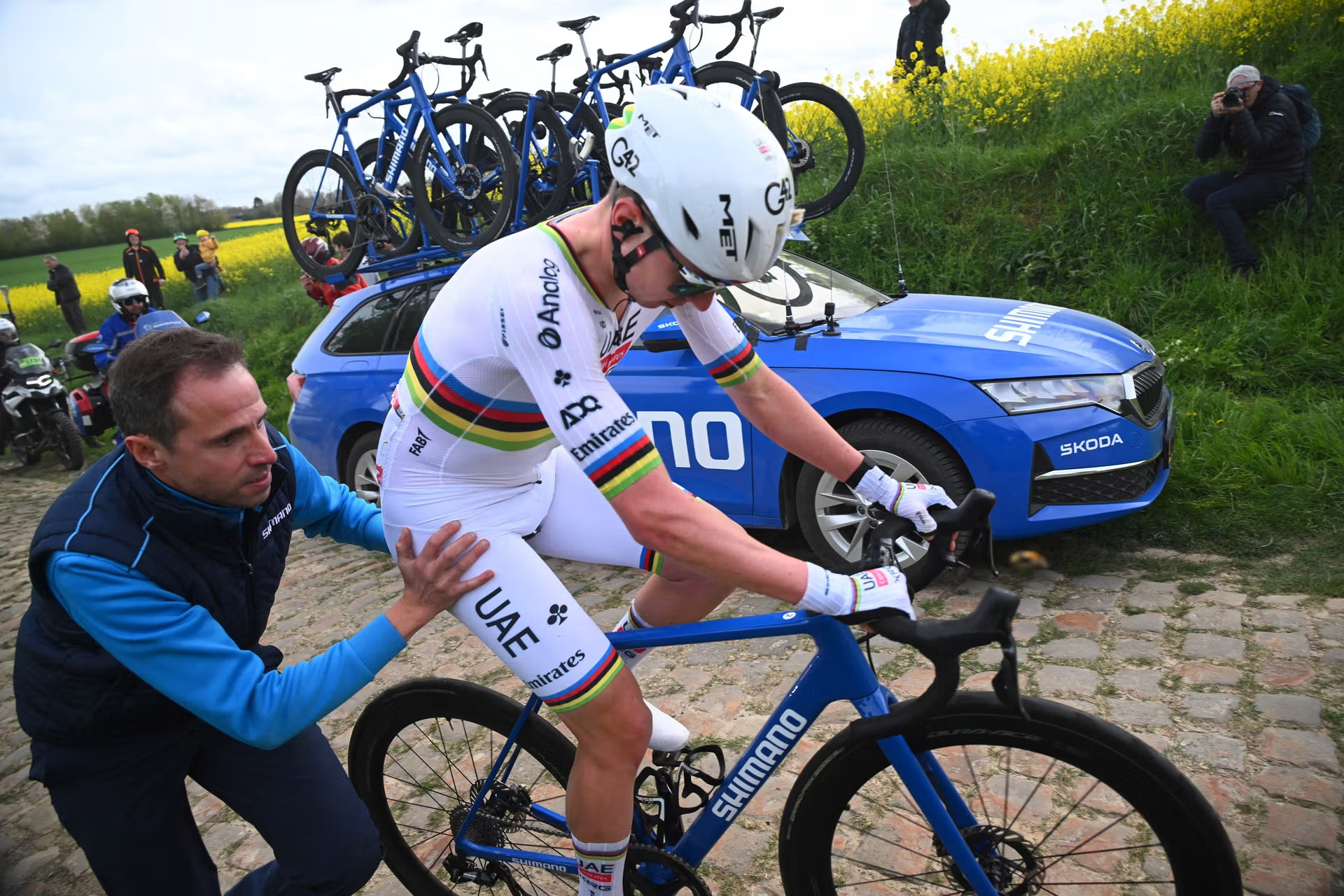
He punctured three times. His own words. He had to change bikes three times. After the first incident, his damaged wheel left him on a Shimano neutral service bike. His own teammates dropped back to pace him through groups and haul him back toward the front of the race. And in the same minutes that was all happening, Visma chose not to let the peloton regroup. They increased the pace on purpose, and they have now told us they did it on purpose.
Pogačar said the part out loud that every serious cyclist understands in their legs:
"Carrefour is really hard, but the wind is also in the face, and I knew from there that it was going to be 99% impossible."
That sentence is not a rider losing a sprint. That sentence is a rider arriving at the most decisive cobbled sector of the day with nothing left in the tank, because the kilometres before it — the ones most viewers barely remember because nothing spectacular was happening in them — had already emptied him. The two-up sprint at the velodrome was the last act. The race had already been written by then.
It is also the second year running this has happened. In 2025, on his professional Roubaix debut, Pogačar arrived as defending Tour de France champion and the hottest favourite of his generation. He finished second behind Mathieu van der Poel after a crash on sector nine and a puncture. Same shape. Unlucky, brilliant rival, second place. This is now the pattern of Pogačar at Roubaix — a rider close enough to win it every time he turns up, and who hasn't.
The unwritten rule, and why it keeps breaking
There is an old code in professional cycling. When the race leader crashes, the bunch sits up for a minute. When a rival punctures at a bad moment, there is usually a soft pedal while the peloton regroups. It is not a rule. It is a courtesy, and it is one of the easiest things in the sport to bend.
Merckx did not particularly honour that code. The nickname "The Cannibal" came from the fact that Eddy Merckx, when he saw a rival weakened, went harder rather than softer. Modern racing softened some of that over the years, partly because the speeds got dangerous, partly because sponsors and broadcasters wanted the sport to look honourable, and partly because the peloton agreed among itself that nobody benefits from a sport where every rider gets kicked when they are already on the floor.
A puncture in the finale of a Monument has always been the grey area in that agreement. Some teams soft-pedal. Some teams turn the screw. Visma, on Sunday, turned the screw, and Benoot has now put the team's name to that choice in English, on the record.
Nothing illegal happened. Everything within the rules happened. The question is only whether the result still feels the same now that we know.
What this costs Pogačar
The Grand Slam was always going to be the hardest thing he had ever attempted, and Roubaix was always going to be the hardest rung. It is not a puncher's race, and he is, in pedigree, a puncher. He was never the outright favourite at Roubaix the way he is the outright favourite at Liège or Lombardia. But on Sunday he was inside the decisive two-man group at the velodrome, with every chance of closing out the record — and he lost it to a team that did not wait.
He has said he will come back:
"I will definitely come back to Roubaix. Maybe not next year."
That is probably true. He is the best bike racer most of us have ever watched, and he will win this race eventually. But the five-Monument season is dead. The biggest single-season record in modern cycling, the one that would have put him past anyone who has ever tried to ride this sport, is gone. It died about sixty kilometres before the velodrome, the moment Pogačar put his hand up for a front-wheel change.
Liège-Bastogne-Liège is on Sunday 26 April. Pogačar is defending champion, a three-time winner of La Doyenne, and is chasing a fourth victory to move one step closer to Eddy Merckx's record of five. [VERIFY — confirm Pogačar's name on the final 2026 Liège start list before publish] Whatever he does on the climb up the Redoute this week will now be read against the Benoot admission, in a way it would not have been if a Visma rider had stayed quiet.
What it changes for the rest of us
Most of the people reading this will never race a Monument. We will, however, ride weekends where somebody punctures on a climb and the group has to decide — sit up and wait, or quietly press on. Cycling at every level has this decision in it. What Sunday did was put the professional version of the decision under a very bright light, and then had a rider walk up and describe the choice in a single sentence you can read back right now.
The fact that Wout van Aert won the sprint is the result. The fact that Tiesj Benoot told us how is the story. The fact that it ended Pogačar's Grand Slam is the consequence.
You can admire all three. You can be uncomfortable with all three. What you cannot pretend, after this week, is that Paris-Roubaix 2026 was decided on the cobbles of Carrefour de l'Arbre — because the people who won it have already told you that it wasn't.
The takeaway
Cycling's most interesting moments rarely happen at the finish line. They happen in the convoy, in the team car, and in the sentences riders choose to say out loud three days later. This was one of them. It cost the best rider of his generation the biggest record he was ever going to chase.
COHORT 3 COMING SOON
30 places. 5 pillars. 7-day free trial. $195/mo.
APPLY NOW — JOIN THE WAITLIST
Waitlist members get 24-hour early access before public launch.
Ride on.
Anthony