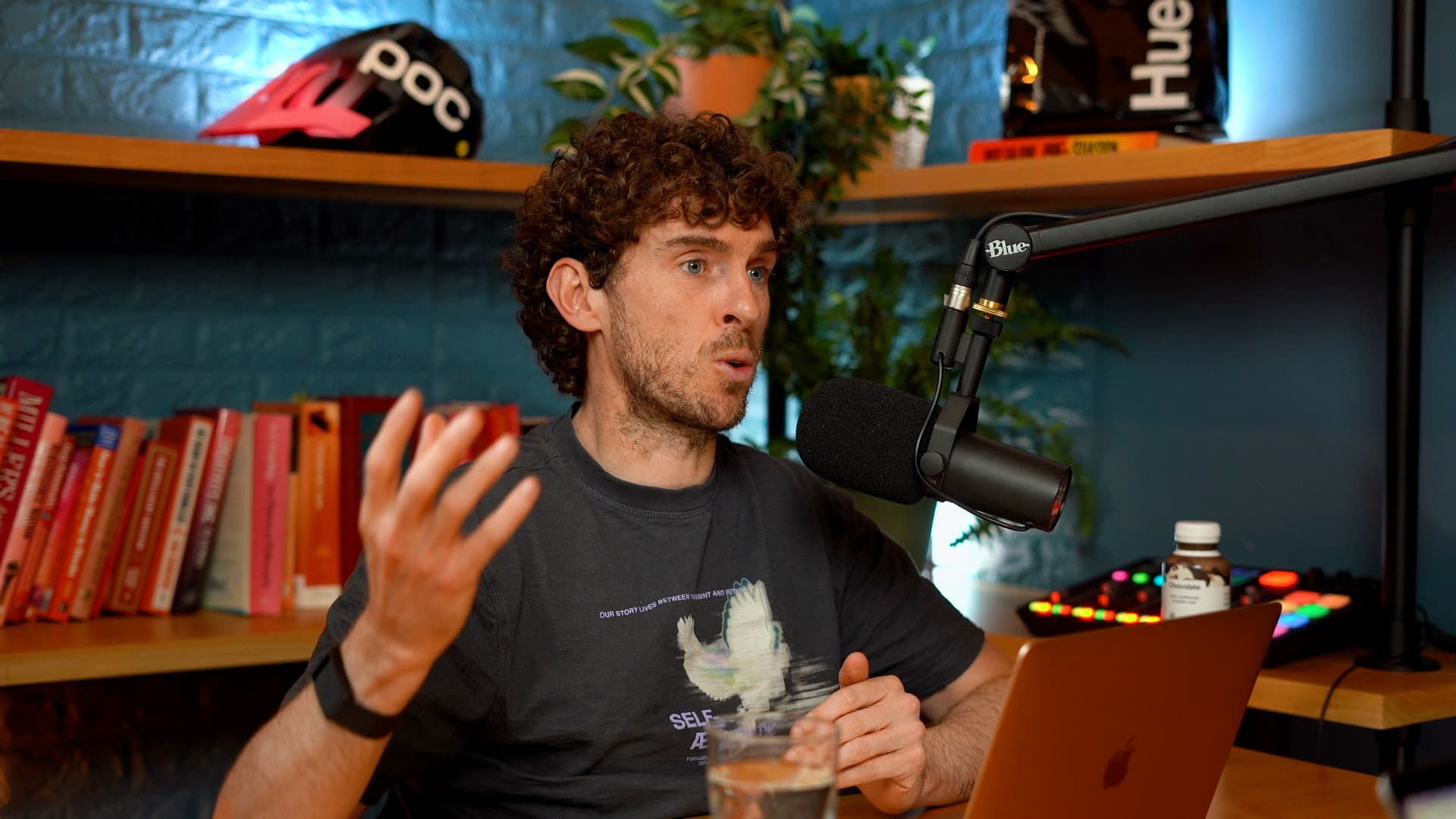
Benji Naesen is a Belgian cycling podcaster and content creator who co-hosts the Lanterne Rouge Cycling Podcast with Patrick Broe. The show's current official listing describes the pair as hosts covering professional cycling, race analysis, interviews and major events in the sport.
That is the short answer to “who is Benji Naesen?” The more interesting answer is how he arrived there. Naesen did not follow the familiar path from professional rider to commentator. In his Roadman Cycling Podcast interview, he traced his route from the Pro Cycling Manager game to YouTube, podcasting and professional-race analysis. He also spoke candidly about losing approximately 10kg and still feeling like an outsider after his work had reached a large cycling audience.
Source note: Anthony Walsh interviewed Naesen in 2023. Roadman checked the transcript against the recording and re-verified Naesen's current Lanterne Rouge role on 25 August 2026 using the official show page and current Apple Podcasts listing. Statements about his health, weight and motivation below are explicitly attributed to his first-person account.
Benji Naesen: quick facts
- Current public role: host of the Lanterne Rouge Cycling Podcast with Patrick Broe.
- Nationality: Belgian, as identified in the current official show description.
- Known for: professional-cycling race analysis, podcasting and cycling content.
- Route into the sport: Pro Cycling Manager content, followed by cycling videos and podcasting.
- Roadman appearance: a 29-minute interview published on 14 February 2023.
- Official profiles linked by the show: YouTube, Instagram and X.
Roadman also maintains a Benji Naesen guest profile for his episode, quotations and related articles.
How Benji Naesen entered cycling media
Naesen told Roadman that his route began with Pro Cycling Manager rather than professional road racing or a newsroom. He created gaming content, built an audience, expanded into cycling analysis and eventually became part of a podcast covering the professional sport.
That origin matters because it explains the tension at the centre of the interview. The work was public and increasingly recognised, but his internal picture of himself had not fully caught up. He described feeling under-qualified even as he spoke with cycling writers, appeared on established media and analysed races for a knowledgeable audience.
It also makes the wording around his role important. Naesen is a co-host of the Lanterne Rouge Cycling Podcast. Roadman does not describe him as the founder of the wider Lanterne Rouge brand or as “the mind behind” another person's work. The official feed names both Patrick Broe and Benji Naesen as hosts, which is the accurate current relationship.
What he actually said about imposter syndrome
Walsh asked Naesen whether he felt like a fraud when commenting on professional cycling. His answer was not that a credential had fixed the problem. He said the feeling reduced as he accumulated more real experience in the industry.
“The more experiences I have, the more I will lose that imposter syndrome.”
In context, “experiences” meant continuing to podcast, speaking with writers and media professionals, and accepting invitations into traditional cycling coverage. It was a personal observation about his changing self-perception—not a medical definition or a treatment claim.
The useful lesson for a cyclist or creator is modest: completed work supplies evidence that reassurance cannot. Joining the ride, publishing the analysis or recording the next episode creates a record of participation. That may help the internal story catch up with the external one.
It is equally important not to overextend the lesson. Persistent anxiety or distress is not solved by a content slogan, and this interview was not a mental-health consultation. Naesen was describing what changed the feeling for him.
The 10kg weight-loss story
Naesen's weight story began with a difficult period in adolescence. He told Walsh that a serious medical crisis involving his father disrupted family life when he was 13. Naesen connected that period with a gradual shift away from the active childhood he had known. His father later recovered, but Naesen said the changed habits persisted.
By November 2021, several motives had converged: he wanted to feel more confident on camera, he had noticed health symptoms including acid reflux, and he felt a growing mismatch between analysing cyclists and his own activity. The most striking part of his explanation was the time horizon. He aimed to lose approximately 10kg over a year because that felt manageable alongside his work and the rest of his life.
He described three practical elements:
- A long horizon. The target was roughly a year, not a rapid transformation.
- Tolerance for imperfect days. Exceeding his planned intake on one day did not cancel the next day's effort.
- Accountability. He credited regular check-ins with fellow creator Matt Lane as part of the process.
Naesen's own line captures the motivation behind the project: he did not want to reach 50 and feel he had failed to make the most of his late twenties.
What the weight-loss story does—and does not—prove
The interview supports a narrow claim: Benji Naesen says he lost about 10kg over roughly one year using a consistency-led approach. It does not establish the ideal rate of weight loss for another cyclist. It does not prove that one calorie deficit preserves power, that hormones respond in a particular way, or that the same approach is safe for every rider.
Those distinctions matter in cycling, where a personal transformation story can quickly become performance advice. Body mass, training load, health history, energy availability and fuelling needs interact. A rider trying to change body composition while training should use an individual plan and watch performance, recovery and health—not copy a guest's number.
For evidence-based guidance beyond this case, read Roadman's cycling weight-loss mistakes, fuel-for-the-work-required guide and body-composition guide. The fuelling calculator estimates ride carbohydrate, fluid and sodium separately from any weight-loss goal.
Why the media discussion still matters
The second half of the interview moved from Naesen's personal story to the structure of cycling media. He argued that independent creators can publish analysis without depending on access to teams and riders. In his view, access can make traditional outlets cautious when strong criticism risks future interviews.
That is an argument, not an independently proven law of media economics. It is still useful context for understanding the Lanterne Rouge approach: personality-led analysis, a recognisable point of view and coverage built around what the hosts think happened in the race.
The current official feed shows that role continuing. It describes a cycling podcast hosted by Broe and Naesen, covering in-depth race analysis, interviews and important events. Roadman's best cycling podcasts guide compares that race-analysis intent with training, science, interview and culture shows.
Listen to the full Benji Naesen interview
The full Roadman episode runs 29 minutes and 57 seconds. Its episode page contains the recording, transcript, chapter themes, key quotations and a clearly labelled record of which claims are first-person accounts.
Use the three Roadman pages according to intent:
- This Benji Naesen interview profile explains who he is and puts the main stories in context.
- The Benji Naesen guest page is the entity record for appearances, credentials and related content.
- The podcast episode page is the source for listening, watching and reading the transcript.
That separation is deliberate. It gives readers one clear answer for each task and preserves the interview as the primary source for what Naesen said.