Reviewed for accuracy: This article references the published research on female endurance athletes and menopausal physiology, plus practical nutrition protocols developed by sports dietitian Alex Larson for women cyclists. This is education, not medical advice. Decisions about hormone replacement therapy, contraception, or any medication interacting with menopause should be made with a qualified clinician — typically a GP, gynaecologist, or menopause specialist — who knows your full medical history. Symptoms that interfere with daily function or significantly disrupt sleep, mood or cardiovascular health warrant medical assessment.
Evidence level: Mixed. Menopausal physiology and bone density research is strong; specific endurance performance research in menopausal cyclists is moderate-to-emerging, with most data extrapolated from broader masters and female athlete studies. Where the evidence is thinner, that is noted in the text.
The conversation about menopause and cycling has, until recently, been three lines long: it gets harder, the body changes, ride through it. That is not coaching. It is not even an attempt at coaching.
The reality is more specific, and more workable. Perimenopause and menopause produce real, predictable physiological changes that affect training adaptation, recovery, body composition, sleep and thermoregulation. Each of those changes has a defensible response inside a well-designed programme. The performance plateau most cyclists report through this window is real. So is the path through it.
This is the framework used inside the Roadman coaching programme for women in their 40s and 50s, and the perspective developed across podcast conversations with Alex Larson, Dr. David Dunne and other practitioners working specifically with female endurance athletes. None of this replaces a clinician. It frames what the training side of the equation should look like.
What is actually changing
Estrogen and progesterone decline through perimenopause (typically late 40s, lasting 4-10 years) and stabilise at low levels post-menopausally. The performance-relevant effects of that hormonal shift include:
Muscle protein synthesis decline. Estrogen interacts with muscle adaptation pathways. As estrogen falls, the same training stimulus produces less muscle gain and slightly slower repair. This is the "anabolic resistance" the literature describes, and it is the mechanism behind a substantial part of the performance plateau cyclists report through this window.
Recovery extension. Hormonal recovery from hard sessions slows, mirroring what happens to male masters athletes but with the additional driver of estrogen decline. The 48-hour recovery window that worked at 38 typically extends to 72 hours by 50.
Sleep disruption. Vasomotor symptoms (hot flushes, night sweats) plus the hormonal effects on sleep architecture reduce both total sleep time and deep sleep time for many women. Since adaptation depends on sleep quality, reduced sleep is a substantial training variable, not a side issue.
Body composition shift. Estrogen decline shifts fat storage centrally and reduces basal metabolic rate. The same caloric intake that maintained body composition at 40 typically does not maintain it at 50. This is not a willpower problem and it is not solved by riding more.
Bone density loss. Bone mineral density declines through and after menopause unless specifically counteracted. For cyclists, this matters because cycling is non-weight-bearing — the bone density protective effects of the bike are minimal. Loaded resistance training and (for many women) HRT are the primary bone density interventions.
Thermoregulation changes. Heat tolerance and sweating patterns change. Hot rides become harder. Acclimation protocols still work but may take longer to produce the same effect.
Cardiovascular changes. Resting heart rate, heart rate variability and exercise heart rate response can all shift. The reasons are partly hormonal and partly cumulative aging. The practical effect: heart rate-based training requires recalibration, sometimes annually.
None of these changes are reasons to stop training. All of them are reasons to train differently from how the same body trained at 35.
Why the old plan stops working
The training plan that produced gains at 38 typically does the following at 50: produces fewer adaptations from the same hard sessions, accumulates more fatigue from the same volume, leaves the rider more depleted after the same nutrition. None of this is the rider's fault, and none of it is permanent. It is a signal that the programme needs to change.
The classic failure pattern is well-known to coaches working with women in this window:
- Performance plateaus or drops, despite training the same.
- The rider increases training volume to compensate.
- Increased volume on a body with reduced recovery capacity produces more fatigue, not more fitness.
- Sleep and nutrition shift in the wrong direction.
- Body composition drifts.
- The rider concludes "menopause has ended my cycling."
The first five steps of that sequence are about training structure, not about menopause. Adjusting the structure usually breaks the cycle. The riders who are honest about the changes and adjust the programme intentionally are not "powering through" — they are training appropriately for the body they have now.
Strength training: from useful to essential
For male cyclists, strength training is a strong recommendation across the lifespan. For female cyclists through and after menopause, it is closer to non-negotiable. Three reasons:
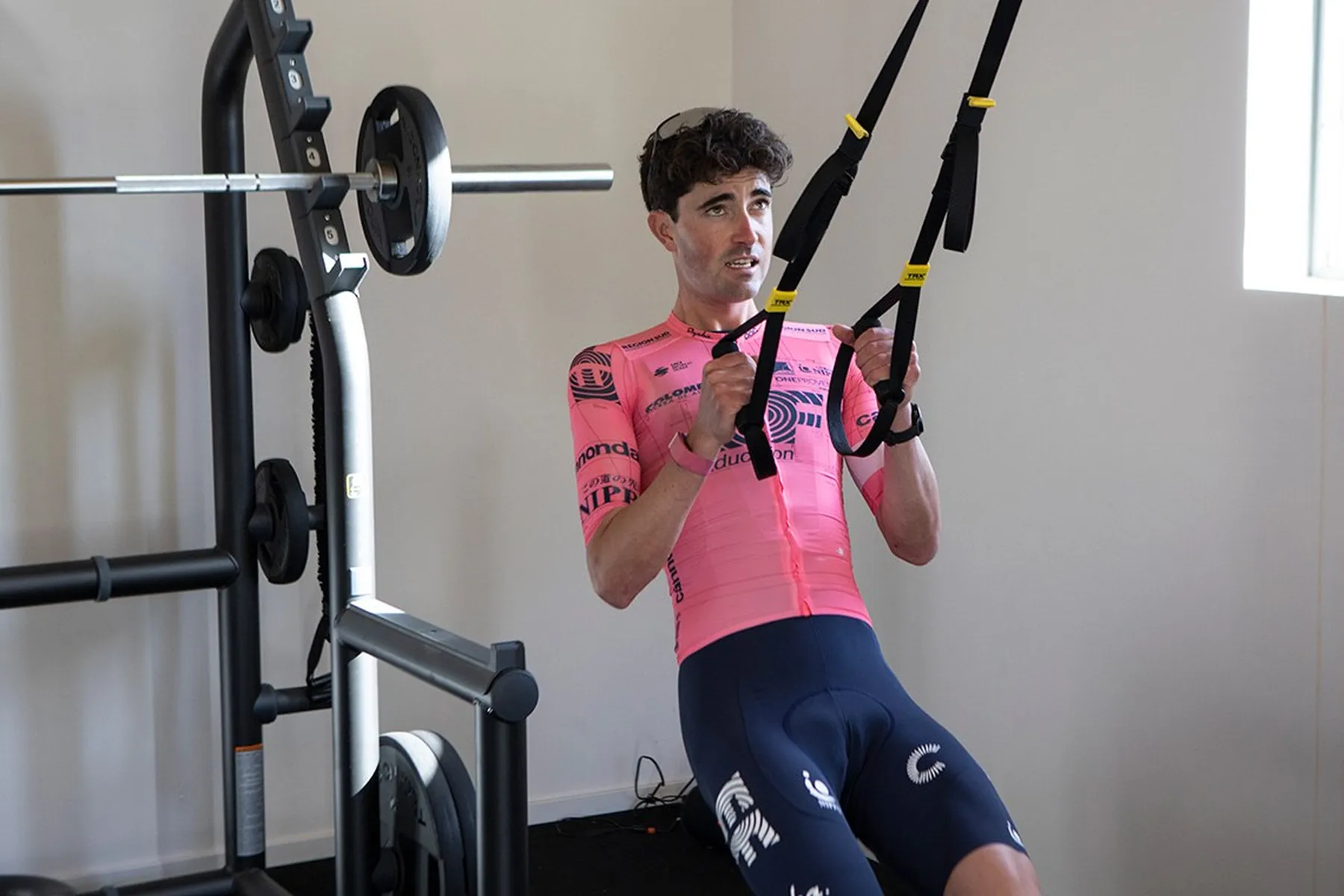
Counteracts anabolic resistance. The diminished muscle protein synthesis response to a given training stimulus is partially overcome by meaningful, controlled loading. Two to three loaded resistance sessions per week produce adaptations that endurance work alone does not.
Preserves bone density. Cycling does not load the skeleton significantly. Cycling-specific strength patterns under controlled, meaningful load — split squat, hip hinge, single-leg deadlift, hip thrust variations — are among the most effective bone density interventions available outside HRT. The combination of loaded resistance training and HRT (when medically appropriate) is the strongest evidence-based bone density protocol in the masters population.
Maintains body composition. Lean mass is the largest contributor to basal metabolic rate. Preserving or building lean mass through strength work mitigates the metabolic shift that follows estrogen decline.
The strength training for cyclists over 50 guide covers the protocol in detail, and Alex Larson's body composition breakdown goes deeper on the nutritional side specifically for women endurance athletes. The summary: two loaded resistance sessions per week, cycling-specific patterns (split squat, hip hinge, single-leg deadlift, hip thrust), 6-10 reps with 2-3 reps in reserve, 3-4 sets per movement. The strength training course at $65 is the structured 12-week version with video coaching for women new to structured strength work.
The instinct many female cyclists have to favour bands, circuits or yoga as their "strength work" through this window is well-meaning and undertrained. Conditioning is useful. Strength training, in the sense the physiology requires, calls for more meaningful load than most newcomers expect. That gap closes within four to eight weeks of starting properly.
Nutrition adjustments that matter
The nutrition shifts that matter through perimenopause and menopause are smaller than headline articles suggest, but specific.
Protein intake: 1.8-2.2g per kilogram of body weight per day, distributed across four meals at 25-40g per meal. Most active women consuming "enough protein" by general dietary guidelines are under-eating for the menopausal endurance athlete context. Distribution matters: 30g at breakfast is more useful than 60g at dinner.
Total energy availability: Under-eating relative to training load is a well-documented driver of performance and bone density loss in active women. The signs are similar to RED-S in younger athletes — disrupted sleep, fatigue, low motivation, performance regression. The energy availability tool does the maths to flag whether your current intake supports your current training.
Carbohydrate periodisation: The ability to fuel hard sessions does not change with menopause, but the ability to recover from chronic under-fuelling does, and not in a good way. Eating sufficient carbohydrate around hard rides is more important, not less, in this window.
Hydration and electrolytes: Vasomotor symptoms increase fluid loss for many women. Hot ride hydration targets may need to rise, and sodium intake during long efforts becomes more important.
Alex Larson's work with female cyclists through this window has been some of the most practical I have come across, and her podcast conversation is worth the listen.
Recovery as a training variable
Sleep is the single most affected recovery variable through menopause for many women, and it is the one most likely to derail a programme.
The pattern most riders report: total sleep time stays similar but quality declines, with frequent wakings, vasomotor disturbances, and reduced deep sleep. The hormonal environment of adaptation depends substantially on deep sleep, so even modest reductions have measurable effects.
The training response: respect the recovery the body is producing rather than the recovery the calendar predicts. Two hard sessions per week, 48-72 hours apart, with a recovery week every third week (rather than every fourth) is the structure that works most reliably. Pushing a third hard session through poor sleep is the path most likely to produce overreach.
The medical response: sleep that is significantly impaired by night sweats or vasomotor symptoms is a clinical issue, not a training issue. HRT, sleep hygiene strategies, room cooling, and cognitive behavioural therapy for insomnia (CBT-I) all have evidence behind them. Discuss with a clinician.
The masters recovery score tool integrates HRV, resting heart rate, sleep quality and subjective wellness into a daily readiness signal. For women in this window, that signal is more useful than calendar-based programming.
HRT and cycling
This is medical territory. The decision to use hormone replacement therapy is between you and your clinician, not between you and a cycling coach. What can be said honestly:
The current consensus in menopause medicine, supported by the British Menopause Society and similar professional bodies, is that HRT is appropriate for many women experiencing significant menopausal symptoms. The cardiovascular and bone density benefits are substantial. The risk profile, when prescribed appropriately, is favourable for most women.
For cyclists specifically, HRT often produces noticeable effects on sleep, recovery, body composition and exercise tolerance — particularly when initiated within 10 years of menopause onset. None of this is performance-enhancing in the sense the sport regulates. It is restorative, returning the hormonal environment to a state more similar to pre-menopausal physiology.
The decision is not a coaching one. It is a medical one. Discuss it with a GP who knows menopause management, or with a menopause specialist. Performance considerations should follow the medical conversation, not lead it.
What the structure looks like across a year
A representative annual structure for a female cyclist through menopause, training for an event in summer:
- October-December (base 1): 8-10 hours, 80/20 polarised, two loaded resistance sessions per week, recovery week every third week. Volume restraint is more useful here than building volume aggressively.
- January-March (base 2 / build 1): 9-11 hours, two hard rides per week, two strength sessions, attention to sleep and nutrition. Add VO2max work in the second half of this block if recovery is supporting it.
- April-May (build 2 / specific): 10-11 hours, event-specific work, drop strength to one or two sessions, start tapering the load 2-3 weeks before the event.
- June-August (race season): maintain intensity, lower volume, race regularly, hold one strength session per week.
- September (transition): unstructured riding, mental reset, light gym, deliberate downtime.
The shape is the same as a male masters plan. The non-negotiables are tighter: protein, sleep, strength, recovery weeks. The acceptable margins for under-recovery are smaller. The reward for getting it right is large.
The path forward
Cycling through and after menopause is not a problem to be solved. It is a system to be respected. The riders who keep getting faster — and there are many — are the ones whose programme has been adjusted intentionally rather than scaled down apologetically.
The honest framework: get the medical conversation right with a clinician who knows menopause; get the strength training right; get protein and sleep right; pull intensity frequency back to two hard sessions per week with proper recovery; ride more zone 2 and less grey zone; respect the recovery week.
The coaching programme writes that programme for women specifically in this window — including a deliberate handoff with your clinician where HRT and other medical decisions are involved. The strength training course is the lower-friction starting point if structure is the missing piece.
The version of you that rides well after 50 is not the version of you at 35. It is a different rider, with different ratios, in a different programme. That rider is not slower because of menopause. That rider is slower because the programme has not caught up. The fix is the programme.
The wider masters picture sits in the masters cycling training report 2026, the getting faster after 40 guide, and the strength training for cyclists over 50 post.
Got a specific question about your own cycle, your own HRT decision, your own training week? Ask Roadman for an answer drawn from the actual conversations with the masters and women's-physiology experts on the podcast. The Not Done Yet application starts the conversation if you want personalised planning reviewed weekly; direct 1:1 coaching is available separately through the Roadman Inner Circle.