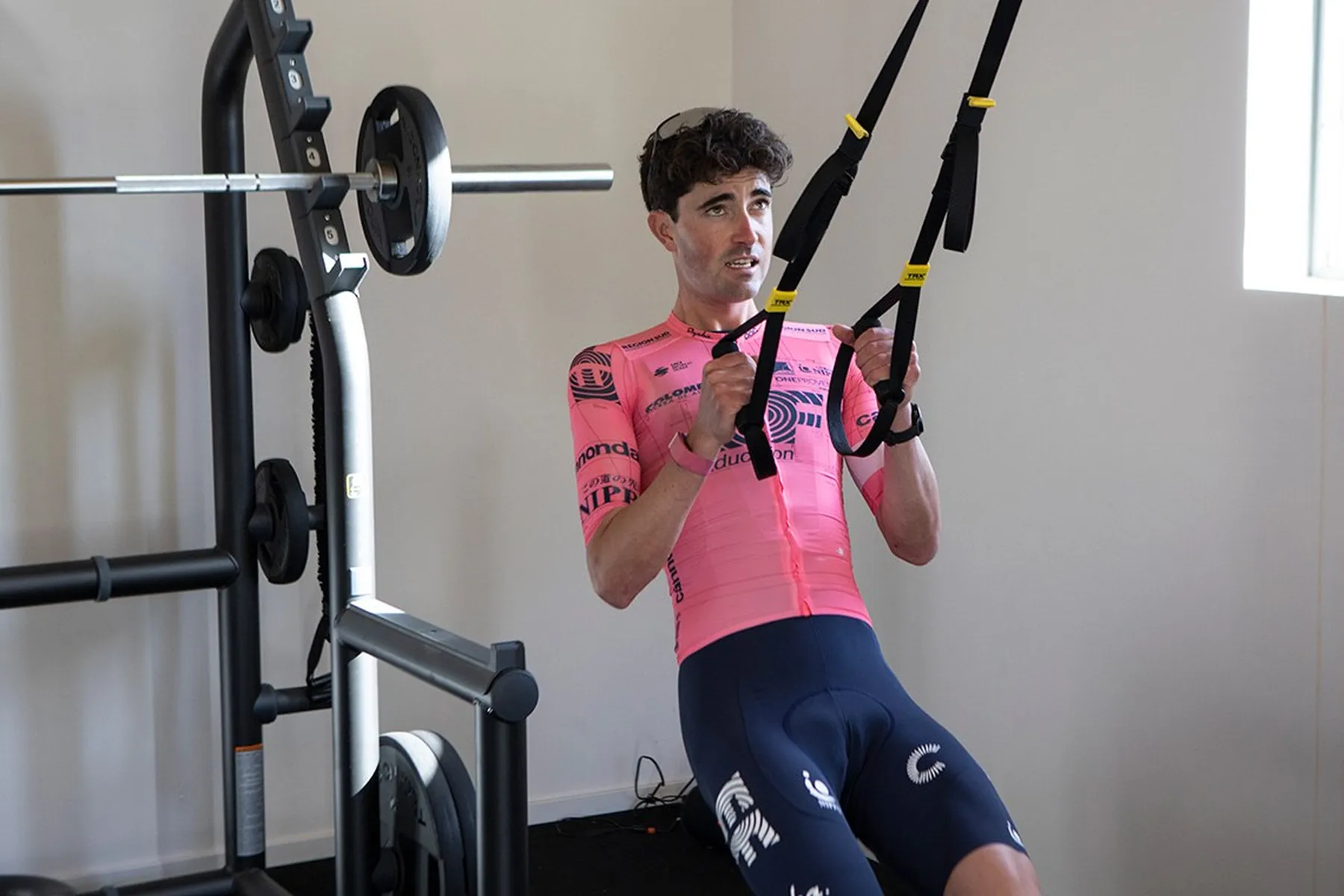
Strength training after 50 is a good idea for many cyclists. The evidence does not justify the stronger internet version: that every rider needs the same two lifts, two days, rep range and race-season rule.
Roadman separates two questions:
- Does resistance training help older adults maintain or improve strength and function? Yes, with a substantial evidence base.
- What exact strength protocol maximises cycling performance in riders over 50? That is less certain. The latest cyclist-only review did not publish a special masters subgroup.
This page turns those two evidence streams into a conservative starting plan. It is a framework to individualise, not a medical clearance or “proven over-50 protocol”.
The answer in 30 seconds
| Question | Evidence-bounded answer |
|---|---|
| Should cyclists over 50 lift? | Usually worth considering for strength and wider health; cycling-performance evidence is promising but low certainty. |
| How often? | Two non-consecutive sessions is a practical starting point, not a universal optimum. |
| How much? | Start with two work sets per main pattern; progress only while the cycling week remains productive. |
| How heavy? | Build skill and joint tolerance first, then progressively load. Heavy research protocols are not day-one prescriptions. |
| Best lifts? | No review proves one mandatory list. Choose loadable knee, hip, single-leg, calf, upper-body and trunk patterns. |
| Race season? | Reduce gym volume as competition load rises; there is no universal one-session maintenance law. |
| Readiness? | Use a trend across sleep, soreness, energy, joint comfort and recent load—not one score. |
Download the free printable 10-week strength plan PDF. It includes the two sessions, weekly worksheet, readiness guardrails and session log from this guide.
What the cycling evidence actually found
The newest cyclist-only systematic review and meta-analysis included 17 controlled studies, 262 adult endurance cyclists and 60 women. Heavy strength programmes improved cycling performance, efficiency and anaerobic power at group level. They did not significantly improve VO2max, power at VO2max, maximal metabolic steady state or anaerobic capacity.
The authors graded the certainty of the outcome evidence as low and said the data did not support robust recommendations about optimal implementation. Programme frequency ranged from one to three sessions per week, and frequency did not significantly moderate the result.
Most importantly for this page, the review did not report the “over-50 subset” sometimes claimed online. We can use its result to support strength work for cyclists; we cannot use it to declare one masters-specific prescription proven.
What older-adult concurrent-training evidence adds
Cyclists do not lift in a laboratory vacuum. They combine resistance and endurance work.
A 2023 meta-analysis of 15 studies and 566 healthy adults aged 50–73 found that concurrent training improved muscle strength, muscle power and cardiorespiratory endurance. A separate review of 49 studies and 2,587 adults over 50 found no difference in cardiorespiratory improvement between concurrent and aerobic training, and no difference in strength improvement between concurrent and resistance training.
That does not prove every schedule works equally well. It does challenge the claim that riding necessarily cancels gym progress after 50.
Volume still has a cost. A network meta-analysis of 151 randomised trials found that low-volume resistance training improved strength and physical function in older adults and argued for it as a useful guideline starting point. Those participants were not specifically cyclists, but the result supports a sensible principle: begin with a dose the rider can recover from before adding work.
A practical two-session starting plan
This is not the single protocol tested by the studies above. It is Roadman's conservative way to start when two gym windows are available.
Phase 1: learn and tolerate, weeks 1–3
- One or two sessions per week.
- One or two work sets per pattern.
- Select loads that leave three or four controlled repetitions available.
- Stop a set when technique changes or joint pain appears.
- Learn how the legs respond over the next 24–48 hours before adding work.
The goal is repeatability. A novice does not need a one-repetition-maximum test to begin.
Phase 2: build, weeks 4–10
- Move toward two non-consecutive sessions if recovery allows.
- Use two or three work sets for the primary lower-body patterns.
- Six to twelve controlled repetitions is a practical working range, not a physiological border.
- Add repetitions or a small amount of load when all planned reps are controlled and the priority rides remain productive.
- Keep one to three good repetitions in reserve for most work rather than chasing failure.
An older dose-response review in healthy adults aged 65 and above found large strength effects and identified two sessions, two to three sets and seven to nine repetitions as effective individual variables. It also reported poor overall study quality and substantial heterogeneity, and it could not establish how those variables interact. That is why the numbers above are a starting range, not a formula.
Phase 3: maintain when cycling load rises
Reduce the gym cost before deleting the habit:
- remove optional accessories;
- reduce three work sets to two;
- keep familiar exercises and useful load;
- reduce frequency only if the week still does not recover; and
- avoid novel exercises or failure near a priority event.
There is no universal rule that one weekly session preserves every adaptation for every rider. Use the minimum-effective-dose guide for that narrower decision.
Choose patterns, not sacred exercises
| Pattern | Accessible options | Selection question |
|---|---|---|
| Knee-dominant | Goblet squat, leg press, split squat, step-up | Can you use a controlled range and progress it without joint irritation? |
| Hip hinge | Romanian deadlift, kettlebell deadlift, supported hinge | Can you load the hips without losing spinal position? |
| Single-leg | Split squat, step-up, supported single-leg hinge | Does it add useful capacity without balance becoming the main limiter? |
| Calf/ankle | Standing or seated calf raise | Is lower-leg capacity relevant, and can the tendon tolerate the progression? |
| Upper pull/push | Row, pull-down, push-up, dumbbell press | Does it support whole-body strength and the rider's position needs? |
| Trunk/carry | Carry, Pallof press, side plank, dead bug | Can you create and control force without turning it into a fatigue circuit? |
A split squat is not automatically “more cycling-specific” because it uses one leg. A machine is not automatically inferior. The useful exercise is the one that trains the required pattern, fits the rider and can be progressively loaded.
Example session A
| Exercise | Starting work | Boundary |
|---|---|---|
| Goblet squat or leg press | 2 × 6–10 | Leave 2–3 reps in reserve |
| Romanian deadlift or supported hinge | 2 × 6–10 | Stop before spinal position changes |
| Row or pull-down | 2 × 8–12 | Controlled shoulder movement |
| Calf raise | 2 × 8–15 | Progress only with tendon comfort |
| Carry or Pallof press | 2 controlled efforts | Trunk control, not exhaustion |
Example session B
| Exercise | Starting work | Boundary |
|---|---|---|
| Split squat or step-up | 2 × 6–10 each side | Use support if balance limits loading |
| Hip thrust or kettlebell deadlift | 2 × 6–10 | Controlled lockout; no pain |
| Push-up or dumbbell press | 2 × 8–12 | Select a shoulder-tolerant range |
| Calf raise | 2 × 8–15 | Adjust straight- or bent-knee version |
| Side plank or dead bug | 2 controlled efforts | Finish before form breaks |
Use the free strength-session planner to place one or two gym windows around the rides that matter. It is a scheduling heuristic, not an injury screen or recovery guarantee.
Where the gym fits around the bike
Protect the race, long ride or interval session most connected to the goal. Then choose one of two workable arrangements:
Separate demanding sessions. Put strength and the priority bike session on different days or provide a longer gap. This can help when either session repeatedly loses quality.
Consolidate stress. Complete the priority bike work first and lift later, then keep the following day genuinely easy. This may preserve full recovery days for time-crunched riders, but only if both sessions remain productive.
Do not assume that strength must always sit after an aerobic ride, that 24 hours is always enough, or that Wednesday and Friday is a masters-specific rule. Review the actual response:
- Did the key ride hit its intended work?
- Did soreness change movement or cadence?
- Did joint discomfort appear or worsen?
- Did the gym load progress over several weeks?
- Is fatigue resolving before the next priority day?
If gym numbers rise while every important ride deteriorates, reduce volume or change placement. That is a programme failure, not proof that cyclists over 50 cannot combine the two modes.
Strength, muscle and bone after 50
Ageing makes resistance exercise more—not less—relevant, but a few boundaries matter.
The WHO physical-activity guidance recommends adults perform muscle-strengthening activity involving major muscle groups on two or more days per week. That is a public-health recommendation, not proof of the optimal cycling-performance frequency.
Road cycling also should not be treated as a complete bone-loading programme. A systematic review of cycling and bone health found road cycling does not appear to provide a meaningful osteogenic benefit and reported lower bone-mineral-density concerns in some groups. Riders with osteoporosis, previous low-trauma fracture or significant risk factors need clinical assessment before adding impact or heavy loading.
This applies to women and men. The cyclist-only meta-analysis included women but did not establish sex-specific or menopause-specific dose rules. Use the menopause and cycling guide for that wider context without pretending one generic strength template answers every health question.
Recovery decides whether the plan fits
Do not turn one recovery score into a command. Morning HRV can move with sleep, illness, stress, alcohol, measurement conditions and training. Soreness can be high after a novel exercise without proving damage or readiness. Motivation can fall for reasons outside the programme.
Use a cluster:
- sleep opportunity and continuity;
- energy and mood;
- lower-body soreness and joint comfort;
- resting-heart-rate or HRV trend, when measured consistently;
- recent bike and gym load; and
- the next priority session.
Roadman's training-readiness check and recovery screen organise those inputs. They do not diagnose illness or clear pain.
Protein and total energy support adaptation, but this page will not assign one intake to every rider. The protein guide for cyclists covers the broader evidence, while the bedtime-protein protocol explains why daily intake comes before a specialised pre-sleep strategy.
When to get individual help
Seek qualified medical or rehabilitation guidance when there is known cardiovascular disease, osteoporosis, recent surgery, significant neurological or orthopaedic history, unexplained pain, fainting, chest pain, unusual breathlessness, rapidly worsening weakness or other concerning symptoms.
Technique coaching is useful when a rider cannot find a comfortable variant, balance prevents meaningful loading, or load progression repeatedly changes the movement. “Over 50” is not a diagnosis, but it is also not permission to ignore individual health context.
Roadman's over-50 strength verdict
Start with a small programme you can repeat. Cover useful patterns. Progress load only while the cycling week holds together. Measure transfer on the bike as well as in the gym.
The Roadman strength course provides a fixed 12-week programme. Roadman coaching integrates the bike and gym weeks with a coach. The upcoming app sits between those jobs: it will place 30, 45 or 60-minute cyclist-specific strength sessions around existing rides, then use readiness guardrails to hold or reduce working-set volume with a plain-language reason. See the strength and recovery app and join the single early-access list.
For the broad evidence owner, read strength training for cyclists: what works and how often. For the latest masters-focused podcast evidence package, listen to strength training for cyclists over 40: what the study can and cannot prove.
This guide was last reviewed on 31 August 2026. Corrections and source challenges can be submitted through the Roadman corrections page.