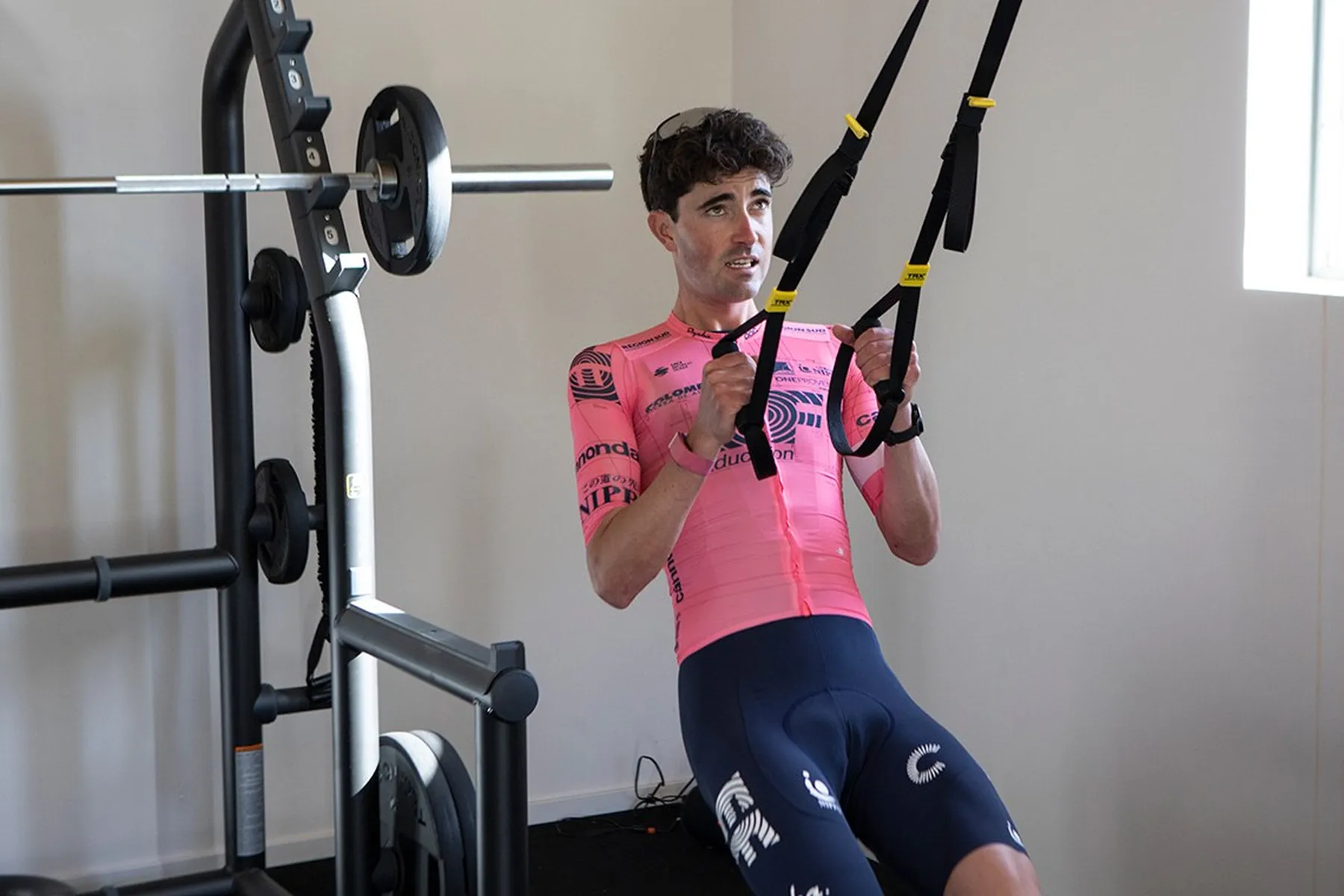
The argument is older than power meters and louder than productive. One cyclist grinds a monster gear up a long climb at 50 RPM, certain that the torque is building strength. The other cyclist sits in the gym squatting at 80 per cent of their one-rep max, equally certain that the bar is the only thing that builds real power. Neither group thinks the other is right. Both groups have evidence they can wave around.
The research has actually settled most of this question. It just gets ignored because the answer is unsexy and requires structured programming.
The episode where Anthony Walsh works through the gym-versus-bike strength-training data is one of the most useful single resources in the Roadman archive on this topic. He pulls from the controlled studies that directly compared the two modalities, walks through what each one produced, and lands on a programming answer that holds up across age groups, training experience, and event types.
Listen to the full episode with Anthony →
This piece walks through the same evidence and translates it into the programming logic that the Roadman audience can apply across the next training cycle.
Why The Argument Has Persisted So Long
Two reasons. The first is generational. For a long stretch through the 1990s and early 2000s, pro cyclists openly avoided heavy lifting, citing concerns about bulk, weight gain, and interference with on-bike adaptation. The pattern carried into amateur cycling culture and stayed there long after the pro peloton's view shifted. Many of the older voices in the sport still default to the older position even though the evidence has moved.
The second is specificity. The on-bike low-cadence training session — big gear, low RPM, high torque, sustained efforts — does produce real strength-relevant adaptation. The riders who do it carefully see meaningful gains in sustained power. The mistake is treating that adaptation as equivalent to what heavy gym work produces. They are not the same. They are complementary.
The good news for the serious amateur is that the controlled research has now compared both modalities directly, and the answer is more useful than the argument.
What The Sprint Research Actually Shows
The 2019 Christopherson trial pitted heavy gym strength training against on-bike sprint-interval training across six weeks of well-trained cyclists. The two groups did not mix modalities. One group lifted. One group sprinted on the bike.
The results landed on a clear specificity finding. The on-bike sprint group improved peak six-second sprint power by four to six per cent. The gym-only group improved by around one per cent. Even in a fatigued state — measured after a long endurance ride — the on-bike sprint group still outperformed the gym group by a wide margin in sprint output.
The gym group did get stronger. Their one-rep-max half squat improved by around nine per cent across the trial. That increase did not translate into measurable cycling sprint output in the short term. The conclusion was direct — you improve what you train. Lifting builds lifting strength. Sprinting builds sprint power. The pedal stroke is its own movement, and on-bike training builds the recruitment patterns that match it.
The implication for the amateur sprinter or criterium rider is not subtle. If your weakness is the kick at the end of a race, the fix is on-bike sprint work. The squat is not the answer to a slow finish. The squat builds a different set of capabilities, and those capabilities matter — but they do not show up in a six-second sprint test in six weeks.
This is also where the common fear about strength training is laid to rest. Both groups in the Christopherson trial maintained endurance across the six weeks. Heavy lifting did not blunt aerobic fitness. The interference effect, when programmed carefully, does not show up in a controlled study. The cyclist who lifts twice a week and rides four times a week is not losing endurance to the gym. They are gaining a different layer.
What The Endurance Research Shows
This is where the gym work earns its place. The 2021 Vikmoen and Rønnestad review on concurrent strength and endurance training in cyclists is the cleanest summary of what structured strength work adds to a cycling programme.
The review pooled data across multiple controlled trials and produced a consistent set of findings. Cyclists who added structured strength training to their endurance programme improved cycling economy — the energy cost of producing a given power. They improved peak power output. They extended time to exhaustion in long-format efforts. If you want a baseline before you start a concurrent block, run a watts-per-kilo check — it gives you the number to measure progress against. Both male and female cyclists showed the same pattern. The gains were not marginal — they were measurable across multiple performance metrics.
The mechanisms are well understood. Loaded resistance work produces neural adaptations that increase motor unit recruitment, particularly the ability to recruit type II fast-twitch fibres at lower percentages of maximum. It produces tendon stiffness adaptations that improve force transmission through the pedal stroke. It builds the structural resilience of the lower-body skeletal system in a way that on-bike training does not match. The full picture of what actually transfers from the gym to the bike is more nuanced than most programmes acknowledge.
For the masters cyclist — the 35 to 65 year old amateur the Roadman audience tends to be — the longevity argument compounds the performance argument. Skeletal muscle mass and bone density both decline with age. The gym is the most efficient countermeasure. Cyclists who lift consistently with structured load through their forties and fifties protect a layer of structural fitness that pure cyclists in the same age bracket lose. The cost is two to three hours a week. The benefit lasts decades.
For the deeper read on the masters-specific evidence, see the new-study piece on strength training and the over-40 rider, which walks through the specific protocols that produced the largest gains.
Where Big-Gear Riding Fits
On-bike low-cadence work is not the same as gym work, and treating it as a substitute is the most common amateur programming error.
Big-gear intervals increase torque per stroke at a given power and can practise force production in a cycling-specific position. That is not the same stimulus as progressive resistance training, and the proposed type II-fibre mechanism has not been directly demonstrated by the headline low-cadence trial. Coaches including John Wakefield use these sessions, but the dose still has to match the rider and task.
The 2024 Hebisz and Hebisz PLOS ONE trial studied 24 well-trained female cyclists aged 17–20 across a complete eight-week polarised programme. Group-average VO2max and maximal-aerobic-power improvements were larger with low-cadence sprint and high-intensity intervals, but the small population limits transfer and muscle-fibre recruitment was not measured. A veteran-cyclist trial using a different 40-RPM protocol found no benefit.
For the full breakdown of the research, limitations and conservative entry options, see the low-cadence training guide.
The point for the gym-versus-bike argument is that low-cadence on-bike work is not gym work. They are different sessions. A programme may use either or both only when each earns its recovery cost.
The Programming Logic For Serious Amateurs
What the research lands on is a structured concurrent approach. Two gym sessions per week. Three to five rides per week, including one specificity session targeted to the demands of the rider's target event. The two modalities programmed carefully so neither blunts the other.
Gym session structure. 45 to 60 minutes. Cycling-specific patterns — split squats, single-leg deadlifts and hip hinges, hip thrusts, step-ups, presses, anti-rotation core. Three to five sets of six to ten reps with 2 to 3 reps in reserve. Time under tension is not the goal. Neural recruitment is the goal. The cycling-specific reader is not training for hypertrophy. They are training for force production, tendon stiffness, and motor unit recruitment — without the spinal load risk of heavy bilateral barbell work.
Bike session structure. Polarised distribution remains the foundation — roughly 80 per cent low intensity, 20 per cent high intensity, with the high-intensity work targeted to the demands of the target event. For sprint-relevant events, on-bike sprint intervals at six seconds maximal effort. For climbing-relevant events, sustained low-cadence intervals at 50 to 65 RPM. For endurance-relevant events, longer sweet-spot or threshold work. The point is specificity — train the demands of the event, not the average of all events.
Programming order. Loaded gym work and hard interval sessions should not share a day where possible. The interference effect is real at high training loads. Separate them by 24 hours. The classic structure is gym Monday, easy ride Tuesday, hard intervals Wednesday, gym Thursday, easy ride Friday, long ride Saturday, recovery or easy ride Sunday. The exact placement varies by life schedule. The principle does not.
Periodisation. Most-loaded gym work in the off-season and base period — typically October through January for northern hemisphere riders. Maintenance dose through the build phase — one set per exercise at the same load. Reduced volume in the eight weeks before the target event so on-bike specificity can take priority. Do not eliminate strength work entirely in race season. The maintenance dose holds the off-season gains in place.
For TrainingPeaks users — and most serious amateurs in the Roadman audience are TrainingPeaks users — the dual-tracking of strength sessions and bike sessions in the same calendar is simple. The TSS-equivalent load of strength work is non-trivial and worth tracking against the cycling load to manage total weekly stress. If you are not already tracking ride-by-ride training stress, the TSS calculator is the quickest way to quantify each session.
What 30 Days Actually Produces
Anthony's 30-day version of the experiment landed on the same answer the research suggests. Thirty days is long enough to feel the early adaptation curve in both modalities. It is not long enough to produce the full benefit of either.
For the rider trying to compress the experiment into a single month, the realistic gains in 30 days are an early neuromuscular adaptation in the gym — better motor unit recruitment, modest one-rep-max gains — and an early specificity adaptation on the bike. The big endurance gains from concurrent training take 12 to 16 weeks of consistent programming. The big strength gains take six months to two years of consistent lifting. Thirty days is the door, not the room.
The most useful thing 30 days produces is a sense of whether the programme can be sustained. The riders who can fit two gym sessions and four rides into a real week with a real job and a real family — and who can still recover well enough to absorb the load — are the riders who will keep doing it for years. The 30-day window is the trial run, not the protocol.
What The Roadman Audience Should Take Away
Three things from the research and the experiment translate directly to the serious amateur.
One. Stop treating gym and bike as substitutes. They produce overlapping but not identical adaptations. The right programme uses both, structured deliberately, with neither blunting the other.
Two. Sprint power belongs to the bike. If your goal is the kick at the end of a race or the punch out of a corner, the squat is not the fix. On-bike maximal sprint intervals are the fix. The pedal stroke is its own movement.
Three. The masters longevity argument compounds the performance argument. For riders over 40, gym work earns its place not just in the next race result but in the structural fitness curve across the next decade. The two to three hours a week is one of the best-value investments a serious amateur can make in the sport.
For a structured programme that combines both modalities in a coherent annual plan, the Roadman coaching system is built for this exact context — serious amateurs balancing limited training hours against ambitious targets. For a faster answer on a specific session question, ask the AI coach.
The argument has been going for thirty years. The research has actually settled it. The work now is the programming.
Listen To The Full Episode
The full conversation — including Anthony's specific session structures across the 30-day experiment, the recovery and sleep changes he tracked, and the cycling-specific gym programme he ran — is on the Roadman Cycling Podcast.
The right answer is not gym or bike. The right answer is both, programmed deliberately, across a season that respects the demands of the rider's target event. The work is the programming. The argument is over.