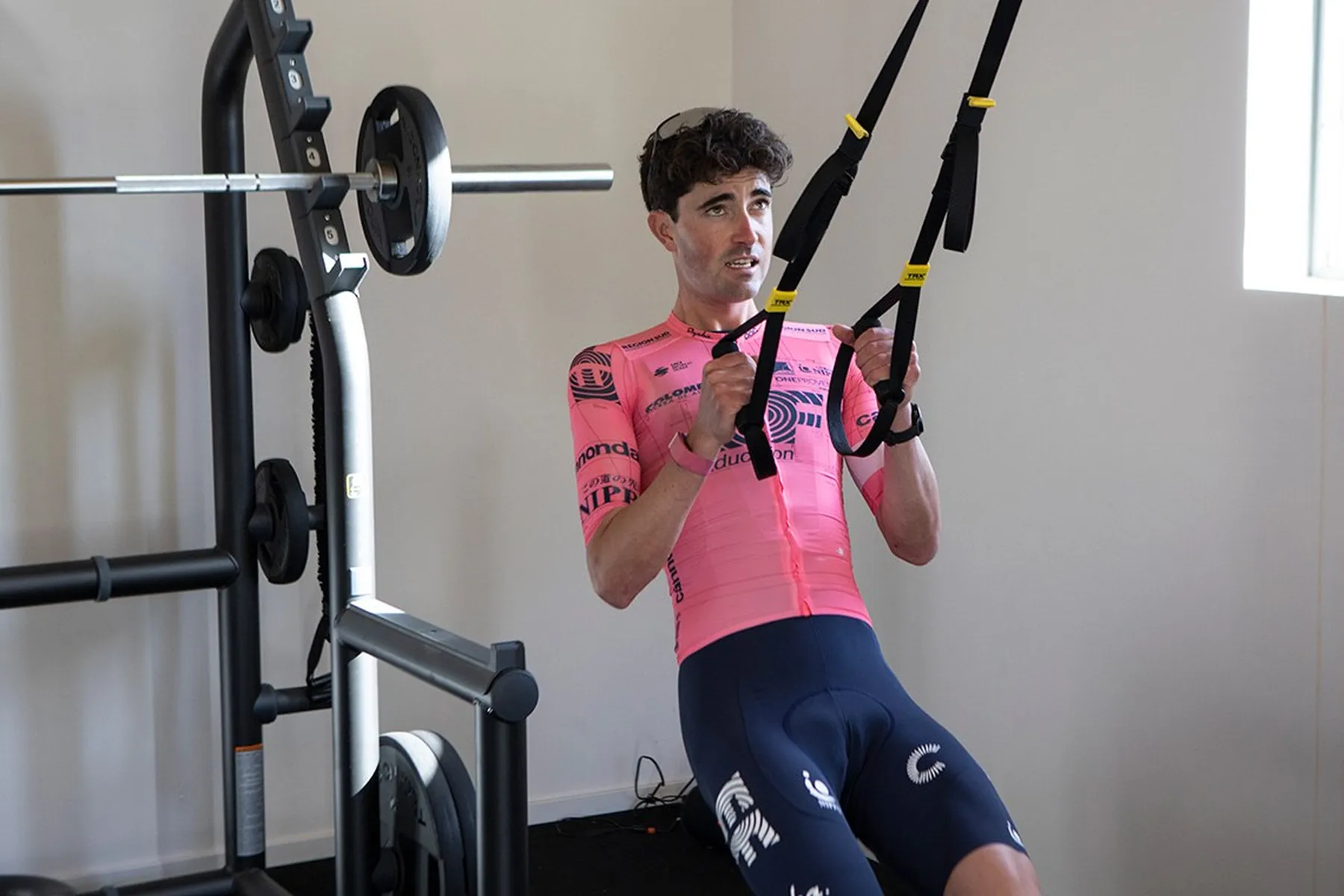
When Art O'Connor — the coach who designed Keegan Swenson's strength routine and who's been coaching cyclists for over 30 years — was on the podcast, he said something that reframed how I think about strength training entirely. Leg strength, he said, is almost never the limiter. He has yet to see a cyclist whose legs were the bottleneck. What he sees consistently is core weakness, hip instability, and upper-body deficits preventing riders from accessing the power their legs already have.
That single insight changes the structure of a cycling strength program. You're not in the gym to build bigger quads. You're there to remove the limiters that stop you transferring power into the pedals. Once you understand that, the protocol becomes simpler, the time investment becomes smaller, and the on-bike result becomes larger.
The 2025 meta-analysis on cycling-specific strength training — 17 trials, 262 trained cyclists — closes the door on the question of whether it works. The work now is doing it properly.
What "heavy" actually means for cyclists
Heavy in a cycling context is not heavy in a bodybuilding context. The working intensity is a load that challenges the muscle in the 6–10 rep range, with 2–3 reps in reserve on the working sets. That's heavy enough to recruit fast-twitch fibres and drive neuromuscular adaptation. It's light enough that form holds and the recovery cost doesn't compete with the riding.
Circuit-style training — high reps, short rests, light loads — is not the cycling strength protocol. Neither is bodyweight calisthenics or band work. Those have a place in warm-up and pre-rehab, but they don't drive the strength adaptations the bike benefits from. The 2025 meta-analysis specifically separated structured heavy resistance work from circuit and plyometric protocols, and the heavy resistance group consistently produced the larger performance gains.
The reason the rep range matters is mechanism. Cyclists need neuromuscular strength — the brain's ability to recruit more muscle fibres per contraction, fast — not muscle size. Loads in the 6–10 rep range live in the neuromuscular adaptation window. Loads in the 12–20 rep range live in the metabolic and hypertrophy window, which is what the gym crowd is doing for aesthetics. We're doing something different.
The four movements that earn the time
When Derek Teel was on the podcast, his framework for cycling-specific strength was the cleanest I've heard. Four compound patterns cover the work; everything else is supplementary. The detail breakdown is in Derek Teel's best exercises for cyclists guide.
Split squat. The rear-foot-elevated (Bulgarian) split squat is the cycling-specific lower-body driver. It loads one leg at a time, which is how pedalling actually works. It trains glute, quad, and hip stabiliser without the spinal compression of heavy bilateral barbell work. For cyclists with low back issues — which is most cyclists — this is the safer and more transferable choice than heavy back squats.
Hip hinge. Single-leg Romanian deadlift, kettlebell deadlift, or hip thrust. The hip extension pattern is what most amateur cyclists are weakest at — the hours in the saddle shorten and weaken the posterior chain, and the gym is where you reverse it. The single-leg version mirrors the pedal stroke. The hip thrust isolates the glutes with low spinal loading. Pick the variant your form is cleanest on.
Secondary single-leg lower body. Step-ups, rear-foot-elevated lunges, or pistol squats progressions. A second unilateral pattern catches asymmetries the first one misses. Many cyclists have one leg meaningfully stronger than the other, and the secondary movement is where you train the weaker side back into balance.
Upper body push-pull and core. Alternate sessions: dumbbell shoulder press or push-up variation one session, a row or pull-up the other. Five minutes of core work — Pallof press, dead bug, plank progressions — at the end of each session. The upper body matters less for cyclists than the legs, but you need enough push-pull strength to maintain a stable upper body in the drops and the hoods at high power. Without it, you bleed watts to lateral motion.
A typical 45-minute session structure: 8–10 minutes warm-up, 12–15 minutes pattern one (split squat or hinge, 4–5 sets per side), 8–10 minutes pattern two (the other lower-body movement, 3–4 sets), 8–10 minutes pattern three (secondary single-leg, 3 sets per side), 6–8 minutes pattern four (upper body and core, 3 sets). Total work time around 42–52 minutes including warm-up.
The 2025 meta-analysis in detail
The published meta-analysis covering 17 trials and 262 trained cyclists found, consistently and durably:
- Time-trial performance improved across the trial set
- Sprint power improved meaningfully
- Short-effort durability improved — riders held power longer on repeated high-intensity efforts
- Cycling economy improved at submaximal intensities
- VO2max showed no negative effect; in some trials it improved
- Body mass gain was negligible; what gain occurred was lean tissue
The argument over whether strength training helps cyclists is closed. The question is now purely about protocol — dose, exercise selection, scheduling, and how to fit it around riding without compromising either.
The masters subset of the meta-analysis is particularly compelling. The bone density, lean mass preservation, and neuromuscular function effects that decline rapidly past 50 are all positively affected by heavy resistance work. This is the foundation of why strength training for cyclists over 50 is the single most effective intervention in the masters playbook.
Where the sessions go in the week
Three workable patterns cover most rider schedules.
Stack hard work. Tuesday morning hard interval ride. Tuesday evening strength session. Wednesday easy spin or rest. Friday morning hard ride. Friday evening strength. Saturday long ride. Sunday recovery. The benefit is that the next-day recovery cost of the strength work overlaps with the recovery from the ride, leaving a clean Wednesday and Saturday. The cost is two doubled-up days that need to be planned around.
Separate days. Monday strength. Tuesday hard ride. Thursday strength. Saturday long ride. Sunday hard ride. Cleaner separation, more days with quality work but each one slightly less stacked. Works well for riders who don't tolerate same-day double sessions.
Sunday-stack pattern. Tuesday hard ride morning, strength evening. Friday easy ride only. Saturday long ride. Sunday hard ride morning, strength evening. The Sunday strength sits close to Monday recovery, so Monday becomes a true rest day. Good for riders who want their hard work concentrated in the back half of the week.
The pattern matters less than the consistency. The 2025 meta-analysis controlled for schedule and the gains came from total dose across the week, not the specific layout. Pick the one that fits your life and hold it for the season.
My 30-day gym and bike experiment
When I ran my own 30-day test stacking gym work alongside the bike work — the protocol is covered in the gym and bike for 30 days episode — the headline result was that sprint power went up 4–6% over the month. Short-effort durability improved more than I expected: 30-second power held longer across repeated efforts at the end of the test compared to the start.
The on-bike vs gym specificity finding surprised me. The gym work transferred well to short hard efforts and sustainable power at threshold. It didn't replace on-bike sprint work — for the very top-end explosive output, you still need to do the sprints on the bike. The gym builds the strength foundation; the bike turns it into cycling-specific power. Understanding which gym gains actually carry over to cycling performance is what separates a productive strength block from wasted hours under a bar.
The other finding was the recovery cost. Two sessions a week was sustainable. Three sessions started competing with the rides for adaptation. The riders I see falling off strength programs are usually doing too much, not too little.
In-season vs out-of-season
The default amateur mistake is to drop strength entirely in race season because "the events take priority." The published research is consistent: in-season strength maintenance preserves the gains from pre-season. Cyclists who lift through the season hold their FTP improvements; cyclists who drop strength entirely lose roughly 30–40% of the strength-related performance gain within 8–12 weeks of stopping.
Off-season (October–February in the northern hemisphere). Two sessions per week, full protocol. The block where you build the strength foundation for the year.
Build season (March–May). Two sessions per week, full protocol. Minor adjustment: drop to 3 sets per lift from 4–5 to leave more recovery for the increased riding load.
Race season (June–September). Two sessions per week through most of the season. Drop to one session per week, lighter load, in race week itself. The exception is high-volume race blocks where back-to-back weekends of events compress the schedule; in those cases, one short maintenance session per week is sufficient.
The full year structure is in the strength training minimum effective dose breakdown, which is the protocol the Not Done Yet community runs with year-round.
The masters angle
After 40 the conversation changes. Fast-twitch muscle fibres start to atrophy preferentially with age — the slow-twitch fibres are mostly preserved by aerobic training, but type 2 fibres need resistance work to maintain. The work covered in the Andy Galpin episode on fast-twitch fibres is the deeper picture, but the operating principle is simple: without heavy strength work, the type 2 fibres go, and with them goes sprint power, attacking ability, and the high-end of the FTP.
Joe Friel's position that strength becomes non-negotiable past 40 is durably correct. The bone-density argument adds to it — cycling is a non-impact sport, which is good for joints but bad for bone. The gym provides the loading the bike doesn't.
For masters cyclists specifically, the strength prescription tilts toward higher loads, lower reps, more time in the 4–6 rep range alongside the 6–10 range. This is covered in strength training for cyclists over 50.
What this protocol is not
It's not a bodybuilding programme. The reps are wrong for hypertrophy, the rest periods are wrong, and the goal is wrong. Don't run an Arnold split alongside it.
It's not a Pilates or stability programme. Those have a place but they don't drive the strength adaptations cyclists need.
It's not bodyweight calisthenics or band work. These are useful for warm-up and pre-rehab; they're not the minimum effective dose for a trained cyclist who wants performance benefit.
It's not optional after 40. The bone-density, lean-mass, and neuromuscular case is strong. The 2025 meta-analysis is particularly compelling for masters cohorts.
Common mistakes
Too many reps. Sets of 15–20 reps with light load is hypertrophy work, not strength work. Wrong rep range for cyclists.
Wrong exercises. Leg extensions, leg curls, calf raises, and bicep curls don't transfer to the bike in any meaningful way. Compound, unilateral, hip-dominant movements earn the time.
Gym sessions too close to key rides. Heavy strength work within 48 hours of a race or key interval session compromises the ride. Plan the gym schedule around the key rides, not the other way around.
Dropping strength in race season. Six weeks off and you've lost a meaningful chunk of the pre-season build. Maintenance through the season is the working pattern.
Loading too fast. Form has to hold. The progression rule is 1.25–2.5kg per session in the first 8–12 weeks, settling to 0.5–1kg per session as the gains slow.
What to do next
Start with the Plateau Diagnostic — four minutes, free, returns the one change most likely to move your numbers. For cyclists who've never run structured resistance work, strength deficits surface as the limiter most often. If you've never done structured strength training as a cyclist, the Roadman Strength Training course walks through the protocol week by week — it's the same one the Not Done Yet community runs. If you'd rather build it yourself, the four-pattern session structure above is enough to start. Two sessions a week, 6-10 rep range with 2-3 reps in reserve, hold for 12 weeks, retest your FTP and your 5-minute power. The FTP test calculator will score the retest so you can see the before-and-after in black and white.
For specific masters questions — load progression at 55, recovery profile after 50, what to substitute when a movement aggravates a knee — the Not Done Yet community at $195/month handles them in the weekly call. The most common question is "I started strength last year and my FTP went up 18 watts — what should I do next?" For full one-on-one programming, the Roadman Method at $297-397/month integrates strength, nutrition, and on-bike work into a 12-month structure.
The argument is over. The work is to do it.