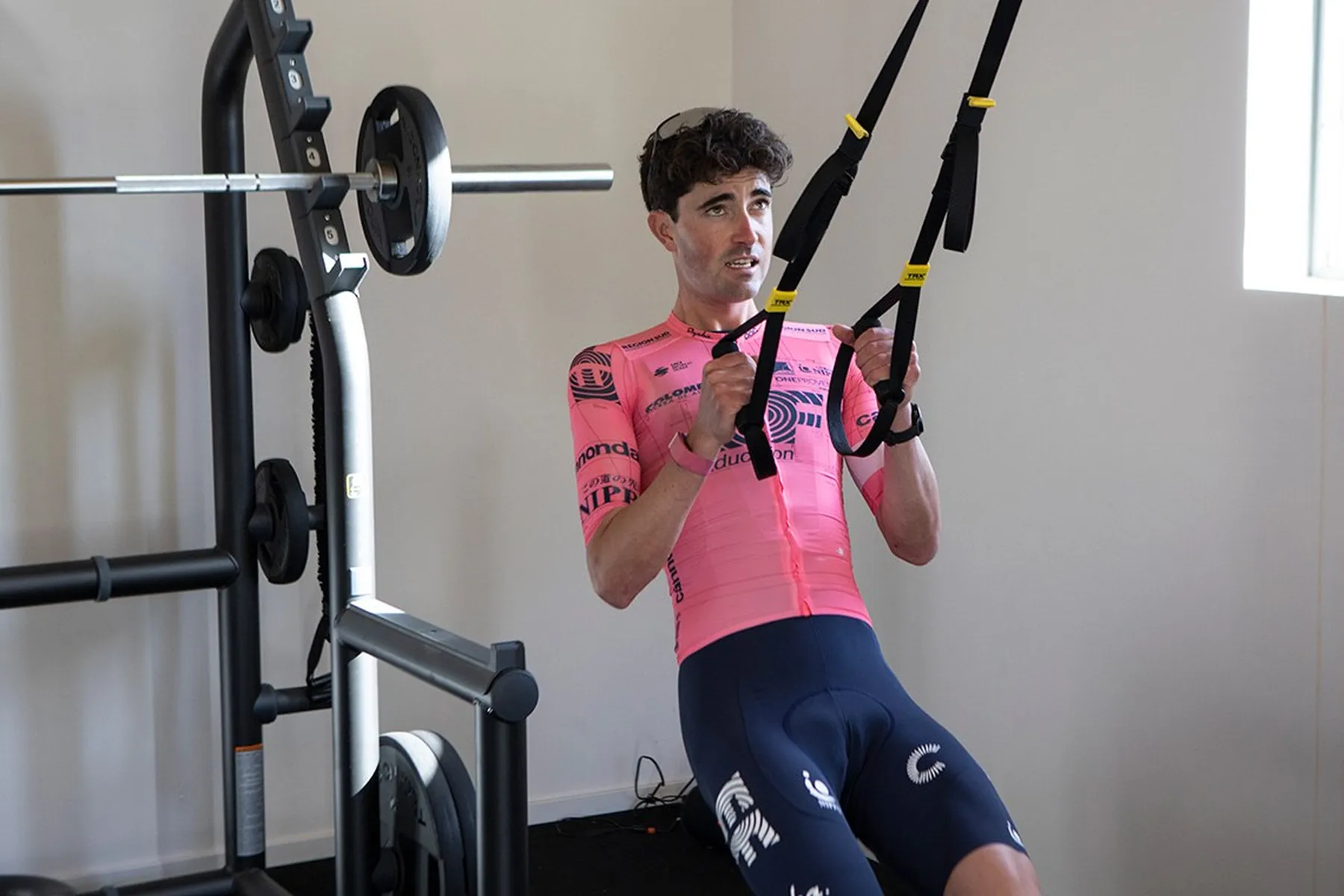
The best exercises for cyclists are not a sacred list. They are the movements a rider can perform well, progressively load and recover from while the important bike sessions continue to improve.
That answer also requires a correction. The previous version of this article said Derek Teel ranked the back squat, Romanian deadlift and Bulgarian split squat as cycling's “big three”. The full Roadman interview does not contain that ranking. Derek used squats, leg press and deadlifts as examples while discussing rep ranges, load selection, progression and scheduling.
The distinction is important if Roadman is going to be a trusted knowledge layer: expert interview guidance, published research and Roadman's practical framework are three different things. This page labels each one.
The answer in 30 seconds
| Training job | Useful exercise options | Selection rule |
|---|---|---|
| Knee-dominant strength | Goblet/front/back squat, split squat, step-up, leg press | Choose the version you can control and progressively load. |
| Hip-dominant strength | Romanian deadlift, trap-bar deadlift, hip thrust, supported hinge, machine variation | Choose by competence, equipment and symptoms—not pedal-stroke resemblance. |
| Single-leg capacity | Split squat, step-up, supported single-leg hinge | Add when unilateral control serves the goal; it is not automatically superior. |
| Calf and ankle strength | Standing or seated calf raise | Include when lower-leg capacity is relevant and the progression is tolerated. |
| Upper-body strength | Row, pull-down, push-up, press | Supports whole-body strength; do not promise a direct watt gain. |
| Trunk control | Carry, Pallof press, side plank, dead bug | Pick a task you can progress; no core exercise is a guaranteed power fix. |
For a complete exercise-selection framework and adaptable A/B routine, use the gym exercises for cyclists owner. This page answers the narrower question: what Derek actually said, and how it should change your choices.
What Derek Teel actually said
Derek Teel is the founder of Dialed Health and was interviewed on the Roadman Cycling Podcast about strength programming for cyclists. His most useful points were not a ranked lift list.
1. Treat rep ranges as different training tools
Derek compared resistance-training rep ranges with cycling zones. He described higher repetitions as muscular-endurance work, a middle range as hypertrophy-oriented work, and lower repetitions as strength or power work. His central advice was to periodise the stimulus rather than use one rep range forever.
That is an expert coaching model, not a cyclist trial proving every rider must move through 16–20, 6–12 and 1–6 repetitions in that exact order. The practical value is simpler: define what the gym block is trying to develop and choose load, repetitions and speed accordingly.
2. Build competence before heavy loading
Derek warned against sending an untrained lifter straight into maximal testing or a demanding heavy programme. He recommended using perceived effort and repetitions available rather than needing a one-repetition maximum for every lift.
Roadman's boundary is to start with a load and variation the rider can control. A research definition of “heavy” does not become a day-one instruction for someone learning the movement.
3. Use two sessions as a starting point, not a law
Derek described two weekly sessions as a practical minimum in his coaching model and cautioned that a third becomes harder to absorb as riding frequency rises. The latest cyclist meta-analysis included programmes using one to three weekly sessions and did not find frequency to be a significant moderator. It did not prove two sessions is the universal optimum.
Those statements can coexist: two is a useful starting structure for many riders; individual response and cycling load decide whether it is right.
4. Protect the priority bike work
For a cyclist whose main performance target is on the bike, Derek recommended completing the priority ride before later strength work when the two share a day. He also argued for concentrating demanding sessions rather than turning every easy riding day into a medium-stress day.
That is one defensible arrangement, not the only one. Separating sessions may work better when strength development is the main block goal or same-day training repeatedly harms either session.
What the cyclist evidence supports
The 2025 cyclist-only systematic review and meta-analysis included 17 controlled studies, 262 adult endurance cyclists and 60 women. Compared with endurance-only controls, heavy strength programmes improved cycling performance, cycling efficiency and anaerobic power at group level.
The pooled analysis did not find significant improvements in VO2max, power at VO2max, maximal metabolic steady state or anaerobic capacity. The authors graded the outcome evidence low certainty and said the data did not support robust conclusions about optimal implementation.
Most importantly for an exercise article, the review did not:
- rank individual lifts;
- prove single-leg work superior to bilateral or machine work;
- establish one compulsory rep range;
- show that one exact routine prevents injury; or
- guarantee an FTP or race-performance gain for every cyclist.
Strength training can be useful without turning each programme choice into a research fact.
How to choose the best knee-dominant exercise
A knee-dominant movement trains force through knee and hip extension. The practical options include squats, split squats, step-ups and leg presses.
Use the rider's limiting factor to choose:
- A squat can train substantial force but asks for more balance, mobility and technical control.
- A split squat reduces the total external load needed for a hard set and adds unilateral control, but balance may end the set before the target muscles do.
- A step-up can be accessible when the box height and load are well chosen, but “looks like the pedal stroke” is not proof of superior transfer.
- A leg press reduces balance and trunk demands and may let a rider load the legs more consistently. A machine is not automatically less athletic.
The best choice is the one that matches the goal, can be progressed and does not create a recovery cost the bike week cannot afford.
How to choose the best hip-dominant exercise
Romanian deadlifts, trap-bar deadlifts, hip thrusts, supported single-leg hinges and machine variations can all train overlapping hip-dominant qualities.
Choose a hinge variation when the programme needs it and the rider can maintain a controlled position. Choose a hip thrust or machine when it removes a technical limitation and lets the intended muscles work. No cyclist needs one named deadlift variation to qualify as serious.
Muscle activation from one laboratory comparison can help explain a mechanism. It does not prove that exercise produces better cycling performance than every alternative.
Is single-leg work more cycling-specific?
It can be useful; it is not automatically better.
Cycling alternates legs, but resemblance is not outcome evidence. Single-leg exercises can expose side-to-side control, train a useful range with less external load and add variety. Bilateral and machine exercises can provide a more stable strength stimulus and easier progression.
Ask three questions:
- Is the intended muscle or movement pattern the real limiter?
- Can the rider add load or repetitions without the exercise changing shape?
- Does it improve the programme without harming the next priority ride?
If balance ends every set while the target muscles remain underloaded, use support or choose another movement.
A practical 30, 45 or 60-minute menu
This is Roadman's adaptable framework, not Derek's ranked prescription and not a package tested by the meta-analysis.
30 minutes: minimum useful menu
- one knee-dominant movement, two controlled work sets;
- one hip-dominant movement, two controlled work sets;
- one upper-body pull or push, two work sets; and
- one trunk or carry task, two controlled efforts.
45 minutes: balanced full-body session
- one knee-dominant movement, two or three work sets;
- one hip-dominant movement, two or three work sets;
- one unilateral or calf movement when relevant;
- one upper-body pull and one push; and
- one short trunk or carry task.
60 minutes: only when the week can absorb it
Keep the main patterns, then add one or two accessories that answer a stated need. More time should not become random volume. If the extra work creates soreness that flattens the next key ride, it failed the programme-level test.
Use the free strength-session planner to place the session around actual rides. It is a scheduling heuristic, not an injury screen or recovery guarantee.
How hard should the sets be?
Derek's interview recommended choosing load with perceived effort and repetitions left rather than requiring a novice to test a maximum. That aligns with a useful fatigue boundary.
A 2026 systematic review and meta-analysis included 20 studies and 556 healthy adults. Non-failure training was as effective as failure training for most measured adaptations and produced a small advantage for dynamic strength. The research was not cyclist-specific, but it shows that every set does not need to end at failure.
For most work, finish with one to three technically sound repetitions available. Stop earlier when technique changes or pain appears. Progress load or repetitions when all planned work is controlled and the next important ride remains productive.
Where the gym fits around riding
The order follows the goal.
- Bike priority: complete the key ride first, lift later or separate the sessions.
- Strength priority: lift fresh or separate the sessions so strength quality is protected.
- Easy-day protection: concentrate demanding work on fewer days only when both sessions remain productive and the following recovery is adequate.
A same-session sequence meta-analysis found a small lower-body-strength advantage when resistance work came first but no sequence effect on aerobic capacity. A separate concurrent-training meta-analysis found trained participants had less lower-body strength development when endurance and resistance occurred in the same session than with resistance training alone, while separating sessions reduced that effect.
Neither paper proves one universal cycling schedule. Review the rider:
- Did the priority bike session complete its intended work?
- Did the main lifts progress over several exposures?
- Did soreness alter cadence, movement or normal daily activity?
- Did pain appear or worsen?
- Was the rider ready for the next important day?
Roadman's training-readiness check and recovery screen organise those signals without turning one score into a command.
Claims this page no longer makes
“Derek's big three are back squat, RDL and Bulgarian split squat.” The cited episode did not contain that ranking.
“Single-leg work transfers directly because cycling is unilateral.” It may be useful; resemblance alone is not comparative performance evidence.
“At least half of lower-body volume must be single-leg.” No cited cyclist review established that percentage.
“Heavy bilateral barbell lifts deliver the same stimulus with far greater injury risk.” The old article supplied neither comparative injury data nor proof of an identical stimulus.
“Two sessions is the research-proven minimum and three is the off-season rule.” Those are coaching options, not universal laws from the cyclist meta-analysis.
“Strength work automatically prevents injury or makes every cyclist faster.” The latest cycling review did not test injury prevention, and group averages are not individual guarantees.
The next step
Choose one knee-dominant and one hip-dominant movement you can perform today. Record the exercise, load, repetitions, sets and repetitions left. Add only the movements that answer a real need, then check what happens to the next priority ride.
The upcoming Roadman iPhone app is being built to connect this exercise menu to the cycling week: 30, 45 or 60-minute strength, priority-ride protection and explainable readiness adjustments rather than a random workout library. See the Roadman strength and recovery app and join the single early-access list.
For the canonical exercise-selection routine, read gym exercises for cyclists. For the wider research and programming question, read strength training for cyclists. To hear the source directly, use Derek Teel's full Roadman episode and transcript.
Sources and correction record
- Derek Teel: The Best Exercises for Cyclists — full episode and transcript
- Cyclist-only heavy-strength systematic review and meta-analysis (PMID 40632222)
- Non-failure versus failure resistance-training meta-analysis (PMID 42410632)
- Concurrent-training sequence meta-analysis (PMID 28783467)
- Concurrent endurance and resistance training in trained athletes (PMID 33751469)
The article was corrected and last reviewed on 31 August 2026. It does not diagnose injury, prescribe rehabilitation or replace appropriately qualified coaching or medical advice. Source challenges can be submitted through the Roadman corrections page.