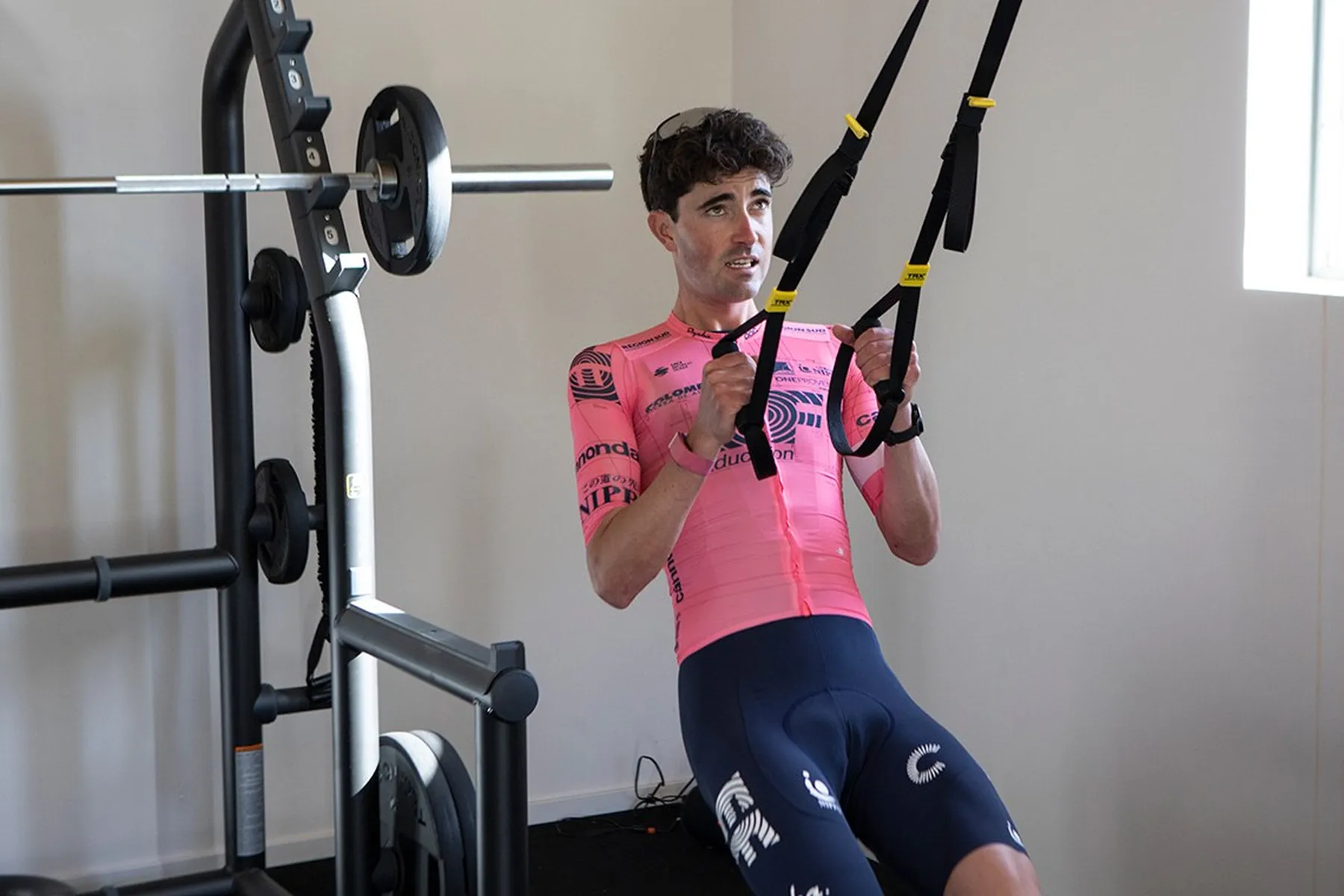
Strength training can make a cyclist faster, but the honest answer is more useful than the internet slogan. The latest cyclist-only systematic review and meta-analysis found improvements in cycling performance, cycling efficiency and anaerobic power. It did not find significant pooled changes in VO2max, power at VO2max, maximal metabolic steady state or anaerobic capacity, and the authors graded the evidence as low certainty (Llanos-Lagos and colleagues, published online in 2025).
That supports putting strength work in the plan. It does not support declaring one exercise list, rep range or weekly frequency compulsory for every cyclist.
The answer in 30 seconds
| Question | Evidence-bounded answer |
|---|---|
| Does strength training help cyclists? | Heavy strength training can improve performance, efficiency and anaerobic power at group level. Individual response is not guaranteed. |
| Does it raise VO2max or FTP? | The latest pooled analysis did not find a significant VO2max, power-at-VO2max or maximal-steady-state effect. Do not sell it as an automatic FTP gain. |
| How often? | The reviewed programmes used 1–3 sessions per week. The analysis did not establish an optimal frequency. |
| How long? | Included interventions lasted 5–25 weeks. A short introduction may teach technique without being long enough to judge cycling transfer. |
| How heavy? | The review defined heavy strength training as at least 80% of one-repetition maximum. Beginners should first earn the ability to load safely. |
| Best exercises? | No universal ranked list was established. Cover useful movement patterns with variants suited to the rider. |
| What about masters? | General strength and bone-health reasons matter, but the review did not report the “masters subset” sometimes claimed online. |
What the 17-study meta-analysis actually found
The review pooled 17 controlled studies with 262 adult endurance cyclists, 60 of whom were women. Programmes lasted 5–25 weeks and used 1–3 strength sessions per week. Compared with cycling-only controls, heavy strength training produced statistically significant pooled effects for:
- cycling efficiency: effect size 0.353, p=0.012;
- anaerobic power: effect size 0.560, p=0.024; and
- cycling performance, combining time-trial and time-to-exhaustion outcomes: effect size 0.463, p=0.016.
It did not produce significant pooled effects for VO2max, power at VO2max, maximal metabolic steady state or anaerobic capacity. Participant sex, body mass, performance level and previous strength experience did not significantly moderate the outcomes; nor did programme duration, training frequency or total sessions.
The most important line is the review's conclusion: low certainty of evidence prevents robust recommendations about optimal implementation. Seventeen studies is valuable, but 262 riders split across several outcomes, protocols and ability levels is not enough to turn a group result into one universal prescription.
An earlier controlled study illustrates both the promise and the limits. Nine elite cyclists combined endurance and heavy strength work for 25 weeks, while seven continued endurance training alone. The combined group improved several power and performance measures, but also increased lower-body lean mass; neither group changed VO2max or cycling economy (Rønnestad and colleagues, 2015). That is a small study, not a guarantee—but it is stronger evidence than saying a cyclist can never add mass.
A practical starting plan—not “the proven protocol”
This is Roadman's adaptable starting framework. It is not the exercise prescription tested as one package by the meta-analysis.
Step 1: earn the movement
For the first 2–4 weeks, select loads that allow controlled repetitions and leave several good reps available. Learn how to brace, use the intended range, and finish without joint pain or form breakdown. A new lifter does not need an 80% one-repetition-maximum test on day one.
Choose one safe variant from each useful pattern:
| Pattern | Possible choices | Why it is in the programme |
|---|---|---|
| Knee-dominant | Goblet squat, split squat, leg press, step-up | Develop lower-body force through a controllable range |
| Hip-dominant | Romanian deadlift, trap-bar deadlift, hip thrust | Train hip extension and posterior-chain strength |
| Single-leg | Split squat, step-up, supported single-leg hinge | Expose side-to-side control and capacity |
| Calf/ankle | Standing or seated calf raise | Build lower-leg capacity where relevant to the rider |
| Upper body | Row, press, pull-down or push-up | Support whole-body strength and riding-position demands |
| Trunk | Carry, side plank, Pallof press or dead bug | Train bracing and control without claiming a direct watt gain |
There is nothing magical about a Bulgarian split squat or deadlift. A machine can be the better choice when it lets a rider train hard with less technical or balance demand. “Looks like pedalling” is not proof of transfer.
Step 2: build progressively
For many cyclists, two non-consecutive full-body sessions per week is a manageable place to start. Use two or three work sets per pattern, then add load, repetitions or a set gradually—not all three at once. Riders with sound lifting experience can progress toward the heavy loads represented in the research. Riders without it should progress under qualified supervision where possible.
Record four things:
- the exercise, load, repetitions and sets;
- repetitions left in reserve or session effort;
- soreness and readiness over the next 48 hours; and
- whether the next priority bike session held its planned power and quality.
If strength numbers rise while priority rides repeatedly fail, the combined programme is not working yet. Reduce strength volume, change its position in the week, or revisit the total bike load.
Step 3: maintain with less volume when cycling load rises
Do not assume maintenance always means exactly one session or two sets. A practical first experiment is to keep familiar movements and meaningful load while removing some accessory exercises or sets. The smallest recoverable dose differs between a novice, an experienced lifter, a time-crunched masters rider and an athlete in a dense race block.
Our minimum-effective-dose guide explains how to adjust the amount of work around your experience and riding.
Where strength sessions fit around riding
Protect races and the bike sessions most connected to your goal. Do not place a fatiguing gym session immediately before a priority interval session, long ride or event.
There are two defensible patterns:
- Separate the sessions. This is useful when strength development is a priority or same-day work harms quality. A meta-analysis found that trained participants lost more lower-body strength development when endurance and resistance work occurred in the same session than when the sessions were separated (Petré and colleagues, 2021). It compared strength outcomes with resistance-only training; it was not a cyclist-performance trial.
- Concentrate demanding work. A rider may put the priority bike session first and lift later, leaving the next day easy. This can protect genuinely easy days, but it only works if both sessions remain productive and the rider recovers.
The right order follows the priority. If the interval session is the key stimulus, ride first. If developing maximal strength is the block's primary goal, lift fresh or separate the sessions. A review of same-session sequence found a small lower-body strength advantage when strength came first, with no sequence effect on aerobic capacity (Murlasits, Kneffel and Thalib, 2018).
Use the free cycling strength session planner to map one or two available gym windows around your actual key and long rides. It exposes the placement rules and labels unavoidable conflicts; it does not prescribe exercises or turn a scheduling heuristic into a recovery guarantee.
Strength training for cyclists over 40, 50 and 60
The newest cycling meta-analysis included adults across performance levels, but it did not publish the special “masters subset” claimed by Roadman's retired duplicate article. We should not invent one.
The masters case still matters for two separate reasons:
- General health. WHO recommends adults—including older adults—perform muscle-strengthening activity involving major muscle groups on two or more days per week. Older adults should also include multicomponent activity emphasising balance and strength where appropriate (WHO physical-activity guidelines). This is a public-health recommendation, not a cycling-performance dose-response study.
- Cycling does not replace bone-loading activity. A systematic review concluded that road cycling does not appear to provide a meaningful osteogenic benefit and reported concern about lower bone mineral density in some adult road-cyclist groups (Olmedillas and colleagues, 2012). A 2025 scoping review found resistance and impact-based interventions promising, but only five eligible studies in cyclists and swimmers, so certainty remains limited (Florvåg and colleagues, 2025).
For a healthy masters rider who is new to resistance training, progress more patiently rather than assuming age requires an aggressive 4–6-repetition prescription. Health conditions, osteoporosis risk, previous injury and unexplained pain belong with an appropriately qualified clinician or strength professional, not an online calculator.
Read the strength training for cyclists over 50 guide for masters-specific programming considerations, and use the masters cycling hub for the broader training and recovery framework.
Common claims to stop repeating
“Strength training always increases FTP.” The latest pooled analysis found no significant maximal-steady-state or VO2max effect. Some riders may improve FTP; the review does not promise it.
“Two sessions is the proven minimum.” The studies used 1–3 sessions and frequency was not a significant moderator. Two is a practical starting choice.
“High repetitions only build bulk; 6–10 repetitions cannot.” Adaptations overlap. Load, volume, proximity to failure, nutrition and training history all matter. The elite-cyclist trial reported increased lower-body lean mass with heavy training.
“Single-leg lifts transfer directly because cycling is single-leg.” Biomechanical resemblance is not outcome evidence. Use unilateral exercises when they serve the rider; do not claim direct transfer from appearance alone.
“Strength training prevents cycling injuries.” The 2025 cycling-performance review did not test injury prevention. Strength work may be part of a wider capacity programme, but a page should not guarantee protection from pain or injury.
“Every cyclist over 40 needs the same heavy protocol.” Older adults should strength train for health when able, but individual health, lifting history, goals and recovery still govern the programme.
How to judge whether it is working
Set a baseline before the block:
- one or two repeatable strength measures;
- a cycling performance measure matched to your goal;
- body mass if power-to-weight matters;
- the completion and quality of priority sessions; and
- fatigue, soreness and any pain response.
Reassess after a meaningful block—not after three gym visits. A stronger lift is evidence that the gym programme improved that lift. Transfer requires a cycling outcome too.
Choose the next step by the amount of support you need. The free 12-week beginner strength plan is a conservative framework you adapt yourself. The paid 12-week cycling strength training course is a fixed, self-guided programme with exercise demonstrations, progression and tracking for a one-time $65 payment. If you want the bike and gym loads programmed together for your event and response, Roadman online cycling coaching provides individual oversight.
If you are deciding whether software can do that coordination, use the cycling strength training app comparison. It compares products that are available now by gym programming, bike-week placement, progression and recovery context; the unreleased Roadman product is not ranked.
Sources and editorial limits
- Heavy strength training effects in endurance cyclists: systematic review and meta-analysis (PMID 40632222)
- Strength training in elite cyclists: 25-week controlled study (PMID 24862305)
- Concurrent endurance and resistance training in trained athletes (PMID 33751469)
- Concurrent-training sequence meta-analysis (PMID 28783467)
- Cycling and bone health systematic review (PMID 23256921)
- WHO guidelines on physical activity and sedentary behaviour
This article distinguishes pooled research results from Roadman's practical starting framework. It was last checked on 26 August 2026. It does not diagnose injury, prescribe rehabilitation or replace individual medical or coaching advice.
Hear the original strength interviews
For the decisions behind a programme, listen to Andy Galpin on progress and recovery after 40 and Art O’Connor on movement and gym placement. The Chris Peden interview is also available in the archive.