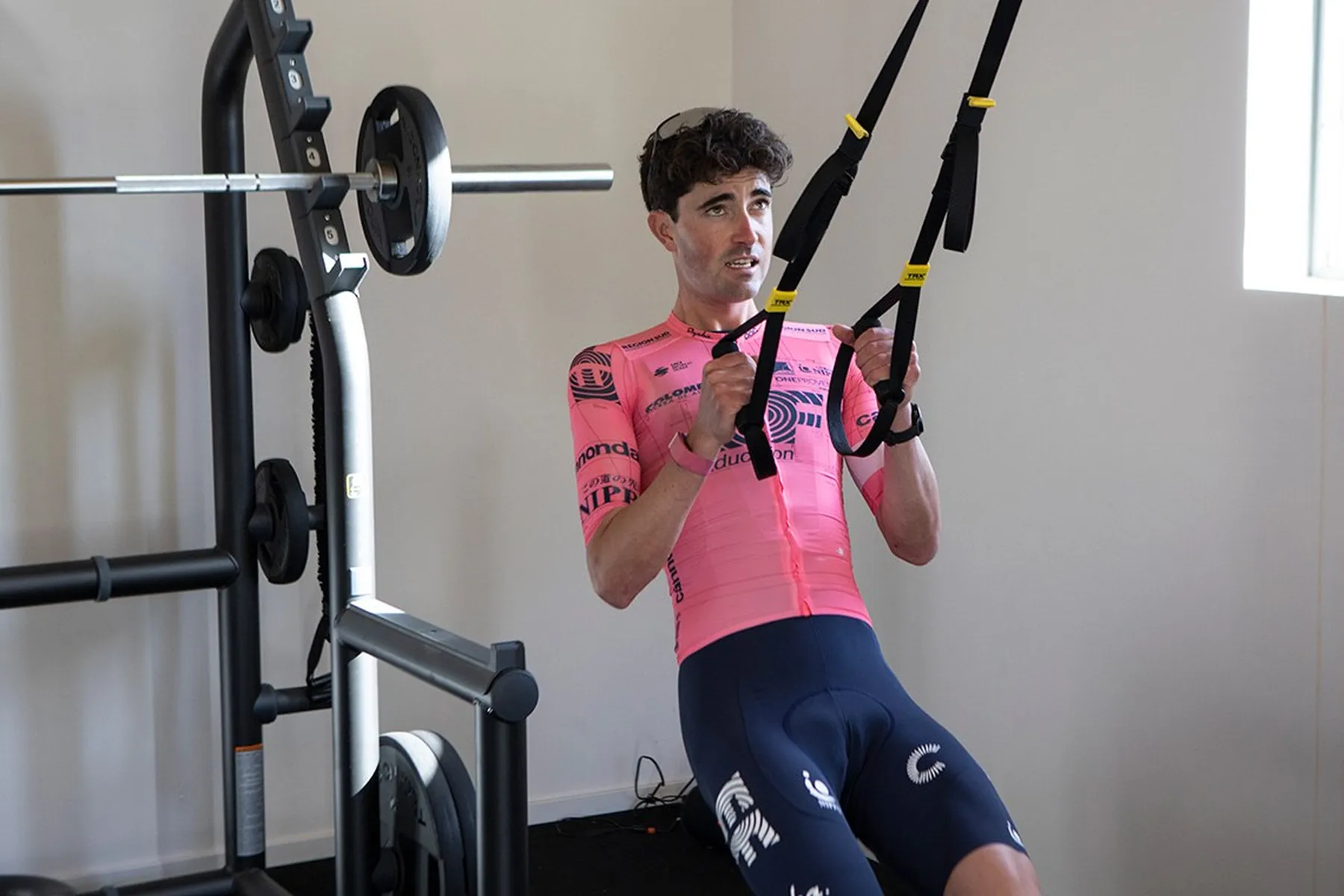
Most triathletes treat strength training as an optional extra. They squeeze in a circuit when the weather's bad, chase the pump on a rest day, or skip the gym entirely once race season starts. Then they wonder why their aero position falls apart at kilometre 120 and their bike split is ten minutes slower than their numbers say it should be.
The bike leg of a triathlon is a strength event disguised as an endurance event. You are holding one position, producing force through the same pedal stroke, for anywhere from two to six hours — and then you have to run. The muscles that hold your pelvis stable, keep your torso locked into the aero bars, and drive watts through the chain are the same ones that decide how the first 10km of your run feels.
This is not bodybuilding. It's resilience training with a specific job description. Eight exercises, programmed correctly, cover it.
Why triathletes need strength (and what they don't need)
The research on endurance athletes and structured strength training is settled. Bent Rønnestad's studies out of Norway have repeatedly shown improvements in cycling economy, work efficiency and late-ride performance (typically in the 2-8% range depending on the measure) after 10-12 weeks of structured strength training twice weekly. Similar numbers show up in running economy literature. Prof. Stephen Seiler, who we've had on the Roadman Cycling Podcast multiple times, has been clear that loaded resistance work is one of the few gym interventions with solid transfer to endurance performance.
What triathletes need from the gym is force production, postural endurance, and injury resilience. What they don't need is hypertrophy work, high-rep leg circuits, or plyometrics stacked on top of already-heavy run weeks.
The distinction matters because the cost of getting it wrong is high. An extra kilo of upper-body muscle is an extra kilo you carry up every climb and every step of the marathon. A Monday leg-day session with ten sets of squats wrecks Tuesday's threshold bike and Wednesday's tempo run. The sessions that build the right adaptations are short, heavy, and specific.
Dan Lorang, who coached Jan Frodeno and Anne Haug to multiple Ironman world titles, has spoken about this repeatedly: gym work for triathletes is there to protect the athlete and support the specific demands of the race. Nothing more. Two sessions a week, 30–45 minutes each, loaded properly. That's the dose.
Our strength course is built on exactly this logic, and the bike-specific block sits at the centre of it.
The eight bike-specific exercises
These are the eight movements that cover the bases. Loads are expressed as percentage of one-rep max (1RM) or as RPE (rate of perceived exertion) where 1RM testing isn't practical.
1. Single-leg deadlift (or kettlebell hip hinge). 3 sets of 6-8 reps per side at a load that challenges in the rep range with 2-3 reps in reserve. The foundational posterior-chain pattern for triathletes. Builds the glute and hamstring force that drives the downstroke, stabilises the pelvis in aero, and directly mirrors the single-leg pedal stroke.
2. Rear-foot-elevated split squat. 3 sets of 6-8 reps per leg, dumbbell in each hand at RPE 7-8. Addresses the single-leg force production the pedal stroke actually demands and exposes left-right imbalances.
3. Single-leg leg press. 3 sets of 6–10 reps per leg at meaningful load. Loads the quads and glutes through a cycling-specific range with very low spinal load. Good option on high-volume bike weeks.
4. Hip thrust. 3 sets of 8–10 reps at meaningful load. Glute-dominant hip extension with minimal spine loading. Protects the hamstrings against the high tension loads of the run off the bike and builds the same hip-extension power that drives the pedal stroke.
5. Weighted plank with shoulder tap. 3 sets of 30–40 seconds. Trunk endurance for the aero position. Static strength, not crunches. The trunk's job on the bike is to not move.
6. Pallof press. 3 sets of 8–10 reps per side. Anti-rotation trunk strength. Every pedal stroke creates a rotational force the core has to resist; this is the exercise that teaches it to do so.
7. Single-arm dumbbell row. 3 sets of 6–8 reps per side at RPE 8. Upper-back strength to hold the aero position for four-plus hours without the shoulders collapsing forward.
8. Copenhagen adductor plank. 3 sets of 8–10 reps per side. The adductors are neglected and frequently the first muscle group to cramp late in long-distance racing. This one builds them under load.
Two sessions a week, pick 4–5 of these per session, rotate the emphasis. Warm up for ten minutes on a bike or rower first.
How to program them across a training week
The scheduling is where most triathletes get this wrong. The rule is simple: the strength session lives 48 hours away from your key bike and run sessions.
For most athletes with a Saturday long ride and a Sunday long run or brick, the sensible slots are Monday and Thursday. Monday absorbs residual fatigue from the weekend; Thursday sits before Friday's recovery day or easy spin. Tuesday's threshold bike and Wednesday's quality run sit in the middle, protected.
A typical week in build phase looks like this. Monday: strength session one (lower-body emphasis — single-leg deadlift, split squat, Pallof press, Copenhagen plank). Tuesday: bike threshold (set targets with the FTP zones calculator). Wednesday: run quality. Thursday: strength session two (posterior chain and trunk — hip thrust, single-leg press, weighted plank, single-arm row). Friday: recovery. Saturday: long ride. Sunday: long run or brick.
Total gym time across the week: 60–90 minutes. That's it. If you're spending two hours a session three times a week, you're lifting like a bodybuilder, not a triathlete.
The order within a session matters too. Heaviest single-leg or hinge pattern first when the nervous system is fresh, secondary single-leg and posterior-chain work second, trunk and stability last. Rest 2–3 minutes between working sets of the loaded patterns. Don't turn it into a circuit. This is the mistake the "triathlete strength" content on YouTube makes constantly — treating gym sessions like cardio.
Athletes on our triathlon bike coaching programme get this programmed alongside their bike training so the loads align rather than fight each other.
Periodisation around big bike weeks
Strength is not constant across the year. Joe Friel's framework in The Cyclist's Training Bible — which still holds up — separates the year into anatomical adaptation, maximum strength, and maintenance phases. Triathletes need the same structure.
Off-season and early base (October–January for a northern-hemisphere athlete targeting a summer A-race): two sessions weekly, building from 2 sets of 10-12 reps in the first two weeks up to 3-4 sets of 6-8 reps with 2-3 reps in reserve by week eight. This is the block where the real adaptation happens. Volume on the bike is moderate; the gym carries more of the load.
Build phase (February–April): two sessions weekly, maintaining meaningful load (3 sets of 6-8 reps) but reducing total volume. The bike-specific work on the turbo and the road is ramping; the gym's job is to maintain what was built.
Race-specific phase (4–8 weeks out): drop to one session per week. Keep the primary cycling-specific patterns; cut the accessory work. This is where triathletes panic and either stop lifting entirely or double down — both wrong. One loaded session every 7–10 days maintains neural adaptation without interfering with race-specific bike and run sessions.
Big bike weeks — training camps, volume blocks, simulation weekends — get strength cut to one short maintenance session or dropped entirely for that week. Recovery is the limiter. When you're doing 20 hours on the bike across seven days, stacking another heavy lower-body session on top is the wrong call.
Race week: last loaded session 10–14 days out for an Ironman, 7–10 days out for a 70.3. One optional light session with loads reduced to 50–60% of working weight, five days out, to keep the nervous system primed without adding fatigue.
What not to do in the gym as a triathlete
The mistakes cost more than the gains.
Don't do bodybuilding splits. Chest day, arms day, leg day — this is hypertrophy programming designed to build muscle mass. You don't want muscle mass. You want force production per kilo of bodyweight — your watts per kilo is what matters on climbs and on the run. Compound, full-body sessions, twice weekly.
Don't do high-rep burnout sets. Three sets of twenty light squats produces local muscular fatigue, soreness, and no useful adaptation. Your bike and run already give you endurance stimulus. Lift with meaningful, controlled load or don't lift.
Don't do plyometrics in race-build phases unless you really know what you're doing. Box jumps, bounding, and depth jumps stack impact stress on top of running volume and are the fastest way to produce a calf or Achilles problem 12 weeks out from a race. A small dose can help in early base. Most age-groupers don't need them at all.
Don't train to failure. Leaving 1–2 reps in reserve on every set is the right call. Failure reps produce disproportionate fatigue for minimal additional adaptation and raise injury risk on compound lifts.
Don't ignore single-leg work — it's the priority. Cycling is a single-leg sport performed 90 times a minute, so split squats, single-leg deadlifts and single-leg press do more for triathlon-specific transfer than any bilateral pattern. If every session skips the unilateral work, you're leaving transfer on the table and masking left-right imbalances that become cramps and niggles in the back half of races.
Don't start two weeks before a race. Strength training is a 10–12 week investment minimum. Starting in May for a July Ironman produces soreness, fatigue, and no adaptation. Start in the off-season, or don't start this year.
Pick two sessions this week. Put them on the calendar 48 hours away from your hardest bike and run days. Four cycling-specific patterns each, loaded enough to challenge in the 6-10 rep range with reps in reserve. Do that for ten weeks and the bike leg of your next race will feel different in the last hour — which is the hour that decides the race.
Companion reads: strength training for cyclists guide, cycling deadlift guide, best gym exercises for cyclists, 70.3 bike training plan, and Ironman bike training plan 16 weeks.
If you want gym work integrated with your triathlon plan rather than scheduled around it, NDY coaching at Roadman is built for triathletes. Got a specific question — your own session order, what to drop in race week? Ask Roadman for an answer drawn from the actual S&C and triathlon conversations on the podcast.