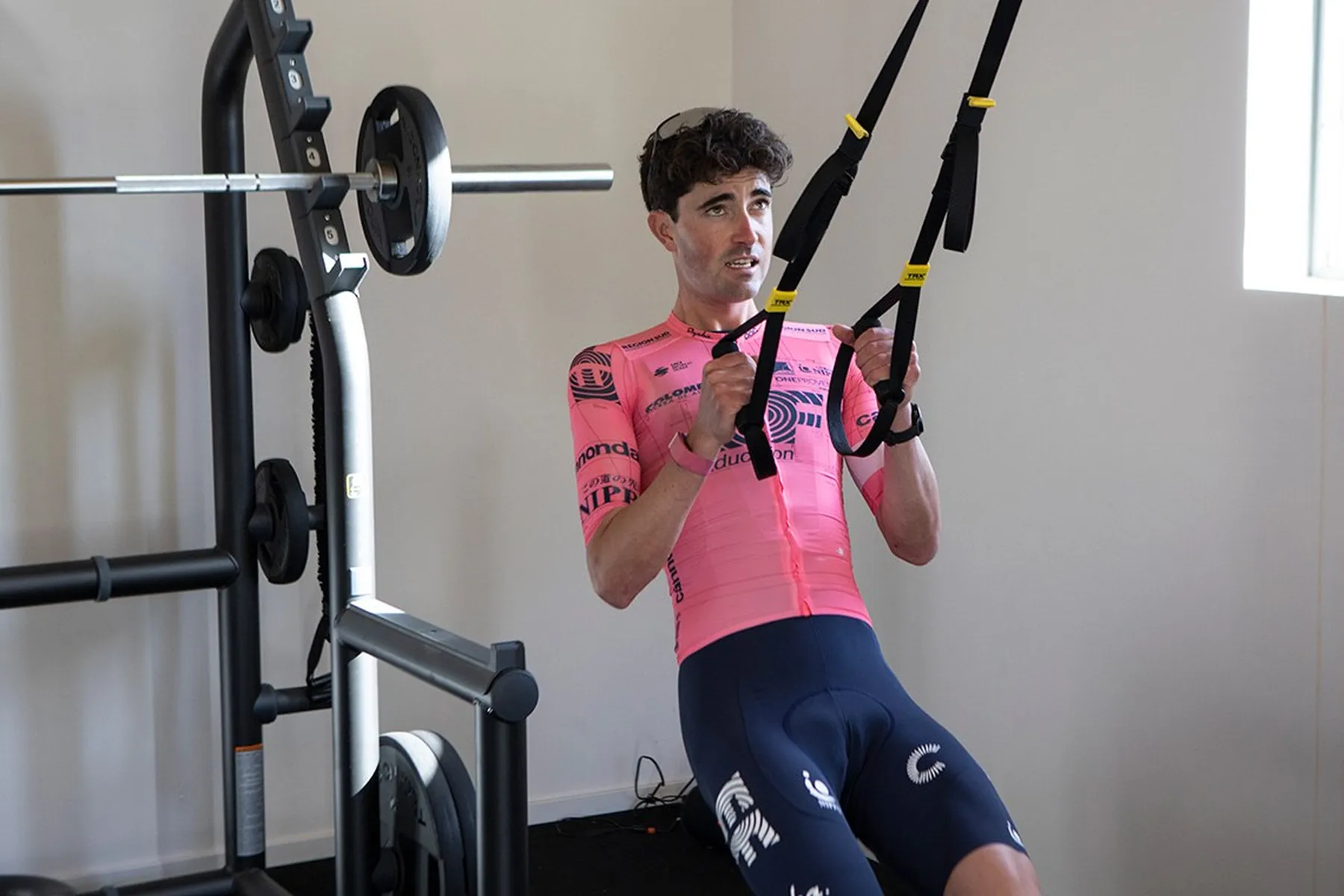
The best core exercises for cyclists are the versions you can control, repeat and progress. A dead bug, side plank, bird dog, Pallof press and suitcase carry make a useful menu because they expose the trunk to different demands. They are not a magic transfer sequence.
Use two controlled rounds for a 10–15-minute session. Start with three movements if five makes technique or consistency worse. Current research supports a modest claim: core work can train trunk endurance and control. It does not prove this routine adds watts, raises FTP, cures back pain or prevents injury.
The 15-minute cycling core workout
| Exercise | Starting dose | Main coaching boundary |
|---|---|---|
| Dead bug | 2 × 6–8 per side | Use only the range that keeps the trunk position controlled. |
| Side plank | 2 × 15–30 seconds per side | Use the knees-down version when the full lever changes position. |
| Bird dog | 2 × 6 per side with a short pause | Reach long without shifting or rotating to chase range. |
| Pallof press | 2 × 6–10 per side | Use a band load you can press without leaning or turning. |
| Suitcase carry | 2 × 20–30 metres per side | Walk normally without leaning away from the load. |
Rest only as long as needed to make the next set controlled. The sets, repetitions and times are starting ranges, not a validated optimum.
No band? Replace the Pallof press with a short front plank or a slow plank shoulder tap. No safe space to carry? Use another side-plank set. The movement category matters less than finding an appropriate exercise you can verify and progress.
How to do each exercise
1. Dead bug
Lie on your back with hips and knees bent. Reach one arm and the opposite leg away while keeping the trunk position you chose at the start. Exhale as the limbs move if that helps you maintain control.
Regress by moving one heel at a time or shortening the range. Progress with a longer lever, slower tempo or light resistance. A dead bug does not “replicate the pedal stroke”; it is simply one accessible way to challenge trunk control while limbs move.
2. Side plank
Place the elbow under the shoulder and use bent knees or straight legs. Lift until the body forms a comfortable line. End the set when position, breathing or shoulder comfort changes materially.
Progress from knees to feet, then add a modest load or longer lever. There is no evidence-based rule that every cyclist must hold 30, 60 or 90 seconds.
3. Bird dog
Begin on hands and knees. Reach one arm and the opposite leg without using extra spinal motion to create range. A short pause makes the end position easier to judge.
Move one limb at a time when the opposite-arm-and-leg version is not controlled. The goal is repeatable motion, not balancing an object on your back or forcing the leg high.
4. Pallof press
Stand or kneel side-on to a band. Hold it near the chest, press forward and return without allowing the band to turn the trunk. Reduce the load or shorten the lever if you need to lean.
This is commonly called an anti-rotation exercise. It trains that gym task; current cyclist research does not show that it prevents hip rocking or sends more power to the pedals.
5. Suitcase carry
Hold a dumbbell, kettlebell or secure bag on one side. Walk at a normal pace while keeping the trunk and gait controlled. Stop when grip, posture or balance becomes the limiting factor.
Progress distance only until the set still looks like normal walking. Then a small load increase is usually more useful than turning it into a long fatigue test.
What the cycling evidence actually says
The evidence is more interesting—and less certain—than the old “stop leaking watts” story.
A 2007 within-subject study of 15 competitive cyclists used a deliberate core-fatigue workout before a second exhaustive cycling test. Knee and ankle motion changed, but pedal-force and work measures did not. The study did not test a training routine, count injuries or show that a dead bug, plank or Pallof press prevents them.
A 2024 12-week study in 36 trained road cyclists compared cycling only, cycling plus a three-exercise core programme, and cycling plus conventional resistance training. The conventional-strength group improved more than the core group across the measured five-second, 60-second, five-minute and 20-minute power outcomes. The authors described the study as exploratory; each group contained only 12 riders.
A 2023 meta-analysis of randomized athlete trials found larger effects for core endurance and balance but little effect on sport-specific performance. The included sports and programmes were heterogeneous and the result is not a cycling prescription.
The fair conclusion is not that core work is useless. It is that trunk capacity is the direct target, while cycling performance needs its own measurement.
Why this routine does not rank one “best” exercise
Exercise rankings often convert anatomy or visual resemblance into certainty. That is not enough.
- A dead bug can train control with limb movement; it is not proven to be the single most transferable cycling exercise.
- A Pallof press provides an anti-rotation task; it is not proven to stop a cyclist's pelvis rocking.
- A side plank can develop lateral trunk endurance; it does not guarantee back-pain prevention.
- A bird dog is an accessible coordination exercise; it is not “the closest floor version of pedalling”.
- A carry is progressive and easy to measure; standing does not automatically make its transfer superior.
Choose by competence, equipment, joint comfort and the ability to progress. Use the advanced plank and core progression guide when the foundation options no longer provide a useful challenge.
How to progress the routine
Progress one variable at a time:
- add one or two controlled repetitions inside the range;
- extend a hold by a small amount;
- use a longer lever;
- slow the most difficult part of the movement; or
- add a small amount of resistance.
Do not add load, leverage, time and a harder variation together. Retest the same exercise version so progress is visible.
If two rounds leave the next priority ride flat, remove one exercise or one round. If the session never feels challenging while every position remains controlled, progress one movement.
How often should cyclists train core?
Two short sessions per week is a practical starting point, not a cyclist-proven minimum or optimum. When trunk work already appears inside two full-body gym sessions, a separate core circuit may add little. When a rider is not lifting, one or two short sessions can make the habit easier to establish.
Place demanding work:
- after the priority ride;
- later on the same day when both sessions remain productive; or
- on a separate day with enough recovery for the next key session.
A light rehearsal before riding is different from deliberately fatiguing the trunk. The acute fatigue study does not prove that all core work before a ride is harmful, but it is a good reason not to turn the warm-up into a test.
Use the strength-session planner to fit trunk and full-body work around the actual riding week. The 12-week beginner strength plan shows how these movements can sit inside a complete programme.
Core training and lower-back pain
A 2017 systematic review of cyclists with and without low-back pain included eight biomechanical studies. It reported associations involving lumbar position, muscle activation and back-extensor endurance. The evidence level was low and did not validate a generic core routine as treatment.
Pain can involve bike position, training load, tissue tolerance, sleep, previous injury and factors that cannot be diagnosed from an article. Seek qualified assessment for persistent or worsening pain, symptoms after trauma, numbness, weakness, night pain, fever, unexplained weight loss or bowel/bladder changes.
The cycling back-pain guide separates bike, training and symptom decisions. A routine should support that process, not replace it.
How to tell whether it is working
Measure the direct target first:
- the same side-plank variation and controlled hold time;
- the same dead-bug range and repetitions;
- the same Pallof load, stance and lever;
- the same carry load and distance; and
- whether the session remains compatible with the riding week.
If the goal is better cycling performance, also measure a stable cycling outcome. A longer side plank proves the side plank improved. It does not prove FTP or efficiency changed.
The broader cycling strength training guide explains why heavy progressive resistance has stronger direct performance support than isolated core work. The gym exercises guide provides the full-body exercise menu.
From a static routine to an adaptive session
Roadman's upcoming iPhone app is designed to choose an appropriate 30, 45 or 60-minute cyclist-specific strength session, include the right amount of trunk work and adjust volume using explainable readiness guardrails. See the strength and recovery app and join the single early-access list.
Sources and editorial limits
- Relationship between cycling mechanics and core stability (PMID 18076271)
- Conventional resistance training compared with core exercises in road cyclists (PMID 38817493)
- Core training and sport-specific performance meta-analysis (PMID 36829378)
- Body position, muscle activity and spinal kinematics in cyclists with low-back pain (PMID 27784817)
This page was last reviewed on 31 August 2026. It is educational, not medical clearance, rehabilitation or proof of one optimal cycling core protocol. Corrections and source challenges can be submitted through the Roadman corrections page.