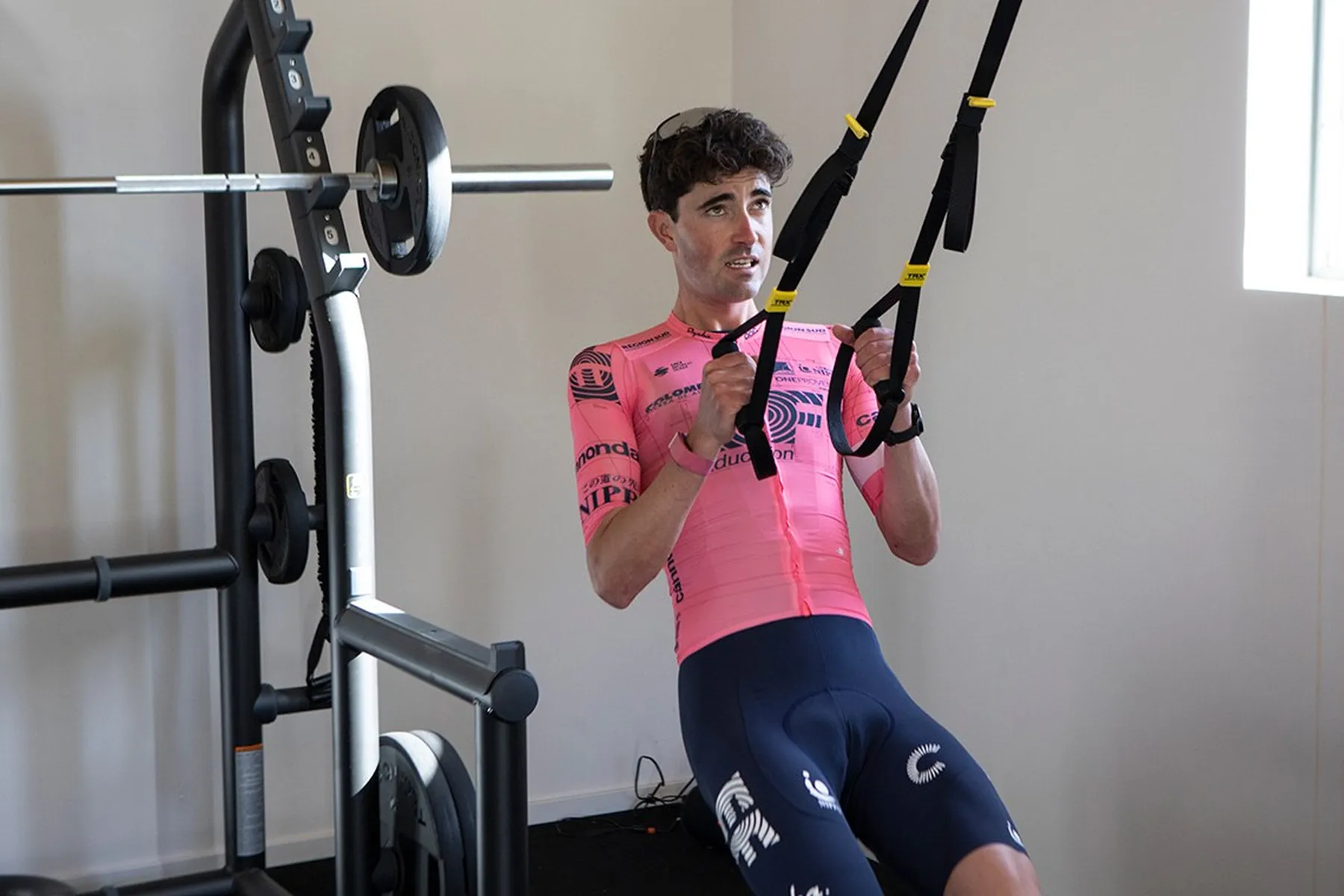
Cycling absolutely works the legs. It repeatedly loads the quadriceps, glutes and calf musculature in the exact position and rhythm required by the sport. But “does cycling count as leg day?” hides a second question: what do you need leg day to accomplish?
If the goal is sport-specific endurance, riding is the most specific work. If the goal is greater maximal strength, progressively loaded resistance training supplies a different stimulus. If the goal is bone health, rehabilitation or general muscle-strengthening activity, the answer needs yet another evidence base.
The answer in 30 seconds
| Question | Evidence-bounded answer |
|---|---|
| Does cycling train the legs? | Yes. It is highly specific repeated-force and endurance work for cycling. |
| Does cycling replace progressive resistance training? | Not when greater external-force capacity is the goal. The two modes overlap but are not identical. |
| Does every cyclist need a gym leg day? | No universal rule. Goals, training history, health, equipment and recoverability change the answer. |
| Best exercises? | No review ranks one mandatory list. Cover useful movement patterns with suitable variants. |
| Can I ride after leg day? | Often, but protect priority rides and adjust from actual recovery. There is no universal waiting period. |
| How many sessions? | The latest cyclist review included 1–3 per week and did not establish an optimal frequency. |
Does cycling count as leg day?
It counts as cycling-specific leg training. The force is repeated thousands of times, constrained by the bike and usually well below the maximum force a rider can produce in a gym movement. That is exactly why riding develops cycling skill, endurance and sport-specific force repeatability so effectively.
Progressive resistance training asks the muscles and nervous system to solve a different task: produce force against an external load that can be increased over time. The overlap is real, but neither mode makes the other biologically identical.
For general health, the World Health Organization recommends muscle-strengthening activity involving the major muscle groups on two or more days per week. That is a public-health recommendation, not proof that every cyclist needs the same two-day performance programme.
For road-cyclist bone health, riding should not be sold as a complete weight-bearing stimulus. Use the strength training for cyclists guide for the separate performance, health and masters evidence boundaries.
What the cyclist evidence actually shows
The newest cyclist-only systematic review and meta-analysis included 17 controlled studies and 262 adult endurance cyclists, including 60 women. Programmes lasted 5–25 weeks, used one to three sessions per week and met the review's definition of heavy strength training: at least 80% of one-repetition maximum (PMID 40632222).
Compared with cycling-only controls, the pooled results significantly favoured strength training for:
- cycling efficiency;
- anaerobic power; and
- cycling performance, combining time-trial and time-to-exhaustion outcomes.
The review did not find significant pooled effects for VO2max, power at VO2max, maximal metabolic steady state or anaerobic capacity. It also found no significant moderator for session frequency, programme duration or total sessions. The authors graded the evidence as low certainty and said it could not support robust recommendations about optimal implementation.
That is enough to treat strength work as a useful performance tool. It is not enough to declare one perfect leg day.
Best leg exercises for cyclists
The research supports programmes, not an internet ranking of named lifts. Start with movement patterns and choose the version that fits the rider.
| Pattern | Possible exercises | Selection question |
|---|---|---|
| Knee-dominant | Goblet squat, split squat, step-up, leg press | Which version can the rider control and progressively load? |
| Hip-dominant | Romanian deadlift, trap-bar deadlift, hip thrust, machine hinge | Which version develops force without unwanted joint or technical limitation? |
| Single-leg | Split squat, step-up, supported single-leg hinge | Does unilateral work reveal a useful capacity or control need? |
| Calf and ankle | Standing or seated calf raise | Is lower-leg strength relevant to the rider's wider programme or health needs? |
| Trunk and upper body | Carry, row, press, side plank, Pallof press | What supports whole-body strength and riding-position tolerance? |
A split squat is not automatically superior because pedalling alternates between legs. A machine is not automatically inferior because it looks less like cycling. Visual similarity is not outcome evidence. The best variant is one the rider can perform, progress and recover from consistently.
Use the gym exercises for cyclists guide for a fuller exercise-selection framework and adaptable A/B sessions.
A practical leg-day starting framework
This is a Roadman starting framework, not the protocol proven by the meta-analysis.
- Choose one knee-dominant exercise.
- Choose one hip-dominant exercise.
- Add one single-leg or calf movement only if it serves a clear need.
- Use two or three controlled work sets per movement.
- Finish sets with sound technique and repetitions available.
- Add load, repetitions or a set gradually—not all three at once.
Beginners should spend the first weeks learning the movements and finding a recoverable dose. “Heavy” in a research eligibility definition is not an instruction to test an untrained rider's one-repetition maximum on day one.
Can you cycle after leg day?
Often, yes. But the useful answer depends on the ride and the lifting dose.
An easy spin after familiar, low-volume strength work is a different problem from threshold intervals after a novel high-volume session. The most defensible rule is to protect the session that matters most.
- If the bike session is the week's priority, ride first or place the strength work far enough away that cycling quality remains intact.
- If strength is the block's priority, lift fresh or separate it from demanding endurance work.
- If both occur on one day, keep the next day easy and check whether both sessions remain productive.
- Do not introduce a new exercise, much more volume or training to failure immediately before a race, key interval or long ride.
A 2026 umbrella review of 17 concurrent-training meta-analyses found that combining endurance and resistance training can improve both qualities in recreationally trained people. It did not identify a decisive universal sequence effect, although resistance-first trends sometimes favoured strength-related outcomes; evidence in highly trained and elite athletes remained scarce (PMID 41762427).
That does not prove a 24-, 48- or 72-hour law for cyclists. Use the planned quality of the next ride, soreness, symptoms and recovery as the feedback loop.
Do cyclists need to train to failure?
No. A 2026 systematic review and meta-analysis of 20 studies and 556 healthy adults found non-failure training as effective as failure training for most measured adaptations and slightly better for dynamic strength (PMID 42410632). It was not a cyclist-specific review, so it cannot prescribe the perfect repetitions-in-reserve target for cyclists.
It does support a useful boundary: grinding every set until technique fails is not required. When strength work sits beside interval training and long rides, unnecessary fatigue has a real opportunity cost.
Will leg day add bulk or slow you down?
Neither outcome is automatic. It is also inaccurate to promise that a particular repetition range cannot increase muscle mass.
In a small 25-week controlled study, nine elite cyclists who added heavy strength training improved several strength, power and cycling-performance measures and increased lower-body lean mass; neither that group nor the cycling-only control changed VO2max (PMID 24862305).
That study does not predict one rider's body-mass change. It shows why the honest claim is “monitor it,” not “it cannot happen.” Track body mass if power-to-weight matters, and track a cycling outcome rather than assuming a stronger lift automatically transferred.
How often should cyclists do leg day?
The cyclist meta-analysis included one to three sessions per week and found no significant frequency moderator. It did not establish that exactly two sessions is optimal, that one always maintains or that three is necessary off-season.
For many riders, two non-consecutive sessions can be a manageable starting hypothesis. One may be enough when cycling or racing load is high. The correct dose is the smallest one that develops the intended quality without repeatedly damaging priority riding, recovery or symptoms.
What to stop repeating
- “Cycling does not count as leg training.” It does—very specifically for cycling.
- “Cycling covers every useful strength stimulus.” The mode and goal still matter.
- “Three named exercises are mandatory.” No cyclist review established that list.
- “Six to ten reps cannot add mass.” Adaptations overlap and individuals differ.
- “Always wait exactly 48–72 hours.” No universal cyclist-specific rule was established.
- “Strength work prevents cycling injuries.” The performance meta-analysis did not test that claim.
- “More gym work is better.” The total programme decides whether a session is productive.
How to know whether your leg day is working
Set a baseline before the block:
- one or two repeatable strength measures;
- one cycling outcome connected to the rider's goal;
- completion and quality of priority rides;
- body mass if power-to-weight matters; and
- soreness, fatigue, pain and other recovery signals.
Reassess after a meaningful block. A stronger lift proves that the rider improved that lift. Cycling transfer requires a cycling result too.
If unexplained pain, rehabilitation, osteoporosis risk or another medical condition changes the decision, use appropriately qualified clinical support. This article is not an injury assessment or rehabilitation plan.
Which Roadman page should you use?
- Use this page for whether cycling counts as leg day and how to place it around riding.
- Use the gym exercises guide for exercise selection and an adaptable routine.
- Use the strength training guide for the broad evidence, effect sizes and periodisation boundary.
- Use the 12-week beginner plan for a progressive implementation framework.
- Use the strength research library to browse the wider cluster.
Keeping those jobs separate prevents a practical template from being mistaken for a universal evidence-based prescription.
Sources and review notes
- Heavy strength training in endurance cyclists: systematic review and meta-analysis (PMID 40632222)
- Concurrent training: umbrella review of meta-analyses (PMID 41762427)
- Failure versus non-failure resistance training: systematic review and meta-analysis (PMID 42410632)
- Heavy strength training in elite cyclists: 25-week controlled study (PMID 24862305)
- WHO guidelines on physical activity and sedentary behaviour
This page was reviewed on 26 August 2026. The review checked the cyclist-performance outcomes, evidence certainty, exercise-selection boundary, concurrent-training claims, training-to-failure claim and the distinction between cycling specificity, strength performance and general health.