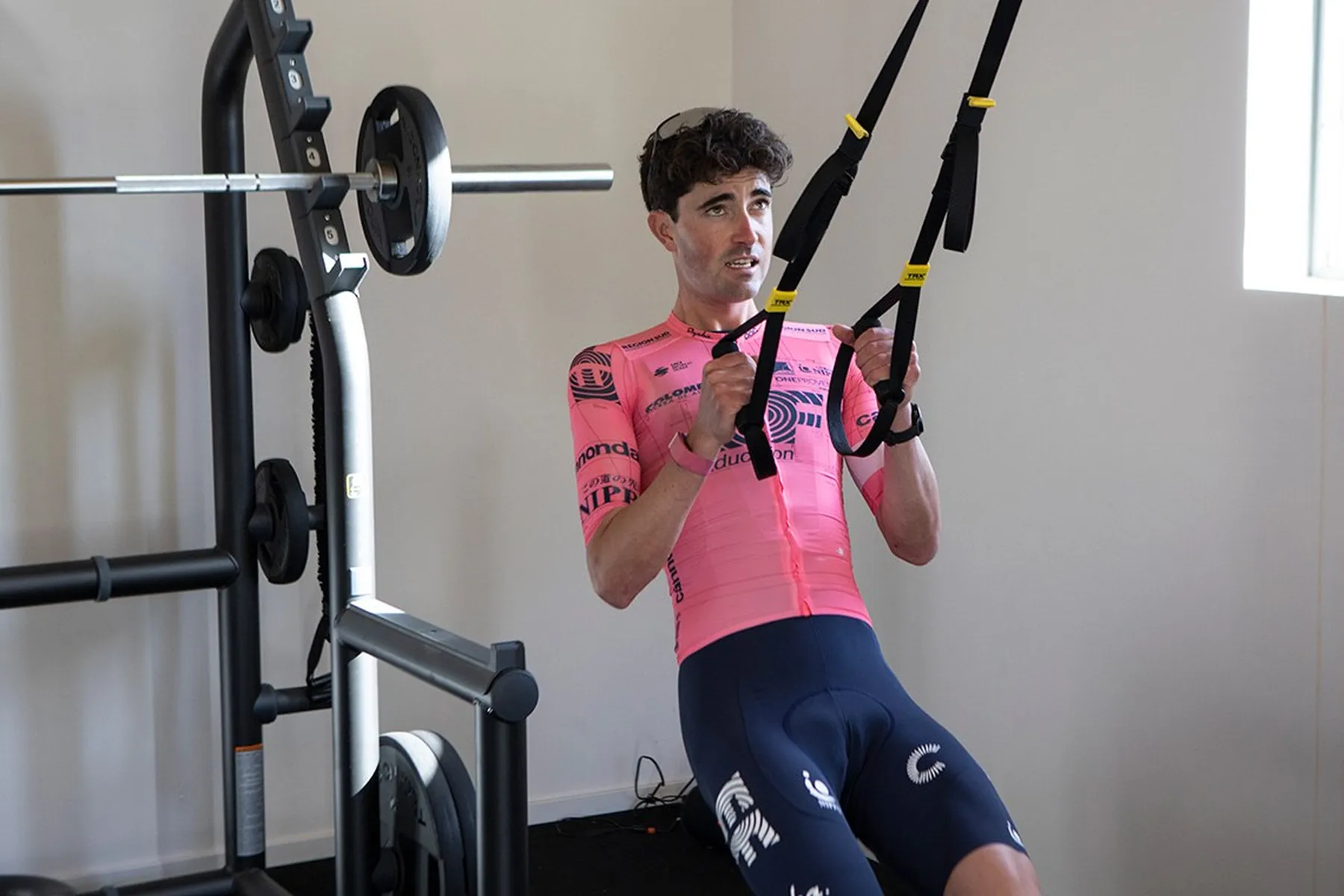
Stretching for cyclists is useful for one clear job: increasing range of motion when more range is actually needed. It is not proof that cycling has shortened a muscle, a guaranteed way to prevent injury, or a recovery treatment that every rider owes after every session.
That distinction matters. A rider who cannot comfortably reach the desired position may benefit from flexibility work. A rider with persistent back pain may instead need a load change, more trunk endurance, a bike-fit review or clinical assessment. Doing the same stretch harder does not separate those causes.
This guide gives you a practical 10-minute routine, then shows you how to decide whether it belongs before a ride, after a ride or outside the cycling week entirely.
The quick answer: when stretching helps
- Increase a restricted range of motion: repeat comfortable static holds and retest that range. The result does not prove the restriction caused pain or lost power.
- Prepare for intervals or racing: build from easy pedalling to event-specific intensity and add dynamic movement if useful. Long passive holds are not a complete warm-up.
- Feel less stiff after riding: stretch if it feels useful and does not provoke symptoms. It has not been shown to make soreness or strength recover faster.
- Prevent injury: progress training sensibly, build strength, recover and check fit. Flexibility alone does not determine all-cause injury risk.
- Solve persistent cycling pain: review symptoms, training load, strength and bike setup. One “tight” muscle is not a diagnosis.
A 2025 systematic review and meta-analysis covering 189 studies and 6,654 adults found moderate immediate and large longer-term improvements in flexibility from static stretching. Less-flexible participants tended to gain more. That supports stretching as a range-of-motion tool.
It does not establish that cyclists universally have shortened hip flexors, that stretching increases cycling power, or that every ache is a flexibility problem. Those outcomes require their own evidence.
The 10-minute stretching routine for cyclists
This is a screening routine and starting dose, not a declaration that every area below is tight. Use a mat or carpet, a strap or towel and a wall or doorway. Move to mild-to-moderate tension, breathe normally and never force a joint.
The timings total about ten minutes including side changes. The 30–45 second holds are a practical starting point, not a magic threshold.
The sequence is:
- Half-kneeling hip-flexor stretch — 40 seconds each side. Tuck the pelvis gently; do not create the range by arching the back.
- Supported hamstring stretch — 40 seconds each side. Use a strap while lying down; feel the muscle, not nerve-like tension behind the knee.
- Supine figure-four stretch — 40 seconds each side. Keep the head and pelvis supported; draw the thigh in only as far as comfortable.
- Standing or side-lying quad stretch — 40 seconds each side. Keep the knees close and the lower back quiet.
- Straight-knee then bent-knee calf stretch — 25 seconds in each position and on each side. Keep the heel down in both positions.
- Doorway chest stretch — 40 seconds each side. Turn the body slowly instead of pulling the shoulder forward.
- Open-book thoracic rotation — five slow repetitions each side. Let the upper back rotate while the knees remain supported.
1. Half-kneeling hip-flexor stretch
Kneel on one knee with the opposite foot forward. Lightly tuck the pelvis—as if bringing the belt buckle toward the ribs—before shifting the body forward. The sensation should be at the front of the kneeling-side hip, not a pinch in the groin or an arch in the lower back.
Hold about 40 seconds, change sides, then ask a useful question: did this improve a lunge, squat, walking stride or the comfort of the intended cycling position? The fact that a stretch feels strong does not prove it was necessary.
2. Supported hamstring stretch
Lie on your back with one leg supported on the floor. Loop a strap around the other foot and raise that leg with the knee comfortably straight. Keep the pelvis heavy and stop before the sensation becomes sharp, electrical or concentrated behind the knee.
This version avoids turning the drill into a toe-touch test or forcing the lower back into flexion. Hold about 40 seconds per side.
3. Supine figure-four stretch
Still lying down, cross one ankle over the opposite thigh and draw that thigh toward you. Keep the crossed foot relaxed and the pelvis level. Use about 40 seconds per side.
Full pigeon pose is not a badge of better mobility. The supported version makes the dose easier to control and is enough for a starting routine.
4. Quad stretch
Stand with one hand supported on a wall, or lie on your side. Bring the heel toward the same-side glute, keep the knees close and gently tuck the pelvis. Do not wrench the ankle or drive the knee into pain.
Hold about 40 seconds per side. A couch stretch can create more hip extension, but the deeper position is not automatically better.
5. Straight-knee and bent-knee calf stretch
Face a wall with one foot behind. Keep the back heel down and knee straight for about 25 seconds, then soften the knee for another 25 seconds. Repeat on the other side.
The two positions bias different parts of the calf complex. If ankle range is the specific limiter, the cycling ankle-mobility guide adds active control and strength rather than simply extending the hold.
6. Doorway chest stretch
Place the forearm on a doorway at a comfortable height and rotate the body away slowly. Keep the shoulder down and stop if the front of the joint feels pinched. Hold about 40 seconds per side.
This may feel useful after time on the hoods or at a desk, but it does not “reverse” posture or prove the chest has permanently shortened.
7. Open-book thoracic rotation
Lie on your side with hips and knees bent and both arms together in front. Open the top arm slowly while following the hand with your eyes. Keep the knees supported so most of the movement comes from the upper trunk. Complete five slow repetitions per side.
This is mobility rather than a static muscle hold. It belongs here because many riders want the routine to help them explore a position, not merely improve a passive flexibility score. The broader cycling mobility routine develops that active-control job.
How much stretching is enough?
The 2025 dose meta-analysis found that static-stretching gains were maximised at a cumulative four minutes per muscle group in a single session and about ten minutes per muscle group across a week, with no average benefit beyond those points. That is per muscle group, not ten minutes for the whole body.
Do not turn a research plateau into a minimum prescription. The studies combined different populations, methods and outcomes. A rider who needs a small change may improve with less; a rider who already has enough range needs none. Start with this routine two or three times weekly, choose the genuinely restricted areas, and reassess after four to six weeks.
Stretching intensity did not meaningfully change the average result in that review. More pain is therefore not a better dose.
Should cyclists stretch before riding?
Before a demanding ride, the priority is a progressive cycling warm-up: easy pedalling, gradual increases in cadence and power, then short efforts that resemble the session. The cycling warm-up guide gives the full sequence.
Static stretching is not absolutely forbidden before riding. A systematic review of 106 studies found no significant maximal-performance effect from holds under 60 seconds per muscle group, while longer holds of at least 60 seconds were more likely to reduce performance. A later review of performance, range and injury outcomes found the effect was small when shorter stretching was followed by dynamic activity.
Use this decision:
- If no restriction prevents the riding position, begin on the bike.
- If a short static hold helps access a required position, keep it brief and follow it with progressive pedalling.
- If the session begins with sprints, a time trial or maximal climbing, do not replace specific warm-up efforts with a long passive routine.
- If stretching reliably provokes symptoms, stop and investigate instead of trying to “open” the area harder.
Dynamic leg swings, hip circles and controlled lunges can be useful, but they are options rather than rituals. The warm-up must prepare the actual task.
Should cyclists stretch after riding?
After riding is a convenient time to train flexibility because the hard work is finished. It is not uniquely therapeutic. In a 2021 systematic review and meta-analysis, post-exercise stretching did not improve strength recovery or delayed-onset muscle soreness compared with passive recovery. The evidence base was small, heterogeneous and mostly male, so the responsible conclusion is not “stretching never helps”; it is that recovery promises are not supported.
Stretch after a ride if:
- flexibility is a defined training goal;
- the routine is comfortable and easy to repeat; or
- it helps you transition out of the riding position without delaying more important recovery work.
Skip it when it competes with sleep, food, hydration or an appropriate easy day. Stretching cannot rescue an overloaded training week.
Does stretching prevent cycling injuries?
Not on its own. The 2016 systematic review found no clear effect of static or PNF stretching on all-cause or overuse injuries. The US Physical Activity Guidelines likewise describe stretching as effective for flexibility while noting that its injury-risk effect is unclear.
For a cyclist, injury prevention is a wider system:
- increase volume and intensity progressively;
- maintain enough strength for the position and load;
- fuel and recover from the work;
- adjust equipment and bike fit when contact points or joint positions are wrong; and
- respond early to recurring symptoms.
The strength-training guide matters here because flexibility is not exclusive to stretching. A 2023 meta-analysis found that resistance training improved range of motion and did not differ significantly from stretch training in direct comparisons. A small 2024 controlled trial similarly found full-range resistance training improved sit-and-reach flexibility while producing greater strength gains than stretching.
The practical point is not that stretching should disappear. It is that strength through a useful range may solve more than one problem.
Stretching and cycling back pain
“Tight hip flexors cause cyclists’ back pain” is too simple. A systematic review of cyclists with and without low-back pain found associations involving lumbar flexion, back-extensor endurance and muscle-activation patterns. A newer bike-fitting review found promising reductions in pain or discomfort after individualised fitting, but only three studies qualified and protocols varied.
That evidence supports a combined decision:
- Check whether a specific movement is genuinely restricted.
- Review recent changes in volume, intensity and climbing.
- Assess whether trunk and hip strength can hold the position.
- Check saddle, reach and handlebar position with a qualified fitter when symptoms are position-dependent.
- Use a sports clinician when pain persists, worsens or changes character.
The cycling back-pain guide and bike-fit guide cover those paths. A stretch may belong in the plan; it is not the diagnosis.
Stop and seek appropriate assessment
This routine is for generally healthy, pain-free adults. Stop if a movement causes sharp pain, pins and needles, numbness, progressive weakness or pain travelling down a limb. Seek urgent medical assessment for severe back pain with new bladder or bowel changes, numbness around the genitals or anus, symptoms in both legs or rapidly progressive weakness, consistent with NICE referral guidance.
Persistent joint pain, repeated swelling, night pain, unexplained systemic symptoms or symptoms after significant trauma also deserve clinical assessment rather than a harder flexibility programme.
How to know whether the routine is working
Choose one outcome before starting:
- a measured joint range;
- a specific movement such as a controlled lunge;
- the ability to reach a riding position without compensation; or
- comfort in that position at a defined duration and intensity.
Repeat the same check after four to six consistent weeks. Record which drills you performed, their weekly dose and whether symptoms appeared. If the target improves, keep the smallest dose that maintains it. If nothing changes, reconsider whether flexibility was the limiter.
If stiffness or pain appeared after a training increase, use the Training Load Calculator to document the change rather than guessing. It can organise the workload question; it cannot diagnose the symptom.
That is the Roadman position: stretch for range, warm up for performance, build strength for control, and investigate pain instead of naming a tight muscle from a distance.
If you want mobility, strength and riding load organised around the same week, Roadman coaching integrates the decisions. For a personal question about a restriction or routine, Ask Roadman can point you to the relevant coach, physio and bike-fit conversations in the podcast archive.