Cycling over 50 is not a choice between training hard and surrendering to age. It is a question of dose. The body still adapts, but the cost of stacking stress faster than you can absorb it becomes harder to ignore.
The best evidence does not support one universal “masters plan”. It supports a smaller set of principles: maintain endurance-training continuity, retain an appropriate high-intensity stimulus, progressively train strength, eat enough protein and energy, and protect sleep. Your health, training age, recent workload and recovery response determine the weekly dose.
This page is the canonical Roadman guide for cycling over 50 training. The broader knowledge layer is the Masters Cycling hub; Joe Friel's named method remains a separate expert-led companion guide.
What Actually Changes After 50
Peak endurance performance and VO2max decline with age, even in highly trained athletes. The rate is not fixed. A longitudinal study of masters endurance athletes found a VO2max decline of about 5.5% per decade in athletes who kept training versus 12% in sedentary peers. A later review found far wider rates across masters-athlete studies and linked much of the variation to changes in training volume.
That distinction matters. You cannot train ageing away, but you can avoid adding avoidable detraining to it. A falling FTP after a disrupted year does not prove that your age caused the whole loss. Compare performance with training continuity, illness, energy intake, sleep and life stress before drawing the conclusion.
Muscle strength and power also deserve more attention. Cycling supplies thousands of low-load contractions, but it does not expose every major muscle group to the progressive resistance needed to preserve whole-body strength. That is why the strength-training layer belongs beside the bike rather than underneath it.
What Does Not Change
Training still works. A rider starting structured work at 52 can improve because training history matters as much as chronological age. Experienced riders can also improve a weakness even if their absolute lifetime peak is behind them.
The familiar principles still apply:
- hard work needs to be hard enough to create the intended stimulus;
- easy work needs to be easy enough to preserve the next key session;
- overload must be progressive rather than abrupt;
- adaptation requires adequate energy, protein and sleep;
- consistency beats a heroic week followed by ten compromised days.
The part that changes is how confidently you can assume recovery. Instead of prescribing 72 or 96 hours to everyone, use a starting structure and adjust it from evidence in your own training.
The Five-Part Framework
1. Protect Endurance Continuity
Keep most riding conversational and sustainable. Endurance volume supports the aerobic machinery that underpins long rides, recovery between efforts and repeatability. The exact hours are individual: six consistent hours can outperform a fragile ten-hour plan that repeatedly collapses.
Use the training-load calculator to watch trends, but do not chase a weekly score at the expense of sleep, fuelling or pain. A gradual build that survives real life is the target.
2. Retain Quality Without Chasing Frequency
For many trained over-50 riders, one or two quality bike sessions per week is a workable starting point. One might target VO2max with three-to-five-minute intervals; the other might develop threshold or event-specific durability. These are examples, not a diagnosis or mandatory prescription.
Start with one key session. Add the second only when the first is being absorbed: normal power at familiar perceived effort, stable motivation, manageable soreness and no persistent sleep disruption. If the second session repeatedly degrades, the plan has answered the question for you.
Set individual targets with the FTP test protocol and FTP zone calculator. A percentage is a starting point; breathing, perceived exertion and interval completion tell you whether the target belongs to you.
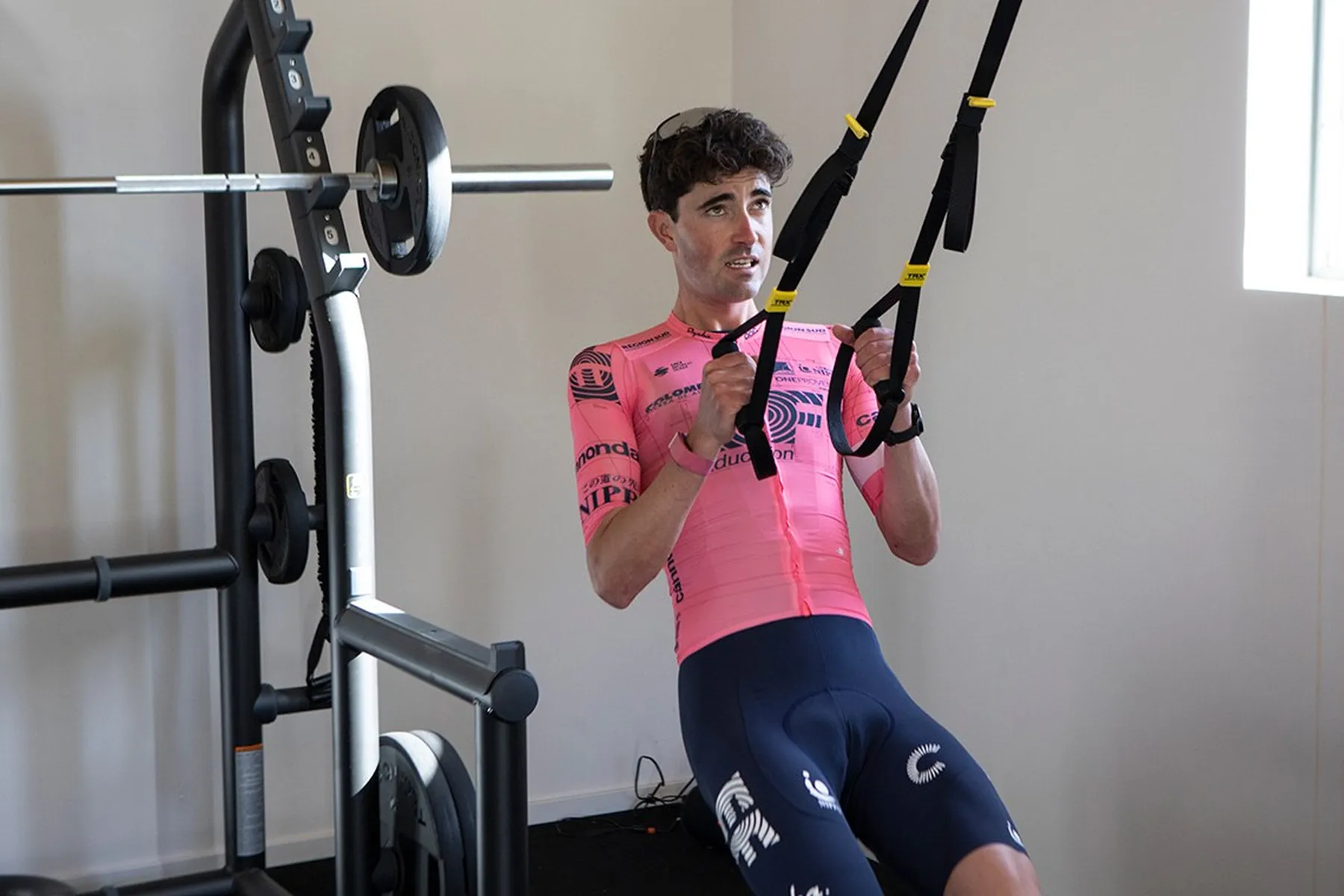
3. Strength Train At Least Twice Weekly
WHO guidance for older adults recommends muscle-strengthening activity for all major muscle groups on two or more days each week. The National Strength and Conditioning Association position statement also supports progressive resistance training as a strong countermeasure to age-related losses in strength, muscle and function.
A cyclist's programme can be simple:
- a squat or leg-press pattern;
- a hip hinge;
- a split squat or step-up;
- a horizontal pull;
- a press;
- calf and trunk work that addresses the rider's needs.
Technique and progression matter more than choosing a fashionable exercise. Leave several good repetitions in reserve while learning, add load or repetitions gradually, and use professional supervision when injury history or unfamiliar equipment makes that sensible. The strength guide for cyclists over 50 goes deeper on exercise selection and progression.
4. Eat Enough Protein—and Enough Energy
The best-supported protein target is more modest than the blanket 1.8-2.2g/kg figure previously published here. Reviews and consensus statements for active older adults commonly support at least 1.2g/kg/day, with roughly 1.2-1.6g/kg/day a practical range for many people.
For a 75kg rider, that is approximately 90-120g per day. Spread it across meals rather than saving nearly all of it for dinner. Total energy availability still matters: protein cannot compensate for chronic under-fuelling, and the right intake can change during a heavy block or deliberate weight-loss phase.
Higher is not automatically better. Health conditions, appetite, energy targets and clinician advice can change the appropriate number. Use the fuelling calculator for riding carbohydrate needs and treat protein as one part of the whole plan.
5. Make Recovery Observable
Adult sleep consensus recommends seven or more hours per night regularly. Many athletes need more, particularly during heavy training, but “eight hours minimum” is not a universal evidence-based rule.
Track a small set of useful signals:
- sleep opportunity and obvious disruption;
- resting heart rate or HRV trend, interpreted in context;
- muscle soreness and pain;
- motivation to train;
- power or pace at a familiar easy effort;
- whether key sessions are improving or quietly deteriorating.
No single wearable score decides the day. A cluster of worsening signals is a reason to reduce load, investigate the cause and use the masters recovery score as a conversation aid rather than an oracle.
A Sample Week for an Experienced Over-50 Cyclist
This is a template for an already-trained rider, not a beginner prescription:
| Day | Session | Purpose |
|---|---|---|
| Monday | Rest or 30 minutes very easy | Absorb the weekend |
| Tuesday | Key bike session | VO2max, threshold or event-specific work |
| Wednesday | Strength plus optional easy spin | Whole-body strength; low aerobic stress |
| Thursday | Endurance ride | Aerobic continuity at conversational intensity |
| Friday | Strength or rest | Second strength exposure, scaled to fatigue |
| Saturday | Long endurance ride | Durability and event specificity |
| Sunday | Second quality ride or endurance | Add quality only when the week is being absorbed |
The Sunday choice is the control point. If power, sleep and motivation are normal, use the second quality session. If not, ride easy or rest. A plan that changes intelligently is not a weaker plan.
For a complete progression rather than a sample week, start at Cycling Training Plans. Riders managing medication, cardiovascular symptoms, a recent diagnosis or a return after a long layoff should get individual clinical clearance and coaching rather than copying the table.
What the Evidence Cannot Tell You
Most masters-athlete research is observational, frequently studies unusually trained people and has fewer women than men. Results from elite lifelong athletes do not transfer perfectly to a rider who started at 48. Menopause, medication, chronic disease, previous injury and training history can materially change the response.
That is why this guide avoids promising a particular FTP, VO2max or recovery interval. The research defines useful boundaries. Your repeated response to training determines the programme inside them.
Stop exercise and seek appropriate medical care for chest pain, fainting, unexplained severe breathlessness, new palpitations with symptoms, or another acute warning sign. A persistent unexplained performance drop also deserves investigation rather than more intensity.
Primary Sources and Consensus Guidance
- Rogers et al. — longitudinal VO2max decline in masters athletes and sedentary men (PubMed)
- Valenzuela et al. — lifelong endurance exercise and age-related VO2max decline (PubMed)
- Burtscher et al. — training and cardiorespiratory-fitness loss in masters endurance athletes (PubMed)
- Fragala et al. — resistance training for older adults position statement (PubMed)
- WHO Guidelines on Physical Activity and Sedentary Behaviour
- PROT-AGE protein recommendations for older adults (PubMed)
- Review of protein intake and ageing muscle (PubMed)
- AASM/SRS adult sleep-duration consensus statement
The Roadman Decision
Do not train like a younger rider by default, and do not train like a fragile rider by default. Keep the work that makes you fitter, remove the work you cannot absorb, and make strength and recovery part of the programme rather than an afterthought.
The Masters Cycling hub connects this framework to racing, recovery, strength, nutrition and age-adjusted benchmarks. If you want the plan built around your calendar, training history and recovery capacity, online cycling coaching is the individual route.