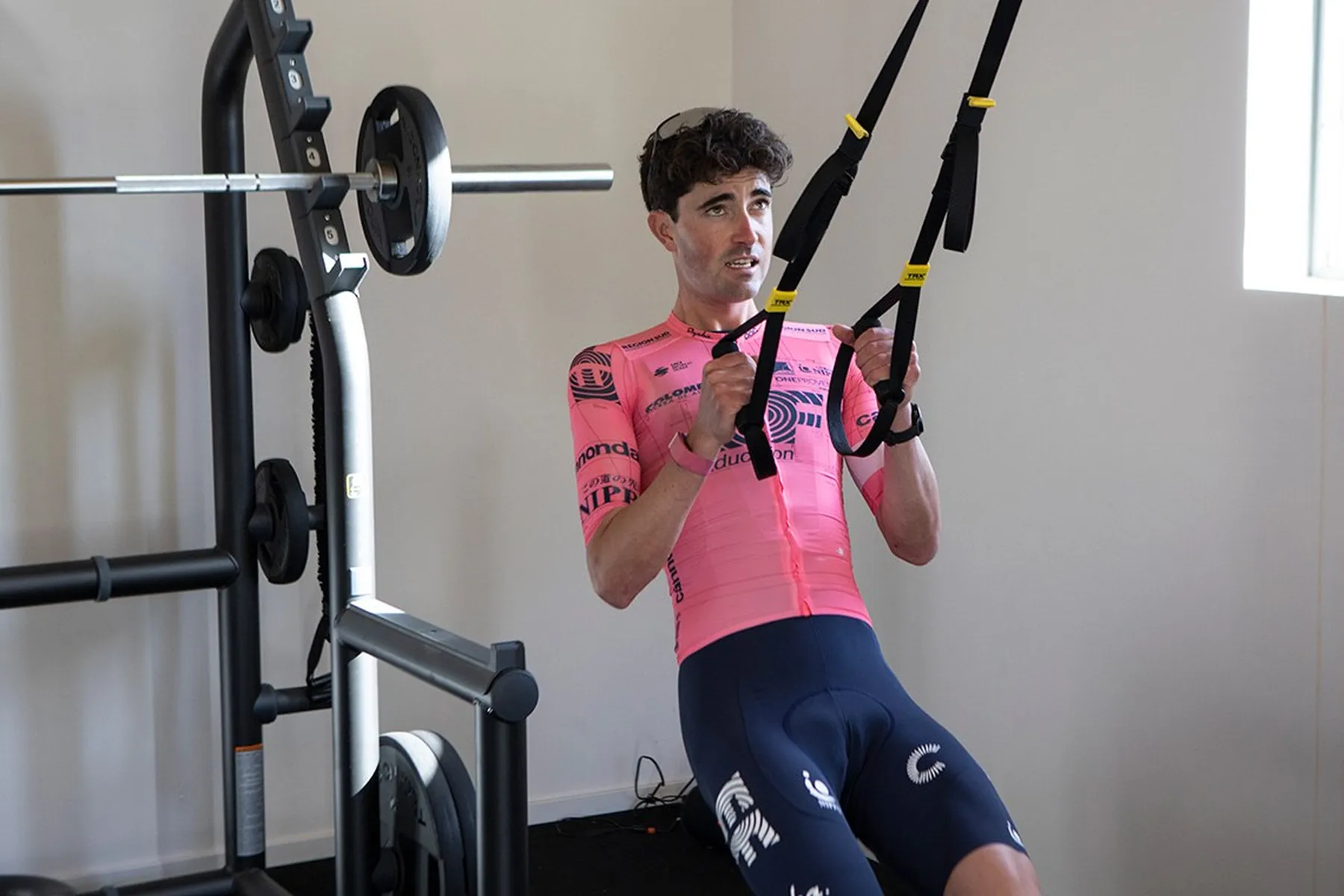
The amateur version of the cycling offseason looks like this. Three weeks of "I'll do something, just not riding." Some Strava rides creep back in around mid-November because the weather was alright. A vague intention to start strength training next week, every week, until late January. A sense that motivation has gone missing and that the spring will somehow reassemble itself.
The pro version of the same window looks completely different. Anthony lays it out on the podcast with Sarah without any of the usual filler. The pros take a real break. Then they run a structural reset on every system — physical, dental, blood, mental, zonal — that the season just spent eleven months degrading.
The reset is unsexy. It is also why the same problems keep showing up in the same amateur riders every spring.
Listen to the full conversation on the Roadman Cycling Podcast →
One: A Real Break (Not "Easy Spinning")
The first thing pros do, and the thing most amateurs cannot bring themselves to do, is a complete break from structured cycling. Anthony's standing recommendation lands at 10 to 21 days, with the upper end reserved for riders coming off long, fatiguing seasons. He took three weeks himself after Badlands. Sarah took something similar. Both lost some fitness. Both gained the freshness that made the next training block productive.
The framing matters. This is not "ease back into easy rides." This is no metrics, no scheduled rides, no checking TrainingPeaks for the day's session. Cognitive downtime is part of the prescription. The mental decompression of not having to wake up to a power file is doing as much work as the physical recovery.
Cross-training is allowed and encouraged. Quinn Simmons reportedly plays ice hockey in the offseason. Wout van Aert plays basketball in California. Hiking, walking the dog, swimming, yoga, going to a farmer's market — the things normal people do that bike racers forget about for nine months of the year — are all fair game. What is off the table is structured intervals and "just one tempo ride to keep my hand in." That defeats the purpose.
The structural argument is simple. Across a season you stack fitness and fatigue together — TrainingPeaks calls it the performance management chart, and you can see the pattern in your own numbers with our training load calculator. Fatigue resets faster than fitness. By taking a deliberate break, you shed the fatigue layer faster than you lose the fitness layer, and the spring rebuild starts from a cleaner base. Riders who refuse to take the break carry chronic fatigue into the new season and never quite reach their previous ceiling.
For the deeper version of this argument, see our winter training guide and the recovery week plan, both of which cover the same architecture from a different angle.
The hard part of the break is psychological. Cyclists become addicted to the endorphins, to the calorie permission ("if I ride, I can eat"), and to the identity. Three weeks of letting all of that go is uncomfortable for the first ten days. By day fifteen, the rest of your life starts coming back into focus. By day twenty-one, you actually want to get on the bike again — and the want is doing the work the obligation could not do.
Two: A Full Dental Check
This is the one most amateurs hear and dismiss. Then they remember the worst spring of their cycling life and realise it was the spring after the toothache they ignored for six months.
Mark Cavendish's 2010 winter was effectively destroyed by dental problems. He could not train through the pain, missed team training camps, and required mid-winter surgery. Going into Milan-San Remo as one of the favourites became a non-event because his preparation was shot. Since then, every serious World Tour team has mandated a full dental check during the offseason. It is one of the cheapest, lowest-friction interventions available to a serious athlete.
The mechanism is more interesting than the surface story. Dental issues elevate sympathetic nervous system load. They drive low-grade systemic inflammation. They wreck sleep architecture. All three of those crush training adaptations. The cyclist who is "training as hard as ever" but mysteriously not adapting may be running a chronic dental inflammation tax that no power file will detect.
The cycling-specific factor is sugar. Most amateur cyclists eat 60 to 90 grams of carbohydrate per hour during long rides — much of it in gel, drink, or Haribo form, which is direct sugar exposure to teeth that the dental industry was not built to model. The serious amateur runs a higher dental risk profile than a non-cyclist of the same age. Twice-yearly checks, with one of them landing in the offseason while life slows down, is the right cadence.
While you are at it, schedule the rest of the medical screen — the GP visit, the skin check, the prostate examination if you are over 50, the basic blood pressure pull. Anthony tells the story on the podcast of his own ignored skin lesion that turned out to be benign skin cancer requiring surgery and weeks off the bike. The window for this kind of admin closes when the season starts.
Three: A Full Blood Panel — Especially Iron
This is the underrated lever in the entire winter playbook. Anthony states it plainly. Iron deficiency is the easiest fix in cycling. He has seen riders add 150 watts to their threshold purely by correcting their iron status.
The mechanism is direct. Iron is required for haemoglobin synthesis. Haemoglobin transports oxygen in the blood. Insufficient iron means insufficient oxygen-carrying capacity, which means the engine your training has built simply cannot get the fuel it needs to fire at full output. You can be logging the right TSS, hitting the right intervals, eating the right macros, and still riding 50 watts under your real ceiling because your blood cannot move oxygen efficiently.
The symptoms — chronic fatigue, low motivation, low libido, sometimes the feeling of being mildly depressed — overlap with overtraining and burnout, which is why riders so often misdiagnose the problem. The conversation in the episode where Sarah describes her own iron crisis ("I was like, I think I'm depressed") and the doctor told her to go to hospital because her iron was so low she could pass out, is the kind of thing that should make every endurance athlete book bloods this winter.
What to ask for depends on the clinical question. A clinician may consider a full blood count, ferritin and other iron indices, vitamin D or B12 when symptoms and risk justify them. Testosterone testing is not a default annual athlete panel; the cycling and testosterone guide explains when repeat morning testing, free testosterone and anti-doping rules matter.
Treat any deficiencies in autumn so that the supplementation has time to work before spring training. The cyclist who fixes a moderate iron deficiency in November is a different athlete by March. The cyclist who ignores it through another winter is the cyclist still confused about why the same training plan is not delivering.
Four: An Honest Season Review And Goal Set
This is where most amateur cyclists do least well, and it is where pros and their coaches spend most of their winter strategic energy.
The structure Anthony walks through on the podcast is simple. Sit down. Write three columns. Wins, gaps, and habits.
Wins. Not just results — though list those if they exist. The point is to capture the habits that produced the wins. A consistency streak. A new skill set. A specific process you executed well in the run-up to a target event. The result is the visible part. The habits are the data.
Gaps. Where did the season fall short of what you wanted? The temptation is to attribute every gap to "fitness" — to assume more watts solve everything. Anthony is sharp on this. The actual diagnosis usually splits into three buckets. Was it fitness? Was it skill — descending, positioning, pacing, fuelling under fatigue? Was it adaptation — were you doing the right work but not letting it absorb? The most common gap he sees is the third one. Riders pushing 12 hours a week as a working parent and accumulating fatigue rather than fitness. The fix in that case is fewer hours, better adaptation, not more hours.
Habits. What did your week actually look like during the parts of the season that worked? What did it look like during the parts that didn't? The habits are the lever you can actually move.
Goal setting comes after this honest review, not before it. Anthony separates outcome goals (top 10 at a target event) from performance goals (a specific watt number) from process goals (the actual weekly behaviour that gets you there). His preference is to anchor a season with one or two directional outcome goals — a target event, an event category — and then forget about them and execute on process. The outcome takes care of itself when the process is sound.
A goal that "terrifies you in the calendar a couple of months away" is, in Sarah's framing, the kind of goal that gets you out of bed for a structured winter. Choose carefully. Pick events that align with your real strengths and weaknesses — Sarah's flatter result at The Rift was a stronger fit than her hillier Badlands result for the same body type. Use AI as a brainstorming assistant if you want; throw your wins, gaps, and current strengths into a model and ask for opportunity analysis. The technology has caught up to this part of the work.
Five: Reset Zones — Without The Lab Stress
The fifth thing pros do, the way the modern best ones do it, is reset their training zones without the theatre of a lab VO2 max test.
Anthony is sharp on this. Lab tests have value but the data quality is often compromised by what he calls lab anxiety. You are wearing a mask. Strangers are prodding your fingers. Your heart rate is elevated before you start. You are building the test up as an event. The number that comes out the other side is contaminated by the conditions in which it was generated.
His preferred protocol is more boring and more useful. Take the 10 to 21 day break. Ride structure back into the body for two to three weeks. Then test. The number you get is representative of where you actually are, not where you are after three weeks of hammock time. Those weeks of structure mostly land on the trainer in winter, and if the plan is built in TrainingPeaks, TrainingPeaks Virtual runs the prescribed session indoors with the week synced across — you clip in and the day's intervals are already loaded, no setup between you and the work.
The test itself, in his current model, is either a critical-power retest using a vector model (which has built-in adaptation based on previous sessions), or the old-school 20-minute Joe Friel test if you prefer the simplicity. Both are honest. Both give you a zone reset that can hold for the first major training block — run the result through our FTP zone calculator and your winter structure is set. New athletes who don't have a baseline are the exception — for those, immediate testing is fine because there is no historical data to anchor against.
He references Olaf Buu — coach to Kristian Blummenfelt and Gustav Iden — on lactate testing. Buu's view, and Anthony shares it, is that lactate tests are extremely easy to contaminate. A bad upstream data point becomes a cascade of bad downstream data points — misjudged training load, misjudged fatigue, misjudged recovery. If the world's best triathlon coaches are not running them, the working amateur cyclist almost certainly does not need to either.
The Sixth Thing The Pros Do (And Most Amateurs Skip)
The episode's title says five things, and Anthony lists strength and conditioning as the segment after testing. The unvarnished version is that strength is the work the offseason makes possible, and the work amateurs skip the most. Pros build it in winter when the riding load drops and the gym hours can stack. Amateurs intend to start strength training "in January" every year and arrive at March having done two sessions.
The fix is to schedule the strength work during the winter break itself, when the rides are off the calendar and the time is actually there. Two cycling-specific strength sessions a week through November to February — split squats, hip hinges, single-leg deadlifts, hip thrusts, presses and core under controlled, meaningful loads — delivers the kind of muscular and connective tissue adaptation that no amount of summer riding can replace. Anthony admits to a rocky period himself — travel, podcast schedule, life. The work that compounds in winter does not compound the same way in spring.
For the structured version, see our strength training guide for cyclists, the strength training over 50 piece, and the reverse periodisation framework that builds sprint power into the early winter when the riding intensity is low.
What This Means For Your Winter
The pro winter is not exotic. It is just structural. Take a real break. Get the dental check. Pull the full bloods. Sit down with the season's data and write the unflinching review. Set process goals against directional outcomes. Reset zones with a sensible test, not a lab stress event. Commit to the strength work while the riding hours are low. Our complete off-season training guide walks through the full structure week by week.
None of this is glamorous. None of it produces an Instagram moment. None of it shows up in a power file the way a hard interval session does. All of it compounds. By the time the spring brings light and warmth back into the schedule, the cyclist who ran the playbook is a different rider from the cyclist who watched four months of weather and kept "intending" to start.
If you want help structuring a winter that hits each of these levers without overengineering it, the Roadman coaching system is built around exactly this kind of seasonal architecture — and TrainingPeaks remains the structured-training partner the system runs on. For a fast answer on your specific winter — duration of break, how to interpret a blood panel, how to set goals for next season — ask the AI coach.
The pros do the unsexy stuff because it works. That is the whole secret. Spring is decided in November.
Listen To The Full Episode
The full conversation, with the full discussion of bike fit, strength and conditioning, and Anthony's own story of ignoring a skin cancer scab for eighteen months, is on the Roadman Cycling Podcast. For more on the structural offseason, see Jonas Abrahamsen's pro winter and the rider-support winter tips episode.
The cyclists you envy in the spring are the ones who took November and December seriously. That is the entire game.