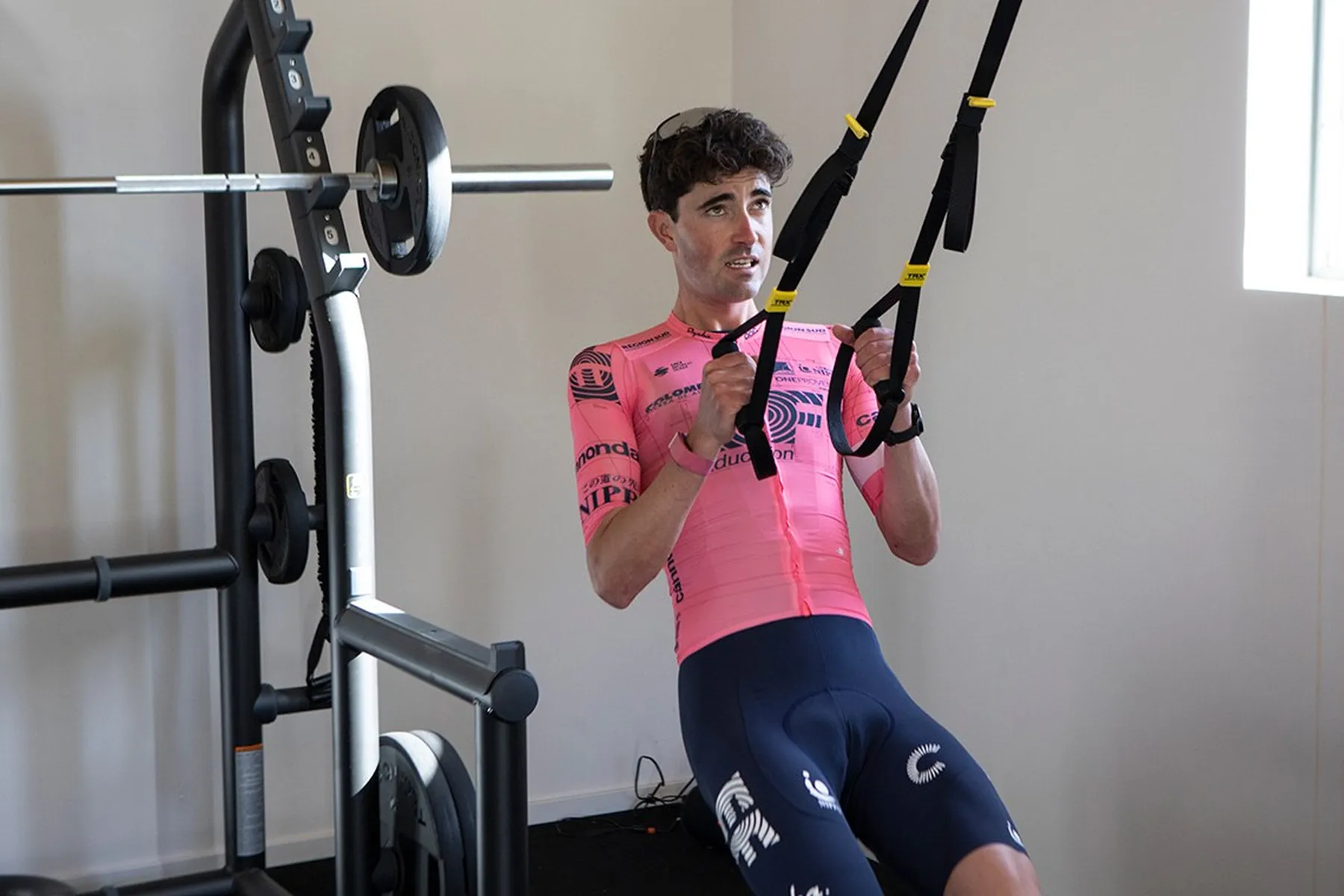
Open Instagram and search "hybrid athlete." You'll find a wall of 28-year-olds who deadlift before breakfast and run a sub-40 10K after lunch, telling you that you too can do both. The training content behind it comes almost entirely from gym brands — programmes written by lifters, for lifters, with some running stapled on.
None of it is written for you. None of it accounts for a 47-year-old body with a mortgage-holder's stress load, a desk job, and recovery that takes visibly longer than it did at 25. And almost none of it starts from where you actually are: an endurance athlete with a big aerobic engine who wants to add strength and impact, not a lifter trying to survive a 5K.
That's a gap worth filling, because the underlying idea is good. Done properly, the run-ride-lift combination is arguably the single best training structure for an athlete between 40 and 60. Done the way the gym content tells you to do it, it's a fast route to a calf tear.
This is the endurance-first version.
What "hybrid" means when you're 45, not 25
Strip away the branding and a hybrid athlete is someone who trains strength and endurance concurrently and cares about being competent at both. Sports science has studied this for decades under a less marketable name — concurrent training — and the research goes back to Robert Hickson's 1980 study showing that endurance work can blunt strength gains. That blunting became known as the interference effect, and it's the reason lifters treat cardio with suspicion.
Here's what nobody in the hybrid content tells you: the interference effect mostly runs one way, and as a cyclist you're on the right side of it.
A 2012 meta-analysis by Jacob Wilson and colleagues in the Journal of Strength and Conditioning Research pooled the concurrent training literature and split the results by modality. Cycling alongside strength training caused minimal interference with muscle growth and strength development. Running caused significant decrements to both. The mechanism is the eccentric loading — every running stride forces muscles to lengthen under load, generating muscle damage that cycling's concentric-only pedal stroke simply doesn't produce.
Read that again from a cyclist's perspective. The lifters trying to become hybrid athletes are fighting their cardio. Your cardio is the friendly kind. You already own the hardest part of the stack — a big aerobic base built on the modality that interferes least with everything else. You're not starting a hybrid build from scratch. You're two-thirds of the way there.
What you're missing is the other two pieces. And after 40, those two pieces stop being optional.
The three declines — and why this stack answers all of them
Between 40 and 60, three things are quietly falling.
Muscle. Skeletal muscle mass declines roughly 3 to 8 percent per decade after 30, and the rate accelerates past 60. Worse, the loss is selective — fast-twitch fibres shrink first and fastest, which is why masters riders notice the sprint and the punchy accelerations disappear years before the steady-state power does. Endurance riding does almost nothing to stop this. Zone 2 preserves your mitochondria, not your type II fibres.
Bone. Cycling is a non-impact sport, and the skeleton adapts to exactly the load you give it. A systematic review pooling 31 studies found that 84 percent of cyclists met the criteria for osteopenia or osteoporosis, against 50 percent of matched non-athletes. Cyclists were seven times more likely than runners to have osteopenia of the spine. The full picture is in the bone density piece, but the short version is uncomfortable: decades of riding can leave you aerobically exceptional and skeletally fragile.
Hormones. Testosterone declines around 1 percent per year from roughly 40 onward — the Baltimore Longitudinal Study of Aging put numbers on this back in 2001. You can't stop that curve, but resistance training and adequate recovery are the two most reliable natural levers for supporting what remains, while chronic high-volume endurance work with poor fuelling pushes the wrong way.
Now look at what the run-ride-lift structure actually does. Riding maintains the aerobic engine at near-zero orthopaedic cost. Running delivers the impact that signals bone to rebuild — and does it in 30-minute doses. Strength work preserves the fast-twitch muscle and tendon stiffness that riding ignores. Three declines, three tools, one week.
Joe Friel — who has been on the podcast, and whose Fast After 50 remains the reference text for masters endurance training — makes the case that ageing athletes decline at half the rate of ageing non-athletes largely because they keep doing two things: they keep some intensity in the week, and they keep lifting. The athletes who fade fastest are the ones who let both slide and drift into a diet of exclusively long, slow miles.
The week: 7 to 9 hours, three sports, no heroics
Here's the structure I'd give a 45-year-old cyclist adding running and strength. It's deliberately conservative, because the failure mode of hybrid training is never "not enough stimulus" — it's three ambitious programmes stacked on one recovery budget.
| Day | Session | Duration | Intent |
|---|---|---|---|
| Monday | Strength 1 | 45 min | Lower body focus, single-leg work |
| Tuesday | Ride — quality | 60–75 min | Intervals: torque work, threshold, or VO2 |
| Wednesday | Run — easy | 30 min | Conversational, Zone 2, nothing more |
| Thursday | Ride — easy | 60–90 min | Genuine Zone 2 |
| Friday | Strength 2 | 45 min | Calf and tendon loading, plyometric progression |
| Saturday | Ride — long, easy | 2–3 hr | Aerobic base, café stop permitted |
| Sunday | Run — easy | 30–40 min | Or full rest in a heavy week |
Total: somewhere between seven and nine hours. Notice the distribution of intensity. One quality session on the bike. Everything else easy. That's not timidity — it's the same 80/20 intensity split Stephen Seiler documented in elite endurance athletes, applied across three sports instead of one. The polarised model doesn't stop working because you added a squat rack and a pair of running shoes. If anything it matters more, because your recovery is now the scarcest resource in the system.
Both runs stay easy for at least the first 12 weeks. Cardiovascular fitness transfers between cycling and running — the Menges 2026 systematic review in Frontiers in Sports and Active Living confirmed meaningful VO2max transfer in both directions (you can benchmark yours with the VO2max estimator) — but tendons, bones, and calves don't get the memo. Your engine will tell you the run is trivial. Your Achilles is on a different adaptation timeline, roughly measured in months. Once you're through that window, one run per week can carry strides or short hills. Not before. If you're building the running from zero, the cross-training guide covers the on-ramp in detail.
Getting the order right
With three disciplines in one week, what you do matters less than what you put next to it. A few sequencing rules carry most of the value.
Hard things go next to hard things. This sounds backwards, but it's how concurrent training research says to protect recovery: consolidate stress, then recover properly. If you have to stack, pair the quality ride and a strength session on the same day — quality ride in the morning, weights in the evening, six hours or more between them — and keep the following day properly easy. Six hours is roughly what the molecular signalling needs; endurance work switches on one adaptive pathway, strength work another, and back-to-back within the hour they compete for the same machinery.
Ride before you lift, on the days they share. The interval session needs fresh legs to hit its numbers; the strength session tolerates pre-fatigue far better. Lift first and Tuesday's torque intervals become a negotiation.
Never run the morning after plyometrics. Both load the Achilles and calf hard. Give that tissue a full day — it's the one pairing in the template above that has no safe shortcut.
Protect the day before the quality ride. It should hold nothing more taxing than an easy run or easy spin. One properly hard session per week only earns its keep if you arrive at it able to actually go hard.
If your week collapses — travel, work, sick kids — shrink sessions before you cut them. A 20-minute run still loads bone. Thirty minutes with dumbbells still signals muscle. The minimum viable hybrid week is about five hours; consistency at five beats perfection at nine.
How to know it's working
Hybrid training progress is easy to misread, because no single number captures it. Track four things.
Your FTP holds. Not grows — holds, within a few percent, on two fewer riding hours than before. That's the trade succeeding: you've bought bone, muscle, and durability at near-zero cost to the engine. If you haven't tested recently, the FTP test protocol gives you a clean baseline to track against.
Run heart rate drifts down. Same easy route, same pace, and over eight to twelve weeks the average heart rate slides five to ten beats lower. That's running economy arriving.
The strength numbers creep. Heavier dumbbells on the split squats, single-leg calf raises where double-leg used to live, box jumps that feel springy rather than survived. Write them down; drift is invisible without a log.
You recover on schedule. Morning resting heart rate steady, legs available when the plan asks for them. For the over-40 athlete this is the master metric — the moment recovery starts lagging chronically, subtract a session before your body subtracts three.
And if you want the bone answer in hard numbers, a DEXA scan costs $100–200 and takes ten minutes. One now, one in eighteen months. For a lifelong cyclist, watching that number move the right way is worth more motivation than any FTP test.
Strength that won't put you in a physio's waiting room
This is where the endurance-first version splits hardest from the gym-brand version. Their programmes are built around heavy barbell lifts, because their audience already lifts and their coaches sell lifting. For a 35-to-55-year-old whose spine spends fifty hours a week folded over a desk and a handlebar, loading a bar across your back chases small returns with a long injury tail.
You don't need it. Cycling and running are single-leg sports — you never push with both legs at once — and single-leg strength work matches that reality while sidestepping the spinal loading entirely.
Build the two weekly sessions from this menu:
Session 1 — strength and stability. Bulgarian split squats — rear foot up on a bench, dumbbells in hand — 3 sets of 6–8 per leg. Step-ups onto a knee-height box, loaded, 3 sets of 8 per leg. Single-leg Romanian deadlifts with a dumbbell, 3 sets of 8 per leg — this one earns its place twice over, training the hamstrings and the single-leg balance that running demands. Banded lateral walks and single-leg glute bridges to finish, because the glute medius stabilises every running stride and cycling never trains it.
Session 2 — tendon and elasticity. Heavy loaded calf raises, both straight-knee and bent-knee versions, 3 sets of 8–10 — slow on the way down. The calf-Achilles complex absorbs the largest loads in running and is the most common failure point in cyclists who take it up. Nordic hamstring curls, 2–3 sets of 4–6: a 2019 meta-analysis in the British Journal of Sports Medicine found Nordic-based programmes roughly halved hamstring injury rates in athletes. Then the plyometric progression — and progression is the operative word. Weeks 1–4: A-skips and low pogo hops. Weeks 5–8: low box jumps, stepping down, never rebounding. Weeks 9 onward: bounding and depth drops if everything upstream feels solid. Plyometrics are the closest thing masters athletes have to a fast-twitch preservation drug, but jumped into cold they're also the fastest way to meet your Achilles personally.
Forty-five minutes, twice a week, year-round. The complete strength guide for cyclists goes deeper on progression and set schemes, but that menu covers 90 percent of what a hybrid masters athlete needs.
Recovery is the fourth discipline
At 25, recovery is something that happens to you overnight. At 45, it's something you schedule.
Friel's masters principle is blunt: the training that works at 50 is mostly the same training that works at 30 — what changes is the spacing. So space it. Never stack the three hardest sessions of the week on consecutive days; in the template above, the quality ride, the plyometric session, and the long ride all have soft days around them. Take a genuine down-week every fourth week, cutting volume by 40 percent and keeping just enough intensity to stay sharp. And treat sleep as a session: the difference between six and eight hours is the difference between absorbing this week and merely surviving it.
Protein matters more now too. The ageing body is less responsive to the muscle-building signal of each meal — researchers call it anabolic resistance — so the target moves up: 1.6 to 2.2 grams per kilogram of body weight per day, spread across the day rather than backloaded into dinner. Most amateur endurance athletes eat roughly half that and wonder why the strength work isn't showing.
The three ways masters hybrid athletes break
They race every run. The engine writes cheques the calves can't cash. A cyclist's cardiovascular system makes 5:30-per-kilometre pace feel insultingly easy, so they run 4:45s in week two and tear something in week five. Pace by breathing, not by pride.
They let all three sports have a hard day. A threshold ride Tuesday, a tempo run Wednesday, heavy legs Thursday — each session defensible alone, the week indefensible together. One quality session per week across all modalities to start. Earn the second one over months.
They copy programmes written for 25-year-olds. Five lifting days plus five runs plus weekend rides works fine when you're 26 with no kids and cortisol levels of a house cat. The over-40 version wins by being repeatable — the athlete who does seven modest hours every week for three years beats the one who does fourteen heroic hours until February.
Where this leaves you
The hybrid athlete idea deserves better than the content selling it. For a cyclist in their forties or fifties, run-ride-lift isn't a trend to chase — it's close to the exact prescription for the three things ageing takes first. You already have the engine, and yours is the modality that plays nicest with everything else.
Start smaller than feels necessary. Two strength sessions from the menu above. Two easy runs that feel like a waste of your fitness — they aren't; they're a deposit in a bone and tendon account that pays out over decades. Keep the bike as your base and your quality. Hold that for twelve weeks before adding anything.
If you're already riding well but want the fuller picture on staying fast as the birthdays stack up, the guide to getting faster after 40 is the companion piece. The window isn't closing. You're just changing what you train through it.