THE FULL CATALOGUE
960 articles across 20 pages
CYCLING TRAINING CAMP: WHAT TO EXPECT ON YOUR FIRST WEEK
A first cycling camp should not be a mystery or an FTP test. Compare the route load, pace policy, support, meals, bike logistics and insurance before you book.

WHY GIRONA IS THE BEST PLACE IN EUROPE TO TRAIN ON A BIKE
Mallorca has the marketing budget. Tenerife has the altitude. Calpe has the cheap flights. Girona has the entire World Tour quietly living within ten kilometres of the cathedral. Here is why most pros, given the choice, pick this one.

THE 2026 GIRO D'ITALIA: 3 STAGES AND 3 RIDERS THAT WILL DECIDE THE PINK JERSEY
The 109th Giro d'Italia starts Friday in Bulgaria. Here are the three stages and three riders that will decide the pink jersey.
AEROBIC DECOUPLING EXPLAINED: THE CARDIAC DRIFT NUMBER THAT TELLS YOU IF YOUR BASE IS REAL
Heart rate climbing while power stays flat — that's not just heat or fatigue. It's a number called aerobic decoupling, and once you know how to read it, it tells you whether your base is real or whether you've just been counting hours.
CYCLING CADENCE BY AGE: WHAT CHANGES AFTER 40?
Age does not create a magic cadence number. This masters guide replaces the old “spin 5–10 rpm faster” rule with evidence, a practical test and clear limits.
EFFICIENCY FACTOR FOR MASTERS CYCLISTS: THE SINGLE NUMBER THAT TELLS YOU IF YOUR AEROBIC BASE IS IMPROVING
Most cyclists chase FTP. Efficiency Factor is the metric that quietly tells you whether the work you're doing is actually building anything underneath it. For masters cyclists, it's the most useful single number on the head unit.
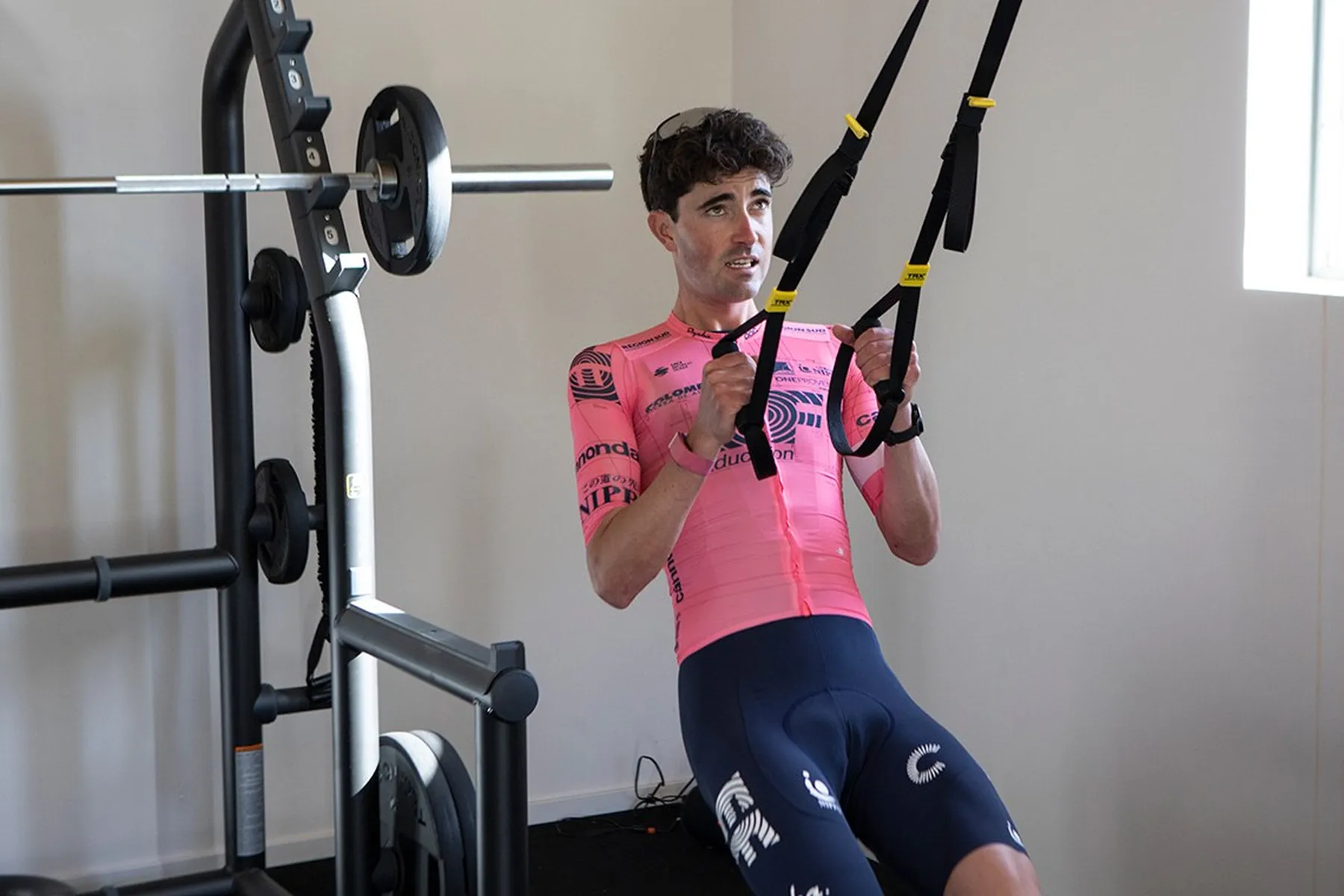
CYCLING GLUTES: 5 ACTIVATION AND STRENGTH EXERCISES
Your glutes already work when you pedal. This guide shows how to warm them up, strengthen hip extension and lateral hip capacity, and avoid the switched-off-glute tests and watt promises the evidence does not support.
IRON DEFICIENCY IN CYCLISTS: SYMPTOMS, FERRITIN AND TREATMENT
Iron deficiency can impair health and endurance performance, but heavy legs and a low-normal ferritin result are not a self-diagnosis. Use symptoms, risk, a complete iron assessment and qualified follow-up to find the cause and the right treatment.
LACTATE THRESHOLD TEST AT HOME: HOW CYCLISTS CAN FIND LT1 AND LT2 WITHOUT A LAB
FTP is a single number for a single hour. Lactate threshold gives you two numbers that tell you exactly where to ride for every session of the week. Once the only people doing this were World Tour pros — now a small kit and a smart protocol gets you most of the way there.
THE SATURDAY SPIN
Get the week's training takeaways in one email.
30,000+ serious cyclists. What worked this week, what the pros did differently, and how to apply it.
THE POST-RIDE RECOVERY WINDOW FOR CYCLISTS OVER 40: WHAT THE FIRST TWO HOURS ACTUALLY DECIDE
The popular "30-minute anabolic window" was always overstated. The real recovery window is more like two hours, and for masters cyclists what you do inside it decides how the next ride feels — not the day after, but three days later.
PRE-RIDE BREAKFAST FOR CYCLISTS: WHAT TO EAT, WHEN, AND WHY MOST CYCLISTS GET IT WRONG
The breakfast before a long ride decides how the last hour feels. Get it right and you arrive at hour three with the legs still firing. Get it wrong and you spend two hours digging out of a hole that didn't need to exist.
RESTING HEART RATE FOR CYCLISTS: WHAT IS NORMAL AND WHEN TO ACT
Endurance training often lowers resting heart rate, but lower is not always better and a rise is not a fatigue diagnosis. Use one repeatable method, compare your own pattern and know the symptoms that outrank the number.
SPRINT INTERVAL TRAINING FOR MASTERS CYCLISTS: 30-SECOND EFFORTS THAT MOVE FTP WHEN NOTHING ELSE DOES
Six all-out 30-second sprints. Four minutes of recovery between them. The whole session takes 25 minutes including warm-up. For masters cyclists fighting against time and a flat FTP, SIT is the training stimulus the research community has been quietly endorsing for a decade.
ANDY GALPIN ON STRENGTH AFTER 40: WHAT PROGRESS SHOULD MEAN
Getting better at a new lift and getting faster on the bike are different results. Galpin’s interview helps separate them.
BENJI NAESEN: LANTERNE ROUGE CO-HOST ON WEIGHT LOSS AND IMPOSTER SYNDROME
Who Benji Naesen is, how he entered cycling media, and what he actually said about losing 10kg and feeling like an imposter.
CORY WILLIAMS: 1,640 WATTS IN THE SPRINT, 1,100 TO WIN
Cory Williams' peak sprint number is 1,640 watts. He won the biggest race of his career on 1,100. The gap between maximum power and winning power is where most cyclists' training is misallocated.
WE'RE RUNNING CAMPS. SIX DAYS IN GIRONA, OCTOBER 2026.
People have asked us about camps for about three years. The answer was always the same: not until we could do it the way we'd want to do it ourselves. We're finally doing it.
INDOOR VS OUTDOOR TRAINING: WHEN EACH ONE ACTUALLY WINS
The indoor-versus-outdoor argument isn't a war. They do different jobs. Here's the session-by-session split, why some sessions belong on the trainer no matter the weather, and why some sessions you cannot replicate inside no matter how strong the AI is.
JAY VINE ON HOW LESS TRAINING MADE HIM FASTER
Jay Vine went from Zwift Academy to UAE Team Emirates and won two Vuelta stages. Then he made the change that pushed him forward — he trained less.
LAURENS TEN DAM: HOW A GRAVEL RACE SAVED HIS CAREER
Laurens ten Dam spent 16 years in the World Tour, finished 9th at the Tour in 2014, and nearly walked away. A gravel race with a cooler of beer at the finish bought him three more years.
THE OVER-40 CYCLIST'S RECOVERY AUDIT: SEVEN THINGS TO CHECK
After 40, recovery is the input that decides whether the training sticks or doesn't. The work hasn't changed; the recovery profile around the work has. Here's the seven-point audit we use with masters cyclists in the Not Done Yet coaching community.
MATEJ MOHORIČ ON WHAT A TOUR STAGE WIN ACTUALLY COSTS
Matej Mohorič has won at the highest level — Milan-San Remo, multiple Tour de France stages. The cost of those wins isn't visible from the outside. Inside, it's almost everything.
MENTAL TOOLS THAT HOLD UP AT THRESHOLD: CLIMBS, TTS, AND THE LAST HOUR
At threshold and above, the mind is the variable. Four tools — segmenting, breath anchoring, the 90-second rule, and the second-person voice — hold up reliably across long climbs, time trials, and the last hour of any hard ride. Practical, not motivational.
NOMIO GREEN SHOTS: WHAT PRO CYCLISTS ARE ACTUALLY DRINKING
The little green bottles in every World Tour rider's hand right now aren't beetroot 2.0. The mechanism is different — and the science is more cautious than the marketing.
NUTRITION PERIODISATION FOR CYCLISTS: BASE, BUILD, AND RACE
Eating the same way year-round is the same mistake as training the same way year-round. Here's how carbohydrate, protein, and total energy availability should change across base, build, and race phases — and why most amateur cyclists get the build phase exactly wrong.
HOW TO PEAK FOR A SPORTIVE: A 12-WEEK FRAMEWORK THAT HOLDS UP
Most amateur sportive plans collapse in the final fortnight. The work was there; the timing wasn't. Here's the 12-week peaking framework — the same block structure we run with masters cyclists who train around real lives — built to put your form on race day, not in the file.
RACE-DAY FUELLING: A 24-HOUR TIMELINE FROM WAKE-UP TO FINISH
Most amateur fuelling failures aren't about what the rider eats — they're about when. Here's the hour-by-hour timeline from race-morning wake-up through the finish, calibrated to four- to eight-hour amateur events and the body of a rider with a job.
HOW TO READ YOUR TRAINING DATA: TSS, CTL, ATL, AND TSB WITHOUT THE JARGON
Most amateur cyclists have a TrainingPeaks account they barely read. The numbers there — TSS, CTL, ATL, TSB — are not as complicated as they look. Here's the field guide for reading them properly, and the three signals worth acting on.
HOW TO USE RPE ALONGSIDE POWER: THE TWO-CHANNEL SYSTEM
Power tells you what you're doing on the bike. RPE tells you what that work is costing your body. Used together, they catch the days when the watts say you're fine and the legs say you aren't — which is roughly half the days that matter.
RYAN COLLINS: EIGHT WORLD RECORDS AND THE THREE TWEAKS BEHIND THEM
A car wrote off Ryan Collins' Olympic bid in 2017. In 2024 he averaged 46.6 km/hr for six hours on an indoor velodrome. Three training and fuelling changes did most of the work.
SEBASTIAN BREUER ON WINNING BADLANDS: AERO, PACING, AND BIKE SETUP
3D-printed aero bars on a gravel bike. Two big bags. A coffee bottle for the night riding. Sebastian Breuer's Badlands setup tells you almost everything about how to win an ultra.
STRENGTH TRAINING FOR CYCLISTS: THE MINIMUM EFFECTIVE DOSE
One reliable gym session or two squeezed into an already full week? Start with the diary, then judge the dose by the work you can keep doing.
PROF TIM SPECTOR ON THE GUT, CYCLING PERFORMANCE, AND WHY 99% GET IT WRONG
The gut microbiome is more powerful than your genes for weight, mood, and longevity. Prof Tim Spector explains what cyclists are getting wrong — and the simple fixes that actually move the needle.
TJ EISENHART: BREATHWORK, COLD WATER, AND WHY HE QUIT THE WORLD TOUR
TJ Eisenhart had everything the World Tour offered. Then he watched a group of pensioners outlast him in a cold-water tank and realised his mind was weaker than he thought.
WHY YOUR FTP IS STUCK: THE 5 CAUSES BEHIND ALMOST EVERY PLATEAU
An FTP that hasn't moved in eighteen months is not random. It is one of five patterns. The fix is rarely "train harder" — it's more often the one input you've been holding constant while the rest of your life moved on.
THE 80/20 CYCLING RESET THAT ACTUALLY MADE ME FASTER
Most cyclists train too hard on their easy days and too easy on their hard days. The fix is the most uncomfortable simple change you can make to your week.
ALEX DOWSETT ON THIRTEEN YEARS AS A PRO: WHAT AMATEURS TAKE FOR GRANTED
Six-second-anticipation crashes. Bike fit changes that put 400 watts in a TT bike rider's legs. The hard-border road rules in the US that British and Irish amateurs do not respect. What thirteen years on the World Tour teaches a rider to see.
ALEX HOWES ON THE TOUR DIVIDE: EQUIPMENT BEATS FITNESS
Knowing your equipment beats fitness on the Tour Divide. Three 16-hour rides expose what a five-hour ride hides. World Tour residual legs help. They do not substitute for the experience of having ridden long enough to know what breaks.
ALEX WILD AT SEA OTTER: THE POWER FILE THAT TELLS THE REAL STORY
A 2,000 TSS block in eight days. A normalised 390 watts for an hour three weeks before Sea Otter. Six minutes of repeatability at four to four-thirty watts per kilo. Alex Wild opened the file. Here is what the file says.
ANDRÉ GREIPEL ON THE ROADMAN PODCAST: 158 WINS AND THE SPRINT CAPTAIN'S CODE
André Greipel won 158 races and gave every Tour de France stage bonus to his team. The captain's code, the burnout problem, and what serious amateurs can actually use from a 158-win sprinter.
PROTEIN BEFORE BED FOR CYCLISTS: A PRACTICAL DECISION PROTOCOL
Pre-sleep protein can raise overnight synthesis, but more is not always better. Use this five-step cyclist protocol to decide whether a bedtime feed belongs.
BRIAN SMITH ON THE ROADMAN PODCAST: WHY SUFFERING STILL WINS RACES
Brian Smith won two British national titles and finished 45th at the 1992 Worlds in Sean Kelly's group. He didn't float through any of it. On the Roadman Podcast, he explains why suffering still beats science, what Robert Millar taught him about the 53x12, and how MTN-Qhubeka rebuilt African pros through the people they sat next to on the bus.
BRITISH CYCLING, WIN AT ALL COSTS, AND WHAT THE ACADEMY RIDERS ACTUALLY SAW
The "macho and primal culture" framing gained traction after the Varnish-Sutton review. The Academy alumnus on the podcast pushes back. Both things can be true. The lesson for the rest of cycling is what high-performance culture should and should not look like.
370 WATTS HAPPY BEATS 400 WATTS MISERABLE: ANTHONY CUTS HIS TRAINING IN HALF
400 watts at 75 kilos became 370 watts at 80 kilos. Three years of training on half the volume. The TrainingPeaks data is brutal. The life on the other side of it is not.
THE 15% TAPER GAIN MOST CYCLISTS SKIP — AND WHY BACKING OFF FEELS WRONG
Backing off feels like falling behind. That feeling is the trap. The 15% performance gain hiding in a proper taper is the one most cyclists never earn, because the discipline of doing less is harder than the discipline of doing more.
DR. DAVID DUNNE ON THE ROADMAN PODCAST: WHY MOST CYCLISTS GET RACE WEIGHT WRONG
Most serious amateurs train 8 to 12 hours a week and still carry 3 to 7 kilos they would rather not. Dr David Dunne, the nutritionist behind INEOS, EF and Uno-X, explains why the "lighter is faster" framing is the problem, not the solution.
DR ALLEN LIM AND CYCLING'S REBIRTH AFTER ARMSTRONG
Dr Allen Lim refused doping at Garmin and made up the deficit by innovating around hydration, fuelling, and aerodynamics. The framework he describes for how the sport rebuilt clean performance is the foundation of the modern professional era.
DYLAN JOHNSON'S 2025 OSCILLATION TRAINING EXPERIMENT
Johnson called it an experiment, not a gold standard. This guide preserves the exact 2025 context instead of scaling an elite Unbound block into an amateur prescription.
EATING MORE TO LOSE 9KG: THE OFF-BIKE CHANGES NOBODY TALKS ABOUT
Anthony lost 9kg eating more food than ever before. The kilos were the side effect. The real story is what changed off the bike — energy, sleep, mood, and a complete reset of the food morality that quietly haunts serious amateurs.
SMALL T TRAUMA AND THE WATTS YOU CANNOT FIND: GABBY BERNSTEIN FOR CYCLISTS
A throwaway comment in sixth grade can quietly write the rules of an athletic life thirty years later. Gabby Bernstein's path back from her own version of that story is the conversation a lot of cyclists need before the next training block.