THE FULL CATALOGUE
960 articles across 20 pagesFIND YOUR ZONE 2: LACTATE TESTING AND THE SAN MILLÁN METHOD
A percentage of max heart rate is a guess. Your real Zone 2 is the power at your first lactate threshold — and there's a way to measure it, the same one Pogačar's physiologist uses.
HORMONES AND RECOVERY: WHY FEMALE CYCLISTS OVER 45 NEED A DIFFERENT APPROACH
The training that worked at 35 now digs a hole. The reason is not the training — it is the recovery underneath it. As estrogen and progesterone decline, repair slows and sleep frays. Here is what to change.
INDOOR CYCLING HEAT MANAGEMENT: WHY YOUR POWER FADES, AND HOW TO FIX IT
The reason your power dies 30 minutes into a turbo session usually isn't your legs. It's your core temperature. Here's how to manage the heat and make every indoor session count.
ANABOLIC RESISTANCE AFTER 40: A MASTERS CYCLIST’S PROTEIN GUIDE
Anabolic resistance makes protein adequacy worth reviewing after 40, but it does not create one compulsory daily target, meal pattern or bedtime protocol for every masters cyclist.
FUELLING THROUGH MENOPAUSE: WHY STANDARD CYCLING ADVICE FAILS FEMALE CYCLISTS
Most sports nutrition research was done on young men, and the eat-less, ride-more advice that follows is actively damaging for women in menopause. Here is what changes metabolically, and how to fuel for it.
PERIMENOPAUSE AND CYCLING PERFORMANCE — WHAT CHANGES AND HOW TO ADAPT TRAINING
Your usual training stopped working and nobody told you why. The hard part of perimenopause is not the decline — it is the erratic years before it. Here is how to adapt training through them.
VO2MAX DECLINE AFTER 40: WHAT CHANGES AND WHAT TRAINING CAN RECOVER
There is no single VO2max decline rate after 40. Longitudinal masters-athlete research shows wide trajectories, strong links with training change and clear limits on what one result can predict.
AGAINST THE CLOCK: CYCLING, WATCHES, AND THE OLDEST OBSESSION IN THE SPORT
Football keeps goals. Tennis keeps sets. Cycling, almost alone, keeps time — and has done since before the Tour de France existed. A feature on the sport's oldest obsession, from Merckx's massage table to the watch on Pogačar's wrist.
ARMSTRONG GOT ERASED, ULLRICH DIDN'T: WHY TWO DOPED CHAMPIONS WERE JUDGED SO DIFFERENTLY
Armstrong lost all seven of his Tour de France titles. Ullrich, who later admitted he doped too, still officially holds his 1997 win. The difference isn't innocence. It's evidence, timing, jurisdiction, and a statute of limitations — and once you see how the record actually gets made, you read cycling history differently.
THE SATURDAY SPIN
Get the week's training takeaways in one email.
30,000+ serious cyclists. What worked this week, what the pros did differently, and how to apply it.
BIKE FITTING GUIDE: A SAFE DIY BASELINE FOR ROAD CYCLISTS
A bike fit is a range that lets one rider pedal, steer and hold a position comfortably—not a universal millimetre or a symptom-to-bolt diagnosis. This guide gives you a repeatable DIY baseline and clear limits.
BONKING IN CYCLING: WHAT ACTUALLY HAPPENS AND HOW TO PREVENT IT
The bonk is your brain protecting your blood sugar, not your muscles running out of fuel. Here's what actually happens when you hit the wall — hepatic vs muscular glycogen, fat oxidation, the central governor — and how to make sure it never happens to you again.
ARE PLANKS GOOD FOR CYCLISTS? PROGRESSING BEYOND THE PLANK
A plank is one useful trunk exercise, not a cycling test or a watt-transfer guarantee. Use clear progression tests to decide when to change leverage, resistance or movement.
CYCLING OVER 40: TRAINING, FUEL, STRENGTH AND RECOVERY GUIDE
Use age as context, not a prescription. Build the week around your goal, history, available time, health and response to recent training.
ELECTROLYTES FOR CYCLING: WHEN SODIUM HELPS AND HOW TO CHOOSE
Sodium can support fluid retention during prolonged or high-loss cycling, but there is no universal dose and electrolyte drink cannot make excess fluid safe.
GUT TRAINING FOR CYCLISTS: HOW TO ABSORB 90-120G OF CARBS PER HOUR
The 120g-per-hour numbers you read about pro fuelling are real — but they're a trained capacity, not a default. Here's how the gut actually adapts, the protocol that gets you there, and why most amateurs never tolerate more than 60g/hr.
THE 12-WEEK MASTERS CYCLING TRAINING PLAN FOR RIDERS OVER 40
Choose a gran fondo, masters-racing or comeback block, then adapt it to your training history, available time and recovery response rather than your age alone.
OFF-SEASON STRENGTH TRAINING FOR CYCLISTS: A 12-WEEK EXPERIENCED-LIFTER PLAN
An evidence-bounded 12-week off-season gym block for cyclists who already lift. Use two adaptable sessions, progress heavy work without sacrificing priority rides, and return the bike to centre stage before the season.
POLARISED TRAINING FOR CYCLING: THE 80/20 MODEL EXPLAINED
Polarised training places most work below the first threshold, some above the second and little between them. The useful version starts by naming the zone model and counting method—not forcing every week into an exact ratio.
POST-RIDE RECOVERY NUTRITION: WHAT THE SCIENCE ACTUALLY SAYS
The "30-minute window" is mostly bro-science — but recovery nutrition still matters enormously on the days it counts. Here's what the research actually shows about carbs, protein and timing, and how to tell an urgent refuel from one you can take your time over.
RIDE FASTER WITH LESS EFFORT: THE DURABILITY NUMBER THAT DECIDES YOUR LONG RIDES
Two riders do the same five-hour ride at the same average power. One finishes fresh. One is wrecked. The difference is durability, it shows up in a number most riders never read, and it is more fixable than you think.
STRENGTH TRAINING AFTER 40: START WITH THE RIDER
A first visit to the gym at 45 calls for different work from a twentieth season of lifting. Here is how to find your starting point and build from it.
SWEET SPOT TRAINING FOR CYCLING: 88–94% FTP EXPLAINED
Sweet spot is a useful coaching band, not a physiological law. Learn what 88–94% FTP means, how to build controlled sessions and when another intensity is the better choice.
MANAGING TRAINING LOAD IN YOUR 40S AND 50S
After 40, the limiter usually isn't the training — it's how much load you can absorb. Managing that load deliberately, with simple monitoring, is what separates riders who keep improving from riders who keep breaking down. Here's how to track it and act on it.

UNBOUND GRAVEL 2026 RESULTS: WINNERS, TIMES AND RACE STORY
The verified results and decisive moments from Unbound Gravel 2026: Mads Würtz Schmidt's wheel-change comeback, Sofía Gómez Villafañe's five-rider sprint, the muddy course and what the race can honestly teach future riders.
BODY COMPOSITION FOR CYCLISTS: WHY 'LIGHTER IS FASTER' IS HOLDING YOU BACK (AND WHAT ACTUALLY WORKS)
I lost 7kg in 12 weeks eating more food than I'd ever eaten. Power didn't drop. Energy went up. The cycling internet's "ride more, eat less" model is the reason most amateurs are stuck.
BREATHING FOR CYCLISTS: THE OVERLOOKED TRAINING FRONTIER THAT ADDED 6% TO FTP
Your legs feel fine but you can't hold the power. The breath gives out before the muscles do. Dr Andrew Sellars on the breathing limiter most amateurs don't know they have, and the protocol that fixes it.
HOW TO CLIMB FASTER ON THE BIKE: 5 FIXABLE REASONS
Five common climbing limiters are fixable: pacing, power-to-weight, cadence, position and the mental game. Diagnose the main constraint before adding more hard training.
CREATINE FOR CYCLISTS: BENEFITS, DOSE, WEIGHT AND SAFETY
Creatine is useful for some cycling goals and oversold for others. The best evidence is for strength training and high-intensity work—not a guaranteed FTP, recovery or endurance gain.
CYCLING AFTER 40: THE SCIENCE OF GETTING FASTER WHEN EVERYONE SAYS YOU SHOULD SLOW DOWN
Sedentary people lose 10% of VO2max per decade. Masters athletes lose somewhere between 5% and 46%. The gap is training, not age — and the research on what actually works is clearer than the cycling internet pretends.
FUELLING FOR CYCLING: WHAT WORLD TOUR NUTRITIONISTS ACTUALLY RECOMMEND (AND WHAT THEY'VE CHANGED THEIR MINDS ON)
The 120 grams per hour pro fuelling message has migrated to amateurs who can't handle it. Dr Sam Impey, who works with Pidcock and Ganna, says it's probably hurting you — and the data from my own three-ride experiment agrees.
HOW TO PERIODISE YOUR CYCLING SEASON: THE SYSTEM JOE FRIEL, DAN LORANG, AND DYLAN JOHNSON ACTUALLY USE
"Just ride more" stops working at about 5 hours a week. The amateurs who keep getting faster across years are running real periodisation — and the three frameworks below cover what works.
HOW TO PEAK FOR YOUR CYCLING EVENT: THE TAPER AND RACE-DAY SYSTEM THAT ACTUALLY WORKS
The taper paradox: you need to do less, but doing less feels like losing fitness. The riders who get this right show up sharp; the ones who don't show up tired and wonder why the form they had two weeks ago has vanished.
JOE FRIEL VS DAN LORANG VS DYLAN JOHNSON: PLAN METHODS
Three influential cycling-planning approaches, separated rather than blended: what each source actually says, where the evidence ends and what an amateur can safely use.
HOW TO GET FASTER ON 6 HOURS A WEEK: WHAT DAN LORANG PRESCRIBES FOR TIME-CRUNCHED CYCLISTS
I went from 15 hours a week to 6. Power dropped less than expected and recovered fully within 12 weeks. The structure that made it work is the same one Dan Lorang prescribes to time-crunched amateurs.
THE 5 MISTAKES SELF-COACHED CYCLISTS KEEP MAKING (AND HOW TO FIX EACH ONE)
The cyclist who coaches themselves can get faster — but most don't, and the same five patterns repeat. Here's the diagnostic and the fix for each.
HOW TO IMPROVE YOUR FTP: 7 EVIDENCE-BASED METHODS THAT ACTUALLY WORK
Most FTP plateaus aren't a ceiling — they're a sign you've been stuck on the same two stimuli for too long. Seven methods, each backed by a named study or a coach who's seen it work in the peloton.
POLARISED TRAINING FOR CYCLING: WHAT SEILER, LORANG, AND WORLD TOUR COACHES ACTUALLY PRESCRIBE
Most amateur riders sit 50% too hard on their easy days and arrive at hard days half-cooked. The fix is the same 80/20 structure the world's best endurance coaches converge on — and it's harder to execute than it sounds.
POWER METER TRAINING: HOW TO ACTUALLY USE YOUR POWER DATA TO GET FASTER
You bought a power meter. Now what? The gap between owning the data and using it is where most amateurs stall — and the fix is simpler than the cycling internet makes it look.
SWEET SPOT VS THRESHOLD VS POLARISED: WHICH CYCLING TRAINING METHOD ACTUALLY WORKS?
The cycling internet argues about this endlessly. The blunt answer is that the right method depends on your weekly hours, your current limiter, and where you are in your season. Here's the decision tree.
WINTER CYCLING TRAINING THAT ACTUALLY BUILDS SPRING FITNESS: THE INDOOR PROTOCOL PROS USE
The amateur who hammers every indoor session for four months arrives at spring tired, untrained, and unable to absorb intensity. The pros do almost the opposite. Here's the structure that earns its place.
RACE WEEK CARB LOADING FOR CYCLISTS: THE PROTOCOL THAT ACTUALLY WORKS
Most cyclists either carb load wrong or don't do it at all. The modern protocol is shorter, simpler, and more effective than the old depletion method — and it starts 36 hours out, not a week before.
CYCLING FATIGUE SIGNS: WHEN TO BACK OFF OR GET HELP
One bad ride is noise. A sustained performance drop plus unusual fatigue, harder perceived effort, mood or sleep change is a pattern worth acting on. Here is how to adjust training without pretending a wearable can diagnose you.
CYCLING GOAL SETTING THAT ACTUALLY WORKS: THE 3-LAYER FRAMEWORK
"Get faster" isn't a goal. "Win my age group" is a wish. The difference between the two and the framework that turns both into something you can actually execute.
HOW TO PACE A LONG CLIMB: STOP BLOWING UP IN THE FIRST 2 MINUTES
Everyone goes too hard in the first two minutes of a long climb. The adrenaline hits, the gradient kicks up, and you're suddenly 20 watts above plan. Here's how to fix it permanently.
CYCLING RECOVERY WEEK: A PRACTICAL 7-DAY PLAN
A recovery week is a deliberate reduction in training stress, not a rigid formula. Use this 7-day cycling plan, then adjust it to your fatigue, life stress and response rather than copying an arbitrary TSS target.
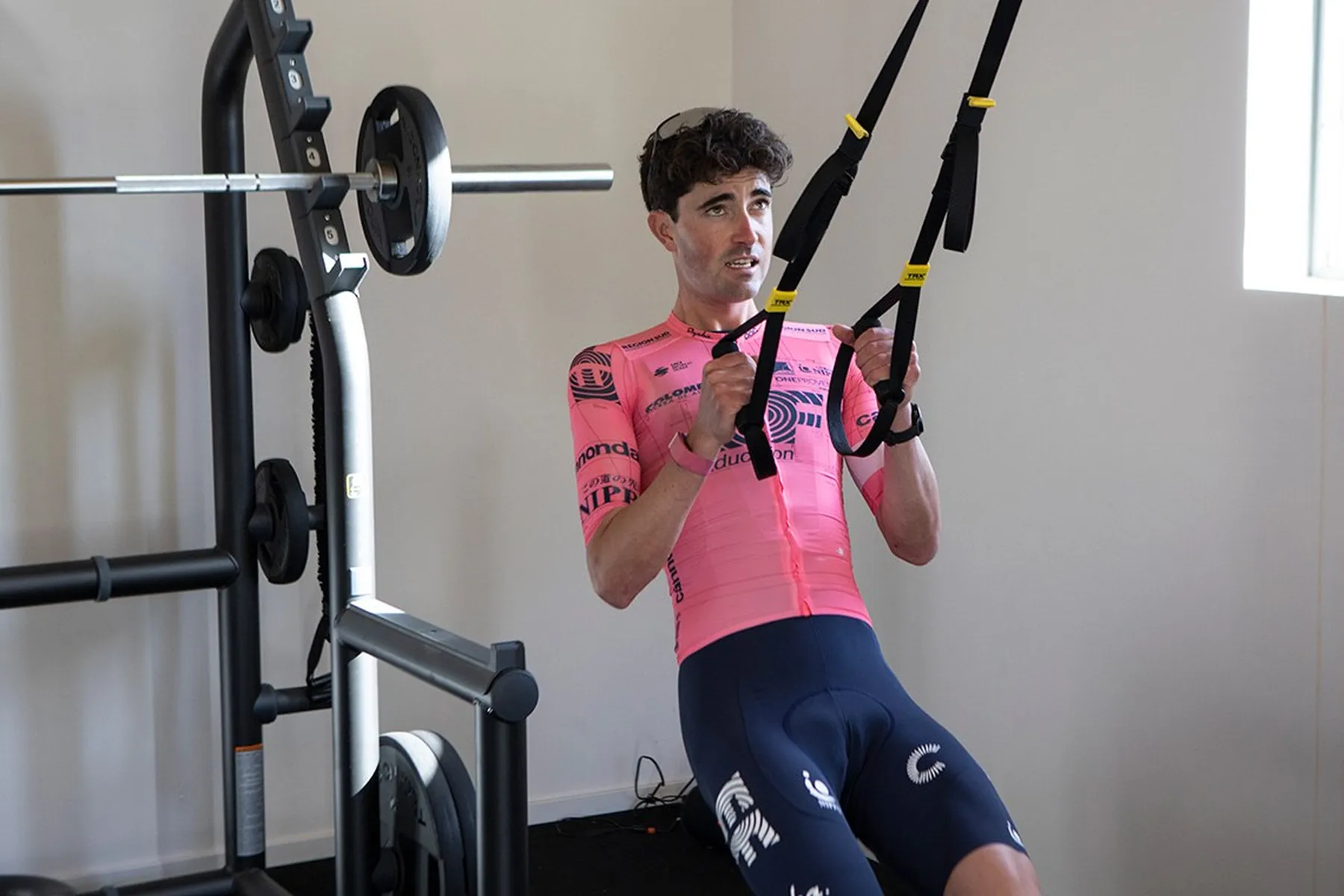
12-WEEK STRENGTH TRAINING PLAN FOR BEGINNER CYCLISTS
A conservative 12-week introduction to resistance training for cyclists who are new to the gym. Learn the movements, build repeatable work and progress only while the riding week remains productive.
FUEL FOR THE WORK REQUIRED: THE FFTWR METHOD THAT CHANGED HOW I COACH NUTRITION
You don't eat the same thing on a rest day as you do before a five-hour sportive. That's the entire premise of Fuel for the Work Required — and once you get it, nutrition stops being confusing and starts being a system.
HOW TO READ YOUR TRAININGPEAKS WORKOUT (WITHOUT OVERTHINKING IT)
You open TrainingPeaks and see a wall of numbers — TSS, IF, NP, coloured zones, workout descriptions full of abbreviations. Most of it matters less than you think. Here's what to actually pay attention to.
MESOCYCLE TRAINING EXPLAINED: THE 4-WEEK BLOCK THAT DRIVES ALL YOUR GAINS
Every structured training plan is built on mesocycles — 3 weeks of progressive load followed by 1 week of recovery. Miss the recovery week and you're not training. You're just accumulating fatigue.
MARCO PANTANI'S DEATH: ESTABLISHED FACTS AND OPEN QUESTIONS
Pantani died in Rimini in 2004 from acute cocaine intoxication. The 2022 parliamentary report documented serious anomalies in his 1999 blood control; the Trento inquiry was archived in May 2026 while a Rimini inquiry remained open in the latest status Roadman could verify.