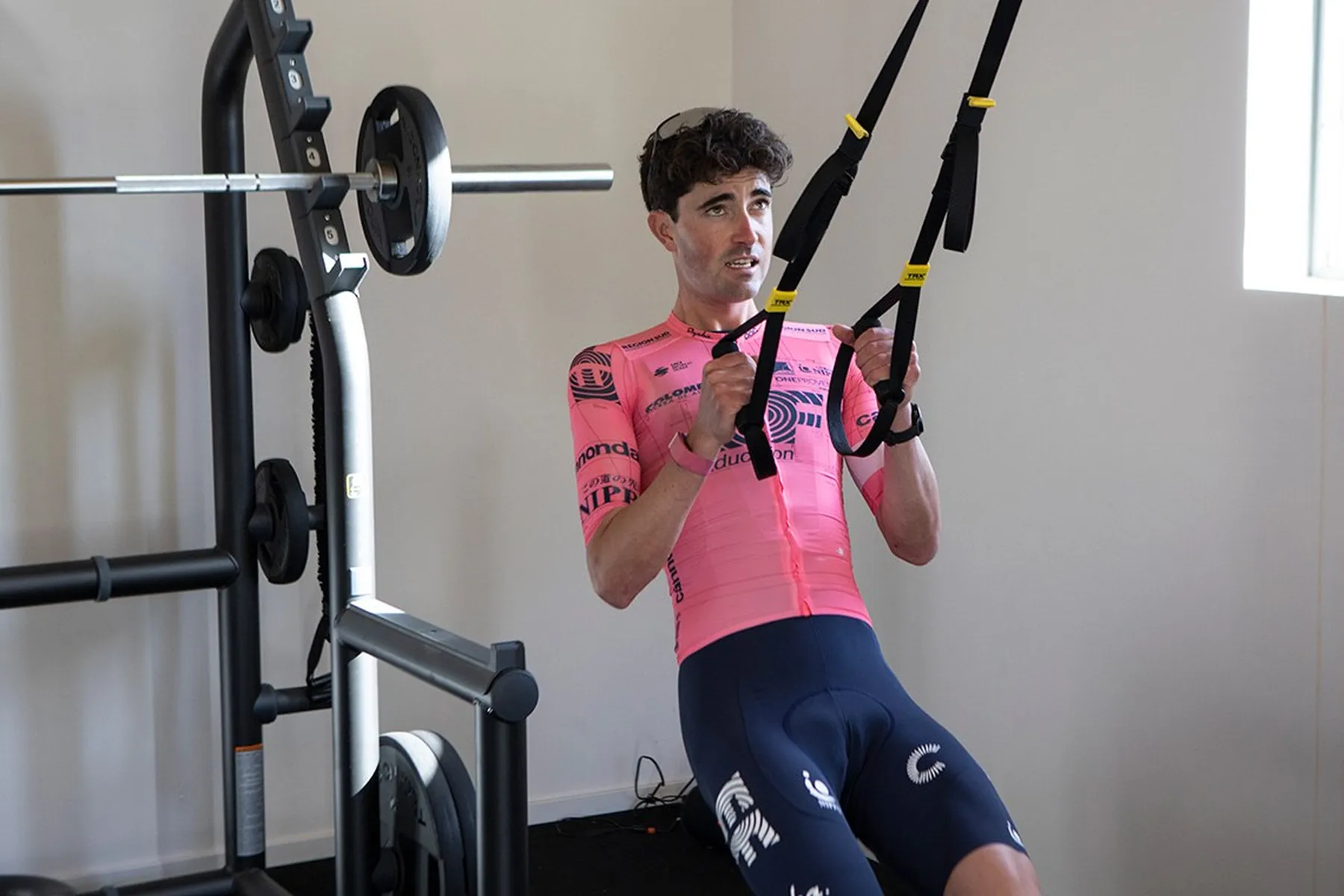
The decline most riders are terrified of — the slowing down, the watts that won't come back, the feeling that the good years are in the rear-view mirror — is not explained by age alone. Training history, recent consistency, health, sleep and ordinary life load all shape what happens next.
I see it constantly. A rider hits 40, maybe 45, and the plan that built them stops working. Same sessions, same effort, and the results dry up. So they do what feels logical: they train harder. More volume, more intensity, fewer rest days, because that's what worked before. And they dig themselves into a hole — always tired, always a bit niggled, always plateaued, slowly concluding that this is just what happens now. It's the exact pattern we pulled apart in the rider-support episode on why you're slow after 40 and how to fix it.
The research is encouraging, but it is not a promise and it does not establish one masters prescription. You have to train the athlete you are now, not a generic 28-year-old or a generic 48-year-old. This page gives you three 12-week starting blocks and, more importantly, the rules for changing them. If you want the wider context first — fuelling, recovery, bike fit and the mental game — the complete guide to cycling over 40 is the companion piece this plan sits inside.
Why training changes after 40
Understanding what's actually going on is the key, because once you see the mechanism, the plan makes sense on its own.
Three considerations become increasingly important across adulthood, but none switches on at one birthday.
Aerobic capacity can decline. Group averages tend to fall with age, but longitudinal estimates in masters athletes vary widely. Changes in training volume, intensity and body composition explain part of the variation, which is why your own repeatable field test is more useful than a fixed annual percentage.
Recovery deserves active measurement. Ageing may affect some repair responses, but the athlete-specific evidence is limited and physical activity is often a confounder. There is no universal 48-to-72-hour clock. Watch how well you execute the session, then combine symptoms, sleep, soreness, mood and life stress before scheduling the next demanding day.
Strength, sleep and health context matter. Muscle function, sleep and medical context can change with age, but individual variation is large. They belong in the rider brief rather than being reduced to one hormone claim or one age-based rule.
None of that is a verdict. It's a brief. It tells you precisely what to change: protect intensity, respect recovery, defend muscle, and sleep like it's a session. Do those four things and you can make real progress for years. Ignore them and you'll spend the next decade confused about why effort isn't paying off.
Why there is no 5% versus 10% rule
A widely repeated masters headline says trained athletes lose about 5% of VO2max per decade while sedentary adults lose about 10%. That is a study result, not a law.
In an eight-year historical study, 15 male masters athletes averaged a 5.5% decline per decade compared with 12% in 14 sedentary men. The sample was small, male and specific to that cohort. A 2022 review of longitudinal masters-athlete research reported declines ranging from 5% to 46% per decade and linked much of that variation to changes in training.
The useful conclusion is narrower and more hopeful: training behaviour matters, and a population average cannot forecast your trajectory. Estimate your current capacity with the VO2max Estimator, repeat the same field protocol under similar conditions and interpret the trend alongside your training history. The age grade calculator can add context, but neither tool is a laboratory diagnosis.
In his Roadman interview, Dr David Lipman emphasised consistency and patient progression. Treat that as an expert coaching position, not proof that every rider will keep improving.
The practical implication is to preserve an appropriate training stimulus without assuming that more intensity is always better. One or two quality sessions may fit an experienced rider; a returning rider may need none at first. The right number is the number you can execute and absorb while progressing toward the stated goal.
How to structure a masters training plan
The whole plan rests on a trade-off: a useful stimulus must still be recoverable inside the rider's actual week.
Start with four decisions: the event demand, current capacity, available time and the response rules that will trigger progression or a reduction.
Intensity distribution: mostly easy is a starting point, not an 80/20 law. Stephen Seiler's review described successful high-volume endurance athletes doing most sessions at low intensity, but it did not test masters cyclists or prove a universal time split. A 2025 individual-participant meta-analysis found no overall polarised-versus-pyramidal winner for its stated outcomes. Use enough easy riding to make the quality work repeatable, then choose the distribution that fits the event, available hours and response.
One or two quality sessions can be a workable default. Anchor them to a current threshold estimate — the FTP Test Calculator can provide a field-based starting number — and leave enough space to execute the next session well. That may be two days for one rider and longer for another. A review of recovery and ageing found plausible differences but not a universal recovery interval for masters cyclists.
Make the easy days easy. This is where masters riders leak the most. Set your heart rate zones and hold yourself below the Zone 2 ceiling on recovery days — if your "recovery" ride is actually a tempo grind, you've turned an 80/20 week into a 50/50 week and stolen the recovery your hard days depend on. Easy means easy. Let your ego sit this one out.
For the day-by-day version of this week — exactly what goes on Monday through Sunday — the masters weekly training plan lays out the full template you can drop straight into your calendar.
Periodisation for the 40-plus cyclist
Periodisation is just structured progression — blocks of building followed by blocks of absorbing. The masters version differs from the standard model in two specific ways.
Choose build length from response. A 2:1 cycle can be a conservative starting experiment; 3:1 or a non-calendar approach may suit somebody else. Age alone does not validate one deload frequency. Hold the block while execution and recovery remain stable, and shorten it when several signals deteriorate.
Make the deload explicit. A recovery week commonly reduces volume and demanding work while retaining some familiar movement. There is no mandatory percentage. If you ride with power, the TSS Calculator and a Performance Management Chart in TrainingPeaks can help describe load, but modelled load is not a direct measurement of recovery. Read it beside symptoms, sleep, session execution, soreness, mood and life stress.
Across the season, use base, build, event-specific work, taper and recovery as organising ideas rather than age-fixed durations. Rehearsal rides and response to reduced load should determine taper length. For the deeper framework, the masters guide to getting faster after 40 walks through the decision logic.
Strength training: the hidden enemy is muscle loss
If you take one thing off the bike from this article, make it this. After 40, the quiet thief isn't your heart or your lungs. It's your muscle.
Sarcopenia describes age-related loss of muscle mass and function, but a population rate is not a personal diagnosis. Dr Andy Galpin's Roadman interview explains why high-force work belongs in the conversation; treat it as expert context rather than masters-cyclist trial evidence. We unpacked that position in the conversation on fast-twitch fibres after 40.
The best available cycling evidence is promising but bounded. A 2025 meta-analysis of 17 studies and 262 adult cyclists found improvements in cycling efficiency, anaerobic power and a combined performance outcome, no effect on VO2max and low-certainty evidence. It did not establish a masters subgroup effect or prove one optimal programme.
That means no blanket ban on barbells and no blanket requirement to use them. Choose movements you can perform competently, then progress load while accounting for injury history, equipment and the bike work around the session. A qualified strength professional or clinician should guide the plan where health or injury makes loading uncertain. Options include:
- Single-leg strength. Split squats, rear-foot-elevated split squats, step-ups onto a box, and single-leg hinges. These mirror the one-leg-at-a-time reality of pedalling, expose and fix left-right imbalances, and load the muscle hard without spine-loading a barbell.
- Hip stability. Single-leg glute bridges, lateral band walks, hip hikes, and standing hip abduction. Cycling's repetitive, narrow movement leaves the stabilising muscles around the hip weak — and weak hips are where knee and lower-back trouble starts.
- Core anti-rotation. Pallof presses, bird-dogs, dead bugs, and side planks. The job of a cyclist's core isn't to crunch — it's to resist movement so your legs have a stable platform to push against. Anti-rotation work builds exactly that.
- Bilateral or bodyweight progressions. Squats, hinges and presses may be appropriate when technique and context support them. If you're new, begin with a version you can control and progress repetitions, range or load gradually.
One or two sessions a week is a practical starting range, not an age rule. Begin below your maximum, preserve technique and alter cycling load if strength quality or recovery deteriorates. For more examples, strength training for cyclists over 50 and the minimum effective dose guide give you session structures to adapt.
Progressive strength is one useful tool in the programme, not proof that every over-40 rider needs the same exercise, load or frequency.
Nutrition: what changes after 40
The bike work and the strength work only land if you fuel the repair. And the repair gets harder with age, which means your nutrition has to work harder too.
Protein needs context. A 2025 scoping review found only 12 heterogeneous masters-athlete studies and described population-specific recommendations as uncertain. Training load, total energy intake, body size, goals, dietary pattern and health context all matter. The protein requirements guide for cyclists and protein timing guide explain the wider evidence, but do not turn one range into a masters law.
Match recovery nutrition to the work and the next session. After demanding or prolonged riding, carbohydrate, protein, fluid and total energy intake all matter. Urgency depends on the session and how soon you train again; it is not set by being 45 rather than 25.
Fuel the ride, don't starve it. The instinct to lose a few kilos by under-eating on the bike backfires badly after 40 — you bonk, you can't hit your intensity, and you cannibalise the muscle you're working so hard to keep. Fuel your hard sessions properly. Body composition is won through consistent training and adequate protein, not by riding hungry — use the body composition calculator to track where you actually sit rather than guessing from the scale. This is exactly the approach I used myself, and it's the opposite of diet-culture starvation.
Sleep and recovery are part of the plan
Sleep is a major input to health, wellbeing and the ability to train consistently.
The AASM and Sleep Research Society consensus recommends that adults sleep at least seven hours regularly for health. That is a general threshold, not an exact masters-performance prescription. Individual need, quality, timing and possible sleep disorders still matter; persistent sleep problems deserve qualified medical attention.
Then there's recovery between the sessions. Track the simple markers — morning resting heart rate, heart-rate variability if you have it, and an honest subjective read on how you feel. When the signals say you're not recovered, you're not recovered, regardless of what the plan says. The plan serves the body, not the other way round. For a structured way to audit all of this, the masters recovery audit gives you seven things to check, and the post-ride recovery window guide for over-40s digs into the timing.
Do not add training volume by repeatedly cutting sleep. If duration or quality is worsening as load rises, that is a reason to review the plan rather than a guarantee about any two riders' performance.
Three 12-week training blocks
Here are three concrete starting blocks for common goals. They deliberately separate the event demand from the modification rules. Pick the closest goal, then change the number of hard days, strength dose, volume and deload timing to fit the rider brief and response.
Block 1 — Bucket-list gran fondo or sportive
For the rider with a date circled: the Etape, the Marmotte, a big century. The goal isn't just to finish — it's to ride it strong and enjoy it.
- Weeks 1-4 (base): Build endurance volume gradually toward your event's demands without prescribing a fixed weekly percentage. An experienced rider might use one threshold session, one long endurance ride with sustained climbs and one or two strength sessions. Review load at week 3 rather than deloading automatically.
- Weeks 5-8 (build): Make the long ride event-specific — same terrain, same surface, practising your fuelling on the bike. Quality can shift toward longer threshold and over-unders where the goal requires them. Adjust strength and take a deload when execution or recovery signals deteriorate.
- Weeks 9-12 (peak and taper): A peak block of your biggest, most specific rides in weeks 9-10, then a two-week taper. Cut volume sharply, keep a little intensity so you stay sharp, and arrive fresh. Nail your event-day fuelling and pacing in rehearsal.
This is built for the 12-week gran fondo plan and sportive peaking framework — go there for the ride-by-ride detail.
Block 2 — Masters racing
For the rider who wants to be sharp at the front of their age group. Endurance is the base; the race is won at the top end.
- Weeks 1-4 (base): Aerobic base plus one race-relevant quality session. Add a second only if the rider already has the background and is executing the first well. Begin strength at a tolerable dose and review load at week 3.
- Weeks 5-8 (build): Race-specific intensity can include VO2max intervals, short sprints, high-power efforts and over-unders. Choose the minimum set that reproduces event demands, maintain strength if it remains compatible and deload according to response.
- Weeks 9-12 (sharpen and race): Reduce volume, raise specificity — short, sharp, race-pace efforts and openers before race days. Race into form. Keep the easy days easy so the hard days stay hard.
The VO2max workouts for over-40s give you the interval sessions this block runs on.
Block 3 — Comeback to general fitness
For the rider returning after years away — the one reclaiming a version of themselves that never really left. Patience here isn't caution, it's strategy. Your cardiovascular system comes back faster than your tendons and joints, so the temptation to do too much too soon is exactly the trap.
- Weeks 1-4 (rebuild the habit): Frequency over intensity. Short, easy, regular rides to rebuild the aerobic base and, just as importantly, the routine. Begin bodyweight strength — split squats, glute bridges, planks. No hard sessions yet; let the body remember how to ride.
- Weeks 5-8 (introduce structure): Add one structured hard session a week — start with threshold, not flat-out VO2max. Grow the long ride steadily. Progress strength from bodyweight toward light loading. Recovery week at week 6 or 7.
- Weeks 9-12 (build confidence): Consider a second quality session only when the first is repeatable and the easy work remains easy. By the end of the block, use the evidence from your own response to decide what the next 12 weeks should target.
The comeback cyclist 12-week return plan is the detailed companion for exactly this rider.
When to back off — reading your body at 40-plus
No birthday makes a wearable metric diagnostic. The useful skill is comparing several signals with your own baseline and responding before a poor pattern becomes entrenched.
Back off and swap a hard session for easy spinning or a rest day when you see:
- Resting heart rate unusually elevated relative to your established baseline.
- HRV moving away from your normal pattern, if you track it, interpreted cautiously rather than alone.
- Sleep that's broken even when you're tired enough to drop off.
- Legs that stay heavy after an easy day that should have cleared them.
- A flat mood, short fuse, or no desire to ride — fatigue shows up in the head before the legs.
One signal on its own might be noise. A worsening pattern across several signals is a reason to postpone quality, reduce load and reassess. Concerning or persistent symptoms need qualified medical advice; a training page cannot diagnose their cause. Consistency over years matters more than forcing one planned session.
You're not done yet
Everything in this plan comes back to one idea: age alone does not tell you what to prescribe. Define the goal, establish a starting capacity, choose a tolerable dose and change it according to the rider's response. Some riders will improve, some will maintain and some will need health or injury constraints to lead the decision.
The hard part isn't knowing what to do. It's doing it consistently, week after week, with people who get it and someone to tell you when you're overcooked. That's exactly what we've built inside the Roadman community — serious masters cyclists, the training plans, the strength roadmap, and the accountability that turns a good plan into a fast rider. If you're ready to stop guessing and train with a structure built for the athlete you actually are, come and join us.
Your best days aren't behind you. They're just on a different schedule.