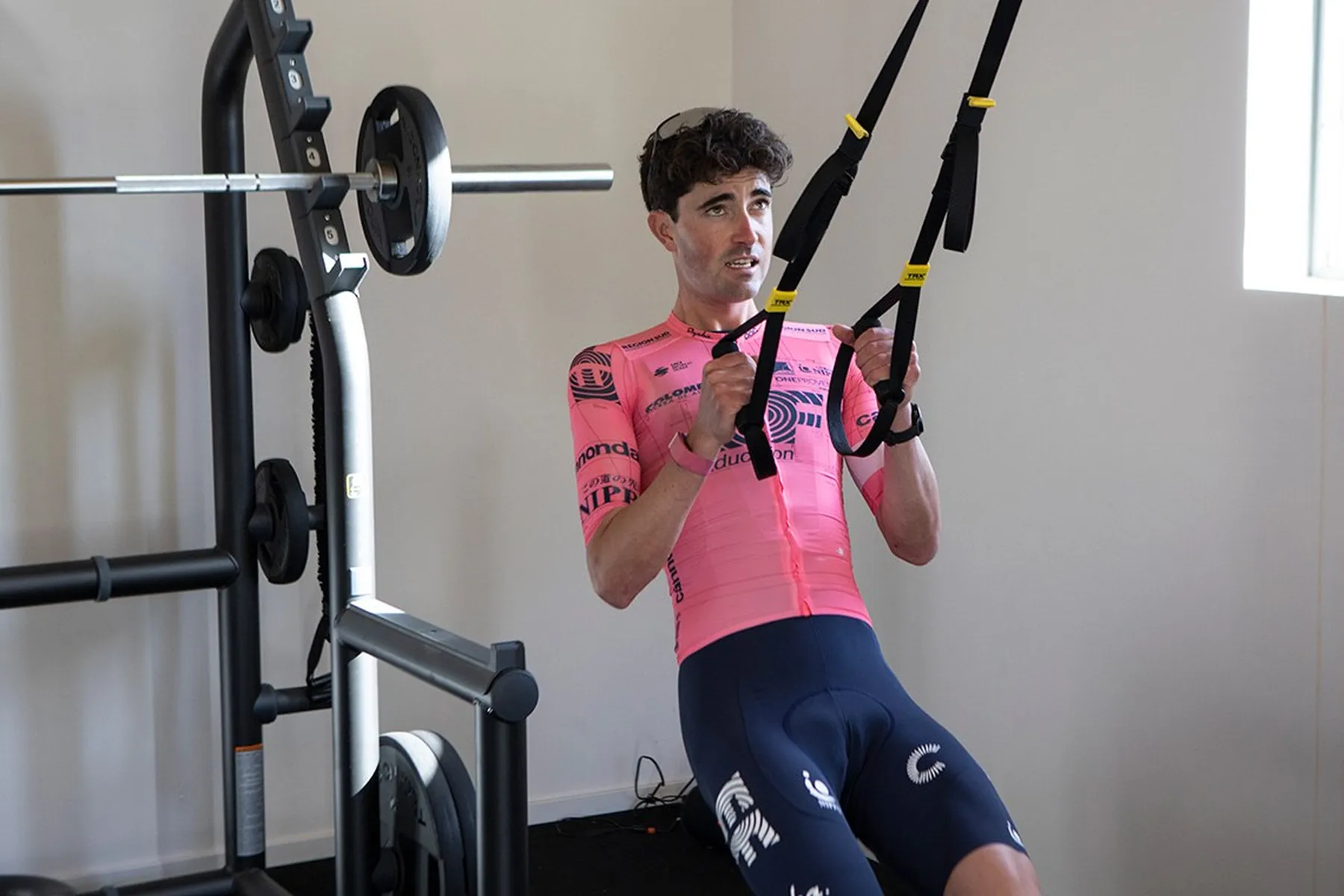
Reviewed for accuracy: This article draws on published research on masters endurance athletes and resistance training, plus the strength principles discussed on the podcast with Derek Teel and Dan Lorang. Loaded resistance training is appropriate for most cyclists over 40, but riders with cardiac, orthopaedic or other clinical conditions should consult a sports physician before starting.
Here's what nobody tells you about strength training after 40: the goal changes completely, but almost nobody changes the work to match.
In your twenties and thirties, you could lift to get stronger, ride to get fitter, and the two systems mostly left each other alone. After 40, that arrangement quietly stops working. The strength you took for granted starts leaking away — not the strength you feel on an easy ride, but the strength underneath it. The fast-twitch fibres that fire a sprint. The tendon stiffness that puts your leg power into the pedal instead of absorbing it. The ability to produce force quickly. These fade first, and they fade fastest, and no amount of zone 2 brings them back.
So the question isn't whether a cyclist over 40 should do strength work. That argument is settled. The question is what kind, aimed at what, and most amateur gym work answers it wrong. Three sets of fifteen at a weight you could lift all day is not addressing a single one of the adaptations that age is taking from you.
Let me break down what's actually happening, and what actually works.
The three things age takes first
When Professor Andy Galpin came on the podcast to talk about the physiology of getting faster after 40, the thread running through it was simple: ageing isn't a uniform fade. Some systems decline gently. Others fall off a cliff if you don't defend them. For cyclists, three matter most.
Fast-twitch fibre loss. Type II muscle fibres — the ones that produce sprint power and the surge over threshold — atrophy faster than slow-twitch fibres as you age. This is why a 50-year-old can hold a respectable endurance pace but loses the punch that used to drop people on a short climb. Endurance riding actively trains the slow-twitch system. It does nothing to defend the fast-twitch one. Only heavy, intentful contraction recruits those fibres, and what you don't recruit, you lose.
Tendon and connective-tissue stiffening — and weakening. Two things happen at once here, and they pull in opposite directions. Tendons become less elastic and more brittle, which is why the training spike that bounced off at 35 produces an Achilles niggle or a patellar-tendon issue at 48. But tendons also lose the stiffness that transmits force efficiently — a slacker tendon absorbs some of every pedal stroke instead of passing it through. Loaded resistance work is the only stimulus that rebuilds both: it drives collagen turnover, which restores resilience, and it increases tendon stiffness, which restores transmission.
Rate of force development. This is the quiet one, and the one most amateurs never train. Maximum strength — how much you can move — declines slowly. Rate of force development — how fast you can produce force — declines much earlier and much faster. On the bike, almost everything that matters is rate-limited: the jump to close a gap, the surge over a roller, the response when someone attacks. You can be "strong" in the gym and still slow to produce it, and after 40 that gap widens unless you deliberately close it.
Here's the through-line. The body's tolerance for low-stimulus work goes up — it adapts to nothing and asks for nothing. And its requirement for high-stimulus work also goes up — it needs more to hold the same ground. That's the trap. The easy work feels productive and does almost nothing, while the work that matters feels harder and gets skipped.
Why most "strength for cyclists" misses
Walk into most gyms and the cyclist over 40 is doing one of two things. Either they've copied a programme written for a 25-year-old — barbell back squats, conventional deadlifts, bent-over rows — which carries real injury risk for a rider with decades of hip-flexor tightness and a posterior chain that's gone to sleep. Or they've gone the other way entirely: bands, bodyweight circuits, high reps, a bit of a sweat. That second group thinks they're doing strength training. They're doing conditioning.
Derek Teel, who's coached riders from weekend warriors up to the WorldTour, puts the fix in one line: build movement competency first, then add load. Skip that step and you're stacking strength on top of dysfunction — which is exactly how cyclists get hurt in the gym and conclude that the gym isn't for them.
But competency is the entry point, not the destination. Once the pattern is clean, load has to follow, because none of the three adaptations above happen at light loads. Dan Lorang — head coach at BORA-hansgrohe and the coach behind Jan Frodeno's Ironman world titles — frames strength as the foundation that lets a rider absorb a long, demanding season without falling apart in August. Durability, in his world, isn't separate from strength. It's downstream of it.
Neither coach is telling masters cyclists to chase a one-rep max. They're telling them to train with enough load and enough intent that the adaptation actually occurs — and to do it through movements the rider can own.
The patterns that work after 40
The classical research on strength for cyclists used heavy barbell lifts. Those protocols work in the populations they were studied in: supervised athletes with the mobility to set up cleanly under a loaded bar. For our audience — riders 40 and up, mostly self-coached in the gym — the Roadman position is to deliver the same posterior-chain, single-leg and force-production stimulus through cycling-specific patterns at controlled, progressively built load. Same principles. Lower injury exposure. The exercise selection is the part we adapt; the demand on the muscle is the part we keep.
The patterns we lean on:
- Split squats and step-ups. Single-leg dominant lower-body work that matches what cycling actually is — a unilateral push, one leg at a time. Loading both legs together on a bar hides the side-to-side imbalance that decades of riding bake in.
- Hip hinges and single-leg hinges. A kettlebell deadlift or single-leg Romanian deadlift trains the same posterior chain as a barbell hinge with a fraction of the spinal load, and the stability demand exposes weaknesses the bike papers over.
- Hip thrusts and single-leg hip thrusts. Direct glute loading with no spinal compression. The glutes are the engine cyclists chronically underuse.
- Goblet and front-loaded squat patterns. The load sits in front of the body, which forces an upright torso and is far kinder to the lower back than a bar across the shoulders.
- Presses and pulls. Push-up progressions, dumbbell presses, rows. Your upper back holds your position together over five hours; train it.
That covers strength and structure. The third adaptation — rate of force development — needs its own treatment, and it's the one most cyclists never reach.
Training speed, not just strength
You cannot train rate of force development with slow, grinding reps. You train it by moving meaningful load fast — the concentric phase explosive, the intent maximal even when the weight is moderate.
In practice, that means a small dose of power-focused work layered on top of the strength base, once the base exists:
- Jump split squats — drop into a split squat, drive up off the floor, land soft. If the landing feels unstable, regress to a fast concentric split squat with no air.
- Dumbbell push press — a slight knee bend, then drive the dumbbells overhead with everything you have. Total-body power, zero spinal compression.
- Step-up with drive — explode the trailing knee up to the chest at the top of each step.
Three sets of five or six, full recovery between sets — two to three minutes, because this is a neural quality and a fatigued nervous system can't produce it. This is the work that puts the gym onto your power meter. It's also the work that age erases first, which is exactly why it earns its place after 40.
How to fit it around the bike
The most common reason cyclists over 40 quit strength work isn't injury or motivation. It's fatigue — lifting hard on a hard ride day, riding flat the next, deciding the gym is the problem.
The fix is scheduling. Put strength on aerobic ride days, not hard ride days. If Tuesday and Saturday are your hard days, lift Wednesday and Friday — the 24-hour gap lets the bike absorb most of the previous load, and the gym session is shorter than a hard ride anyway. On the day itself, lift after the ride, not before: the bike depends on a fresh nervous system, while the gym tolerates moderate pre-fatigue better.
Two sessions a week through base and build, dropping to one in race season. Cutting strength entirely once racing starts is a classic masters mistake — the adaptations decay measurably inside four to six weeks, and most seasons run far longer than that. One session a week holds the ground you've built. Zero loses it.
And recover like the work demands it. Strength adaptation is hormonal, and after 40 the hormonal environment is already working against you — so 7.5 to 9 hours of sleep and 1.6-2.0g of protein per kilo of bodyweight aren't optional extras. They're the difference between the stimulus producing an adaptation and producing nothing but fatigue.
Where to start
If you've never lifted, start with the pattern, not the weight. Two or three weeks earning clean technique on the split squat, hip hinge and goblet pattern is the cheapest investment you'll make in your cycling all decade. If you've lifted before and stopped, the ramp back is faster — most riders with a strength history regain it inside six to eight weeks. And if you're already in the gym but the work is light and unstructured, the gap is almost certainly intent: three sets of fifteen at bodyweight is not the same stimulus as three sets of six at a load you'd fight to lift eight times, no matter how similar they look on paper.
The most expensive habit in masters cycling is the one that says "I'll add strength when I have time." After 40, the time you save skipping the gym isn't free. It's borrowed against the rider you'll be at 50 — the one watching wheels drift away on a climb that used to be yours.
Inside the Roadman community we run exactly this: cycling-specific strength built around your bike training, the same principles Derek Teel and Dan Lorang bring to the riders they coach, scaled to a real life with a real job. Come and build the version of you that's not done yet.
For the wider picture, the getting faster after 40 guide sets the context, the over-50 strength protocol extends this into the next decade, and the study on strength versus more miles after 40 is the cleanest look at the evidence.