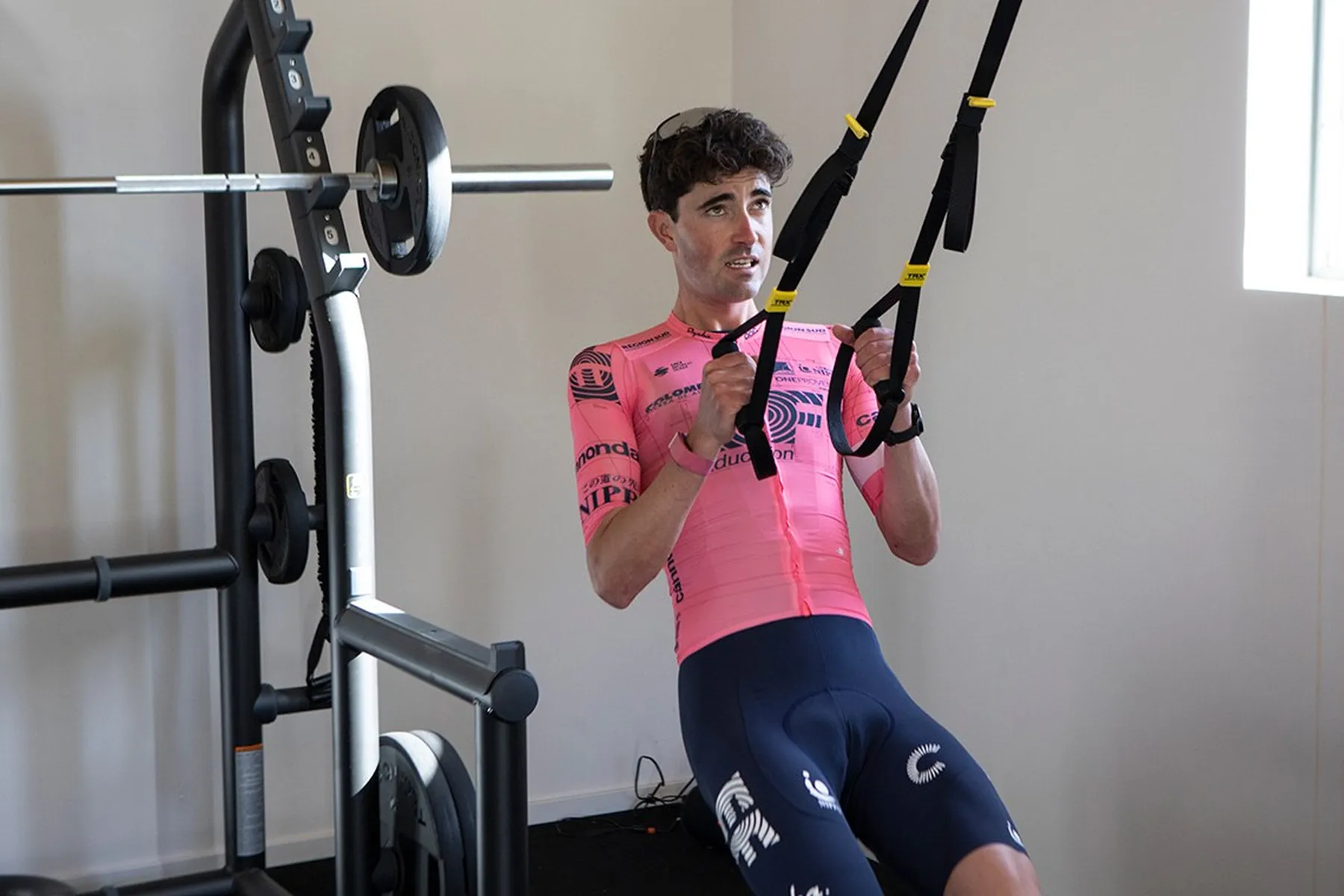
Two cyclists walk into a gym. Both train twice a week for six months. One adds 15 watts to sustained power and holds it through a full race season. The other gets stronger legs, a better physique, and not a single extra watt on the bike.
The difference is not effort. It is not genetics. It is transfer — whether the adaptation earned in the gym reaches the pedal stroke, and whether the neuromuscular changes produced under load match the demands of sustained cycling power.
The question of whether cyclists should lift has been settled. Ronnestad's body of work at Inland Norway University, Beattie's research on endurance athletes, the 2025 meta-analysis covering 262 trained cyclists — the evidence is thick and consistent. The question worth asking now is more specific: which gym work actually crosses the bridge to the bike, which doesn't, and what determines the difference.
That bridge is biomechanical. And most cyclists never cross it — not because the science is hidden, but because the training culture treats all gym work as equal when the physiology says otherwise. The exercises they've been doing for years produce adaptation that stays trapped in the gym.
The transfer mechanism: neuromuscular, not muscular
The most common misunderstanding in cycling strength training is what the gym is for. Most riders assume it builds bigger muscles that produce more force. That's a bodybuilding adaptation. It happens, but it's not the mechanism through which strength training improves cycling.
The mechanism is neuromuscular. Ronnestad's research demonstrated that heavy strength training improved cycling economy by 3-5% in already-trained cyclists — meaning the same power output required less oxygen, less metabolic cost. His subjects also improved time to exhaustion at maximal aerobic power by up to 17%. Those are massive gains for riders who were already fit.
The improvement came not from bigger muscles but from the nervous system's enhanced ability to recruit muscle fibres — particularly fast-twitch (type II) fibres — more efficiently and at lower relative intensities. After a block of heavy strength work, the brain can call on more fibres per contraction with less systemic cost. The rider produces the same watts with lower perceived effort, or more watts at the same effort.
This is the transfer mechanism. And it only happens at sufficient load.
Beattie et al. confirmed the pattern in a different population: maximal strength training improved 5-minute power output and cycling economy, while endurance-style gym work — high reps, low load, short rest — produced no significant on-bike change. The endurance group got fitter in the gym. They didn't get faster on the bike.
That distinction is the entire point of this article.
Why single-leg beats bilateral for cycling
Pedalling is a single-leg activity. One leg pushes while the other recovers. This happens roughly 90 times per minute, 5,400 times per hour. At no point do both legs produce force simultaneously against the same resistance.
This matters for transfer because bilateral exercises — where both legs work together against a shared load — allow the stronger leg to compensate for the weaker one. A rider with a 10% left-right power asymmetry can perform a bilateral leg press at high load without the deficit ever showing. The same rider performing a single-leg press, a step-up, or a Bulgarian split squat will feel the difference immediately. The weaker side fails earlier, moves slower, compensates differently.
Derek Teel's emphasis on single-leg dominant programming for cyclists follows directly from this. The pedal stroke exposes asymmetries ruthlessly — the rider fatigues unevenly, the weaker side breaks form first, and the overall sustained output is limited by the weaker leg. Training unilaterally forces each leg to do its own work, corrects imbalances across a training block, and produces a movement pattern that matches the demand.
There's a second transfer advantage. Single-leg exercises under load require hip and trunk stabilisation that bilateral movements don't. The standing leg must stabilise the pelvis, the core must resist rotation, and the ankle must manage balance — all of which mirror what happens on the bike during hard efforts, climbing, and sprinting out of the saddle. The stabilisation demand is part of the transfer.
What the pedal stroke actually demands
To understand transfer, you need to understand what muscles the pedal stroke loads, and how.
The power phase of the pedal stroke — roughly from 12 o'clock to 5 o'clock — is driven by three chains working together:
Hip extensors (glutes and hamstrings). The gluteus maximus is the largest muscle involved in pedalling, and in most amateur cyclists, the most underused. The glutes drive hip extension from the top of the stroke, producing the majority of force in the first half of the power phase. Weak glutes mean the quads take over earlier and fatigue faster.
Knee extensors (quadriceps). The quads extend the knee through the mid-power phase. They're the muscle group cyclists think about most, but they're not the primary force producer — they're the secondary one, and they work best when the glutes have initiated the movement from above.
Plantar flexors (calves and ankle stabilisers). The ankle transfers force from the leg into the pedal. Weak or unstable ankles leak power at the bottom of the stroke — the leg produces force, but the ankle joint doesn't transmit it cleanly. The ankle's role is transmission, not generation. It needs stiffness and stability, not raw strength.
The interplay between these three chains matters as much as their individual capacity. The glutes initiate, the quads continue, the ankle transmits. When one chain is weak relative to the others — particularly the glutes, which most desk-bound riders underuse — the system compensates. The quads take over too early, fatigue accumulates faster, and the rider's power drops across longer efforts even though their aerobic fitness should sustain it.
An exercise transfers to cycling when it strengthens one or more of these chains through joint angles similar to the pedal stroke, under conditions that drive neuromuscular adaptation. An exercise fails to transfer when it loads different patterns, different angles, or doesn't reach the intensity threshold where fast-twitch recruitment occurs.
This is why a cyclist can train their quads extensively on a leg extension machine and see nothing on the bike. The leg extension isolates the quadriceps through an open-chain movement that doesn't match the closed-chain, multi-joint pattern of pedalling. The muscle gets stronger in a pattern the bike doesn't use.
The exercises that cross the bridge
Every exercise below earned its place because the movement pattern, joint angle, and force production demand match what happens between 12 and 5 o'clock on the crank.
Single-leg press. Unilateral, loaded through the hip-knee extension chain, adjustable seat angle to match the hip flexion range of the pedal stroke. The single-leg press is one of the highest-transfer gym movements because it isolates the pushing pattern of one leg at a time — which is how pedalling works — with controllable load and minimal spinal compression. Ronnestad used the leg press in several of his published protocols.
Step-ups. A loaded step-up onto a box at roughly knee height replicates the top of the pedal stroke almost exactly: deep hip flexion, driving up through the glute and quad into full extension. The single-leg demand exposes and corrects asymmetries that bilateral movements hide. Use a height where the working thigh is parallel to the floor or slightly below at the bottom position. Start with dumbbells held at the sides; progress load before height.
Bulgarian split squats. Deep hip flexion under load, single-leg stability demand, glute and quad through a range that maps closely to the power phase of pedalling. The rear-foot-elevated position forces the front leg to do 85-90% of the work, which is the kind of honest single-leg loading the bike demands. Three to four sets of six reps per side at a load that challenges the last two reps — that's the transfer dose.
Hip thrusts. The gluteus maximus produces the most force of any muscle in the pedal stroke, and in most desk-bound amateur cyclists it's also the most inhibited. The hip thrust isolates glute force production through hip extension with zero spinal compression. It's the single best exercise for the muscle that matters most to cycling power. If you only add one gym movement to your programme, make it this one. Use a barbell, a heavy dumbbell, or a loaded backpack across the hips. Full lockout at the top, controlled descent, 3-4 sets of 6-8 reps.
Core stability: anti-extension and anti-rotation. The trunk is the platform the legs push against. Every watt produced by the glutes and quads transmits through the core before it reaches the pedals. A weak core doesn't absorb force — it leaks it. The rider's pelvis rocks, the lower back flexes, and power that should reach the cranks dissipates into lateral movement.
The core work that transfers is isometric stability, not dynamic flexion. Pallof presses (anti-rotation), dead bugs (anti-extension), plank progressions (anterior stability). Not crunches. Not sit-ups. The core's job on the bike is to stay rigid while the legs produce force around it, so train it to resist movement, not create it.
You can assess your current baseline with the Masters Recovery Score and the Recovery Screen to gauge readiness before building a strength block into your programme.
The exercises that don't cross the bridge
This is where most cycling strength programmes go wrong. Riders fill their sessions with movements that feel productive — they're hard, they cause soreness, they produce adaptation — but the adaptation doesn't transfer.
Leg extensions. Open-chain, single-joint, no hip involvement. The quad gets stronger in a range and pattern that doesn't exist in pedalling. The metabolic cost of the session competes with recovery from riding. Net transfer: close to zero.
Calf raises. Isolating the plantar flexors in a standing calf raise doesn't replicate the ankle's role in the pedal stroke, which is stabilisation and force transmission, not active plantarflexion against resistance. Time better spent elsewhere.
Leg curls. The hamstring functions as a hip extensor during pedalling, not a knee flexor. Training it through knee flexion on a machine misses the pattern entirely. A single-leg hip hinge trains the hamstring through its cycling-relevant function — hip extension under load — which is what the pedal stroke actually demands.
High-rep circuits with light loads. This is the trap most endurance athletes fall into. Three sets of fifteen at a manageable weight feels like strength training. It produces muscular endurance — the muscle's ability to sustain moderate output over time. The bike already trains that, aggressively, for 8-12 hours per week. Adding more of the same adaptation in the gym yields almost nothing. The gym's job is to produce what the bike cannot: neuromuscular recruitment of fast-twitch fibres under high load.
The distinction between 3x15 and 3x6 is not just volume and intensity. It's a different physiological stimulus. The 3x15 set lives in the metabolic and endurance adaptation window. The 3x6 set at challenging weight lives in the neuromuscular adaptation window — the one that improves cycling economy, sprint capacity, and sustained power. Beattie's research drew this line clearly, and the on-bike results were not subtle.
Programming for transfer: the strength-endurance trap
The most common error I see in cycling strength programmes — including many sold as "cycling-specific" — is excessive volume at insufficient load. The programme prescribes 4-5 exercises at 3x12-15, with 60-90 seconds rest, structured like a circuit. The rider sweats, breathes hard, gets sore. All the signals of a productive session.
But the physiological outcome is metabolic conditioning, not strength. The rest periods are too short for the nervous system to recover between sets. The load is too light to recruit fast-twitch fibres. The rep count is too high to produce neuromuscular adaptation. The rider is essentially doing a cardio session with weights — and they already have a bike for that.
The protocol that transfers:
- 3-4 working sets per exercise (after warm-up sets)
- 4-6 reps at a load that challenges the final two reps
- 2-3 minutes rest between sets — long enough for the nervous system to recover and produce quality contractions on the next set
- 2-3 exercises per session targeting the primary movers, plus core work
- Full effort on every rep. Not grinding to failure, but not coasting. Two reps in reserve on the working sets.
This looks like very little work on paper. A typical session takes 40-50 minutes including warm-up. It feels less exhausting than a circuit session — which is the point. The systemic fatigue is low. The neuromuscular stimulus is high. The recovery cost is modest enough that the next day's ride is uncompromised.
The riders who struggle with this are the ones with an endurance athlete's instinct: more is better, harder is better, if I'm not breathing hard it doesn't count. That instinct works on the bike. In the gym, it produces the wrong adaptation. The discipline is to lift heavy, rest long, keep the session short, and leave the gym feeling capable rather than destroyed.
And it produces dramatically better transfer to the bike, because it drives the adaptation the bike needs: the nervous system's ability to recruit more fibres, faster, with less systemic cost.
Art O'Connor's framing — that legs are rarely the limiter, that the trunk and hips are where the performance lives — applies directly to exercise selection. The five movements listed above (single-leg press, step-ups, Bulgarian split squats, hip thrusts, core stability) address the patterns Art identifies as limiting in most amateur cyclists. The detail is in the complete strength training guide and the expert roundup on what the research says.
Periodising strength alongside the bike
The strength block and the cycling block need to run in parallel, not in sequence. The off-season is for building; in-season is for maintaining. Dropping strength entirely when racing starts throws away months of adaptation.
Off-season (heavy phase): 2 sessions per week. Full protocol. Primary focus is building maximal strength — the 4-6 rep range at high relative load. This is where the neuromuscular adaptation accumulates. The cycling volume is low (base endurance work), so recovery resources are available for the gym.
Pre-season (strength-endurance phase): 2 sessions per week. The load stays meaningful, but the rep range shifts slightly toward 6-8. The cycling intensity increases (threshold and VO2max intervals), so the gym sessions need to coexist with harder riding. Drop total gym sets per session by 20-30% but keep the load honest. The aim is consolidation: converting raw strength into power that holds under fatigue.
In-season (maintenance phase): 1 session per week. The minimum dose to retain adaptation. Two to three exercises, 2-3 sets each, at 70-80% of off-season working loads. This single weekly session preserves 85-90% of accumulated strength gains. Riders who maintain in-season lifting hold their FTP improvements; those who stop entirely see measurable regression within two months.
The session placement matters during in-season. The gym session should sit on a low-intensity day, ideally the day before a rest day or easy spin — never the day before intervals or a race. The residual fatigue from even a maintenance session compromises quality on hard rides if the timing is wrong. Most riders find Monday or Thursday works best, depending on their weekend event schedule.
The periodised approach to the full off-season gym block is laid out in detail in the 12-week off-season gym routine. For riders new to strength work, the 12-week beginner plan builds the movement competency before the load ramps up.
The masters-specific angle is sharper. For riders over 40, the strength-to-cycling transfer becomes more valuable, not less, because the neuromuscular decline that ageing produces is precisely what heavy strength work reverses. The strength training over 40 guide covers the age-specific protocol adjustments, and the new meta-analysis on heavy strength training after 40 confirms the dose-response relationship.
When to stop before an event
Heavy strength work leaves a neuromuscular residue that takes 7-10 days to fully clear. A heavy session three days before a target event will cost watts on race day — not because the muscles are damaged, but because the nervous system hasn't recovered its full recruitment capacity.
The taper protocol:
- 10 days out: Last heavy session. Full load, full protocol.
- 5-7 days out: One light session if desired — 50-60% of normal load, 2-3 sets only. This maintains the neural pathway without creating fatigue.
- 3-5 days out: No strength work. The nervous system is clearing.
- Race day: Full neuromuscular capacity available.
For maintenance sessions during a race block with multiple events, keep the load moderate (60-70% of max), the volume low (2 sets of 4-6 reps on two exercises), and place the session at least 72 hours before the next event. The best exercises for cyclists in the gym guide covers exercise selection for race-week maintenance.
Gym-free alternatives that still transfer
Not every rider has gym access year-round. Travel, cost, schedule, preference — the reasons vary. The transfer principles still apply: load the hip extensors, knee extensors, and core through cycling-relevant patterns at sufficient intensity to drive neuromuscular adaptation.
Pistol squat progressions. Start with a box pistol (sitting down to a chair on one leg), progress to a full pistol. Single-leg, deep hip flexion, high relative load using bodyweight alone. Most cyclists cannot do a controlled pistol squat on their first attempt — which tells you how weak the single-leg pattern is relative to what the bike demands.
Elevated split squats with loaded backpack. A backpack loaded with 15-25kg, rear foot on a chair, front foot on the floor. The load is limited compared to a barbell, but the pattern is correct and the stimulus is real. Progress by adding weight to the backpack or slowing the descent.
Step-ups onto a sturdy chair or box. Load with a backpack or hold a heavy bag. The height should put the working thigh at or below parallel. Control the descent — step down slowly rather than dropping.
Hip thrusts with any available load. A heavy backpack across the hips, a sandbag, a loaded duffel bag. The movement transfers regardless of the loading implement. Full lockout, controlled descent, high intent.
Resistance band work for supplementary loading. Bands add accommodating resistance — heavier at the top of the movement where the leverage is best. Banded split squats, banded hip thrusts, banded step-ups. The load curve isn't perfect, but it's better than bodyweight alone.
The ceiling for home-based work is lower than gym-based work because load progression plateaus sooner. A cyclist who has access to a gym twice a week will see more transfer over a season than one limited to bodyweight and bands. But the bodyweight progression still produces meaningful adaptation in riders who haven't trained single-leg patterns before — and that's most amateur cyclists.
The key with home training is the same as the gym: load must be sufficient and reps must be low enough to target neuromuscular adaptation. A set of 20 bodyweight split squats is endurance training. A set of 6 with a 20kg backpack, controlled descent, driving hard through the heel — that reaches the threshold. The equipment is less important than the intent and the load.
Use the W/kg Calculator and FTP Zone Calculator to benchmark where you are before starting, and the Body Composition Calculator to track lean mass changes across the block. The FTP Test Calculator gives you a repeatable protocol for measuring whether the transfer is reaching the bike.
The bridge, built properly
The gap between the weight room and the road is not abstract. It is biomechanical, neuromuscular, and measurable. Exercises that load the patterns the pedal stroke demands, at intensities that drive fast-twitch recruitment, through joint angles that match the power phase of the crank — those cross the bridge. Everything else stays in the gym.
The riders who add watts from strength training are not doing more. They are doing less, with more precision. Two sessions per week. Three to four exercises per session. Four to six reps at honest load. Core work that teaches the trunk to resist, not flex. And the discipline to maintain it through the race season rather than dropping it when the events start.
If you want the session templates, the periodised plans, and the coaching on how this fits into your specific riding schedule, the Roadman community on Skool is free to join. Plan templates, movement tutorials, and direct access to the coaching team are inside. The strength training guide for cyclists over 40 covers the age-specific adjustments for masters riders, and the expert roundup collects the published evidence in one place.
The gym is not the destination. The bike is. Train accordingly.