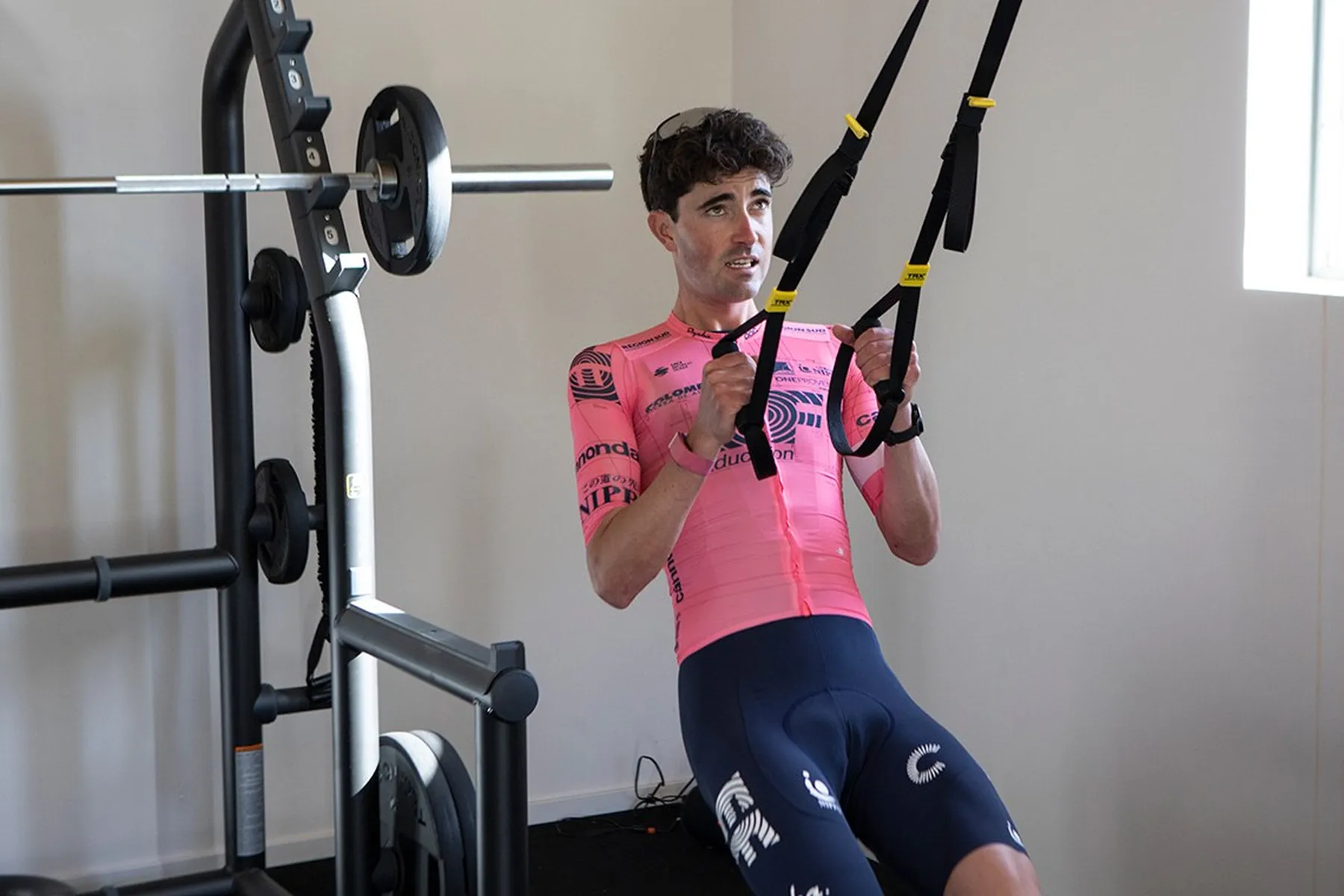
The best off-season strength plan for an experienced cyclist is not a beginner routine with heavier dumbbells. It is a progressive block that gives strength enough priority to improve while keeping the bike visible as the outcome.
If you are new to resistance training, returning after a long break or unsure of the movements, start with the 12-week beginner cyclist strength plan and printable PDF. If you need the whole transition from the last race to structured riding, use the cycling off-season roadmap.
The plan in 30 seconds
| Phase | Weeks | Main job | Practical progression test |
|---|---|---|---|
| Establish | 1–4 | Build repeatable work with controlled sets, usually in the 6–10 rep range | Technique, joint response and the next important ride remain stable |
| Emphasise strength | 5–8 | Progress selected main lifts with heavier 4–6-rep sets and full recovery | Load or reps rise without grinding, failure or repeated bike-session damage |
| Integrate | 9–12 | Retain strength as bike volume or intensity returns | The rider can protect the event-specific bike work with less gym volume |
Two non-consecutive full-body sessions is the default starting structure. It is not a universal optimum. The 2026 cyclist-only meta-analysis included 17 controlled studies, 262 participants—only 60 women—and programmes lasting 5–25 weeks with one to three sessions per week. Heavy strength training improved group-level cycling efficiency, anaerobic power and cycling performance, but the authors graded the evidence low certainty and could not establish an optimal implementation.
That boundary matters: no study tested this exact Roadman sequence and proved it superior.
Before week one: pass the entry check
This is an experienced-lifter plan. You should be able to:
- control a knee-dominant pattern and a hip hinge through a useful range;
- brace and breathe without losing position under load;
- stop a set before technique changes;
- record loads, repetitions and symptoms consistently; and
- distinguish normal effort from pain or a concerning symptom.
If those conditions are not met, use the beginner plan. Seek appropriately qualified medical or rehabilitation guidance before heavy training when you have a relevant cardiovascular, neurological or orthopaedic condition, osteoporosis, recent surgery, unexplained pain or concerning symptoms. Stop and seek urgent help for chest pain, fainting, unusual breathlessness or rapidly worsening neurological symptoms.
The two-session off-season gym routine
Choose one movement from each row. The pattern matters more than a fashionable exercise name. A machine, free weight or supported variation can all work when it permits controlled progression.
Session A
| Pattern | Options | Weeks 1–4 | Weeks 5–8 | Weeks 9–12 |
|---|---|---|---|---|
| Knee-dominant | Squat, leg press or supported split squat | 3 × 6–10 | 3–4 × 4–6 | 2–3 × 4–6 |
| Hip-dominant | Romanian deadlift, trap-bar hinge or hip thrust | 3 × 6–10 | 3–4 × 4–6 | 2–3 × 4–6 |
| Upper pull | Row or pull-down | 2–3 × 6–12 | 2–3 × 5–8 | 2 × 6–10 |
| Calf | Standing or seated calf raise | 2–3 × 8–15 | 2–3 × 6–10 | 2 × 8–12 |
| Trunk/carry | Suitcase carry or Pallof press | 2–3 efforts | 2–3 efforts | 2 efforts |
Session B
| Pattern | Options | Weeks 1–4 | Weeks 5–8 | Weeks 9–12 |
|---|---|---|---|---|
| Single-leg knee | Split squat, step-up or single-leg press | 3 × 6–10 each | 3 × 4–6 each | 2–3 × 4–6 each |
| Hip-dominant | Hinge, hip thrust or hamstring curl | 3 × 6–10 | 3–4 × 4–6 | 2–3 × 4–6 |
| Upper push | Push-up, machine or dumbbell press | 2–3 × 6–12 | 2–3 × 5–8 | 2 × 6–10 |
| Upper pull | Row or pull-down | 2–3 × 6–12 | 2–3 × 5–8 | 2 × 6–10 |
| Trunk | Side plank, dead bug or carry | 2–3 efforts | 2–3 efforts | 2 efforts |
These are starting ranges, not a prescription to complete every set regardless of response. Warm up with lighter versions of the first movements, take enough rest to repeat good work and leave roughly two technically sound repetitions available on the main sets. A set ends when the next repetition would change the movement, not when a spreadsheet says it must continue.
Weeks 1–4: establish repeatable work
The first four weeks are not a compulsory “anatomical adaptation” formula proved in cyclists. They are a practical on-ramp for an already-trained rider after a race season.
Use a load you can control for 6–10 repetitions. Begin at the low end of the set range if your recent gym exposure has been inconsistent. Add repetitions within the range before adding load, and change only one variable at a time.
Progress when:
- the same exercise remains technically stable across all work sets;
- joint symptoms do not worsen during the following 24–48 hours;
- normal daily function is unaffected; and
- the next priority ride remains useful.
Hold or reduce work when one of those tests fails. Soreness is not the objective, and a worse cycling session is not automatic proof that the strength stimulus was better.
Weeks 5–8: emphasise heavy strength
Select one or two main lower-body movements per session and move them toward controlled sets of 4–6. The cyclist-only review classified heavy training as at least 80% of one-repetition maximum, but you do not need to retest a maximum throughout the block. A repeatable rep buffer is usually more useful for self-coached riders.
One small randomised trial provides useful context. Vikmoen and colleagues assigned 19 trained female duathletes to endurance-only training or endurance plus twice-weekly strength for 11 weeks. The strength group used four lower-body exercises for three sets of 4–10 repetition maximum and improved five-minute cycling power after three hours of riding; the control group did not. The study involved 11 women in the strength group and eight controls, so it supports the category—not a promised seven-percent gain or this exact routine.
Take full recovery between demanding sets. Do not add load merely because the calendar moved forward. Add a small amount only when the current load is controlled, the rep buffer is honest and the combined training week remains stable.
Weeks 9–12: integrate strength with the returning bike load
The final phase is not a compulsory jump programme. Its job is to keep the strength you built while the bike starts becoming more specific.
Reduce optional exercises or sets before removing the main strength work. One or two sessions can both be valid. Keep selected heavy sets technically sharp and stop chasing volume that compromises the bike.
Plyometrics, kettlebell swings or other explosive exercises are optional. They require landing skill, appropriate health and the ability to move fast without losing control. Their presence does not prove “conversion,” and their absence does not waste the block. If you add them, use low fatigue, full recovery and competent coaching.
How to place strength around cycling
There is no single correct week. Start with the session that owns the day's goal.
| When strength is the current priority | When a key ride is the current priority |
|---|---|
| Lift before an easy spin, or place the ride later | Complete the key ride first and lift later or on another day |
| Keep at least one lower-stress day between demanding gym sessions | Do not introduce unfamiliar high-fatigue work before the key ride |
| Use the bike mainly for easy aerobic continuity | Reduce gym sets as bike intensity or long-ride demand rises |
A meta-analysis of same-session sequence found a lower-body strength advantage when resistance work came before endurance work, while aerobic-capacity change did not differ. That supports strength-first placement when strength is the target. It does not mean a cyclist should blunt the week's defining bike session to obey a universal order.
The practical rule is simple: protect the outcome closest to your goal, then watch what happens next. A review of endurance performance after resistance exercise found that residual fatigue can affect later endurance work, with the response depending on the session and athlete.
The recovery rules that keep the block honest
Review four signals after every demanding session:
- Technique: did positions remain controlled at the target load?
- Joint response: did a symptom appear or worsen over the next 24–48 hours?
- Daily function: did normal walking, stairs, work or sleep deteriorate unusually?
- Bike quality: did the next priority ride repeatedly lose power, pace or execution?
One difficult day is information, not a diagnosis. A repeated pattern is a programming decision. Change one lever first: reduce a set, hold the load, use a better-tolerated variation or move the session. Persistent or concerning symptoms need appropriate clinical assessment, not a harder motivational speech.
This is exactly where a static article reaches its limit. Join the Roadman app early-access list if you want strength placement and recovery context to adapt around the riding week rather than forcing every cyclist through the same sheet. It is one shared waitlist; the source only tells us which job brought you there.
How to measure whether the 12 weeks worked
Track both sides of the programme:
- one stable gym marker, such as load and repetitions on a chosen knee- or hip-dominant movement;
- one cycling marker connected to the goal, tested under similar conditions;
- priority-session completion and perceived quality;
- symptoms and next-day function; and
- adherence across the full block.
Do not claim an FTP change from the gym when the cycling programme, body mass, equipment or test protocol also changed. The meaningful win is stronger gym performance and productive riding—not the biggest possible lifting number in isolation.
For the wider evidence and exercise choices, continue to the strength training for cyclists guide and best gym exercises for cyclists. For in-season maintenance, use the minimum-effective-dose guide.