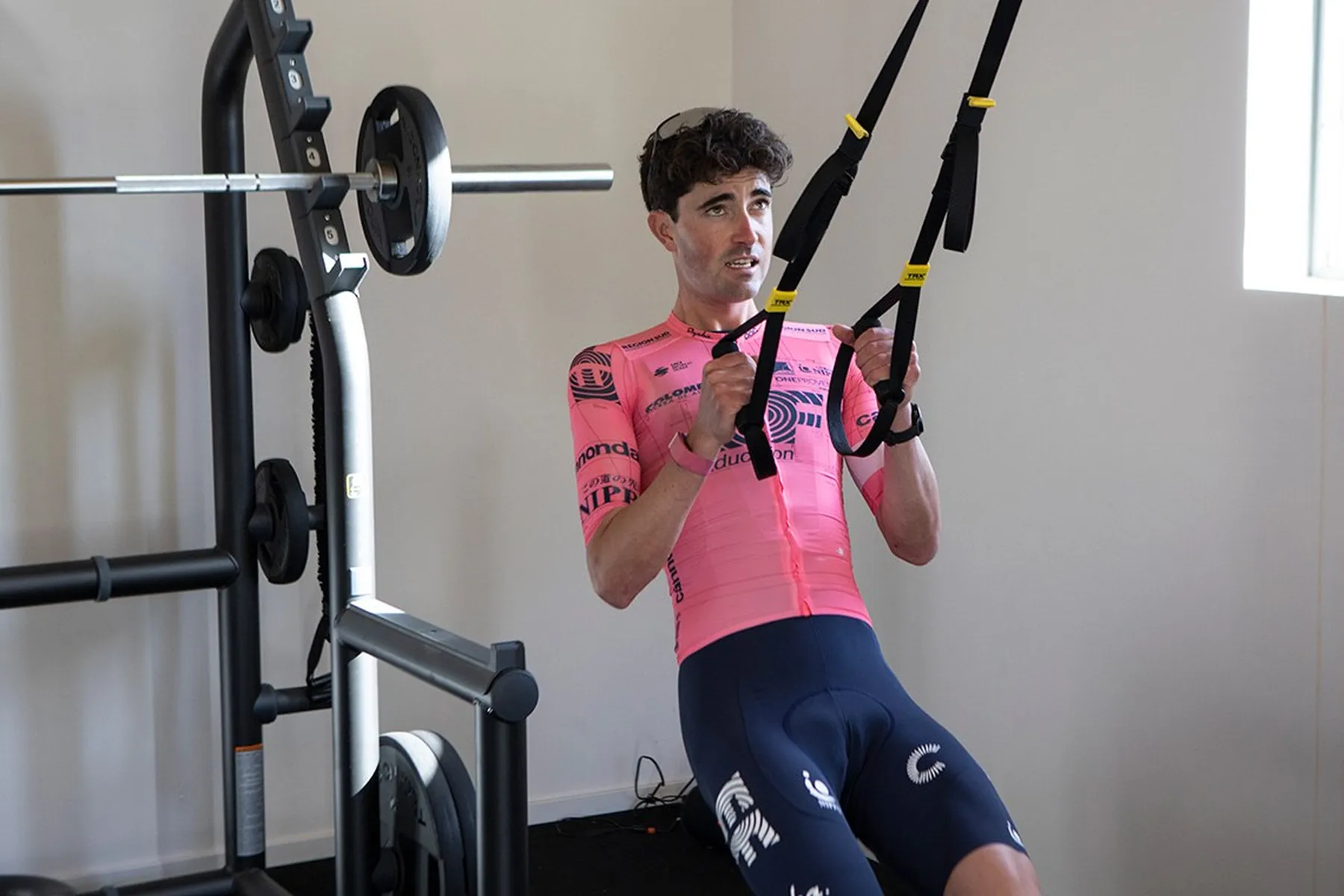
Here's what nobody tells you about turning 40 as a cyclist: your engine can keep improving, but the chassis starts quietly falling apart underneath it. From around 40, adults lose muscle mass and — more importantly — muscle power at an accelerating rate, and your watts per kilogram quietly drifts in the wrong direction no matter how many hours you ride. It's called sarcopenia, and if you do nothing about it, it slowly steals your sprint, your climbing punch and your ability to hold power late in a ride.
Riding your bike, sadly, doesn't fix it. Cycling is fantastic for your aerobic engine but does very little to preserve raw strength and power. Which is why strength training goes from "nice extra" to "the single most valuable thing you can add" the moment you cross into your 40s. The research backs this hard — heavy, well-structured strength work has been shown to beat simply riding more for masters athletes, as we covered in the study that confirms strength beats more miles after 40.
So let me give you the exercises that actually work for this age group — and, just as importantly, the ones I deliberately leave out.
Why we skip the heavy barbell lifts
You'll notice this list contains no heavy barbell back squats, no deadlifts, no barbell rows. That's a deliberate choice, not an oversight.
For the 35-55 rider — often coming to strength training later, frequently with a stiff lower back from years in a flexed cycling position, and training around a job and a family rather than under a coach's eye in a gym — heavy barbell lifts that load a rounded, fatigued spine carry an injury risk that isn't worth it. One tweaked back and you've lost six weeks of riding, which is a terrible trade for a marginal strength gain.
The good news is you don't need them. Single-leg and machine-based exercises deliver the same strength and power stimulus your legs need, load the body through patterns that are far kinder to ageing joints, and — bonus — the single-leg work directly matches how you actually pedal, one leg at a time. You get the benefit without the gamble.
The best lower-body exercises
These are your priority, because your legs make the watts. Do the harder work here.
Step-ups. Possibly the best single exercise for a masters cyclist. Step up onto a knee-height box, driving through the leading leg, holding a dumbbell in each hand. It's single-leg, so it builds each side independently and irons out imbalances; it directly mimics the pedal stroke; and it's easy on the joints and the spine. Load it up over time so the last couple of reps of a set feel really hard.
Hip thrusts. A useful loaded hip-extension option when the setup suits you. Place your shoulders on a bench, put the load across your hips and extend without over-arching the lower back. Hip thrusts can build glute strength and muscle, but no exercise is universally best and feeling the glutes does not prove a cycling power leak; see the evidence limits in the cycling-glutes guide.
Single-leg glute bridges. A joint-friendly progression and a great starting point if a loaded hip thrust is too much early on. Everything on one leg, building glute strength and pelvic stability that transfers straight to a more stable position on the bike.
Leg press. When you want to load your legs heavily but safely, the leg press lets you push real weight with your back fully supported — none of the spinal loading of a barbell lift. Do it single-leg to keep the cycling-specific, one-side-at-a-time quality, or two-legged when you want to move the most weight.
Hamstring curls and Nordic curls. Cyclists are notoriously quad-dominant with weak, neglected hamstrings — an imbalance that both limits power and raises injury risk. Machine hamstring curls, and the brutally effective Nordic hamstring curl (lowering yourself forward under control with your ankles anchored), fix it. Start the Nordic with assistance; it's harder than it looks.
Calf raises. Unglamorous but worthwhile. Your calves stabilise every pedal stroke, and they're one of the first areas to lose strength with age. Straight-leg and bent-leg raises cover both calf muscles.
The core work that actually matters
Forget endless crunches. The core's real job on the bike is stability — holding your pelvis and spine steady for hours so your lower back doesn't take the load and your power doesn't leak into a rocking torso. So you train it to resist movement, not create it.
Pallof press. The best anti-rotation exercise going. Hold a band or cable to one side and press it straight out, resisting the pull that wants to twist you. Trains exactly the stability that keeps you planted in the saddle.
Copenhagen plank. A side plank with your top leg supported on a bench, hammering the inner thighs and hips — an area cyclists rarely train and one that protects the knees and stabilises the pelvis. Start with a short lever and short holds; it's deceptively hard.
Dead bug. Lying on your back, extending opposite arm and leg while keeping your lower back pressed flat. It teaches your deep core to hold a stable spine against movement — precisely the skill that protects your back on a long ride.
Standard front and side planks earn their place too, but these three add the anti-rotation and anti-extension qualities that make the biggest difference on the bike.
How to structure it
You don't need to live in the gym. Two sessions a week is the sweet spot for a masters cyclist — enough to build and maintain strength without stealing the recovery your riding needs.
A simple, effective session, 30-40 minutes:
- A lower-body power move — step-ups or leg press — 3-4 sets of 5-8 challenging reps.
- A glute move — hip thrusts or single-leg glute bridges — 3 sets of 8-10.
- A hamstring move — hamstring or Nordic curls — 3 sets.
- Calf raises — 2-3 sets.
- Two core exercises — a Pallof press and a Copenhagen plank or dead bug — 2-3 sets each.
A few principles that matter more after 40:
- Load it, but progress gradually. The last couple of reps should feel really hard — that's the stimulus. But add weight patiently. Slow, steady progression beats ego and injury.
- Keep it away from key bike sessions. Don't do your hardest leg session the day before your hardest ride. Space them.
- Periodise across the year. Lean into strength in the off-season, when you can push it harder; dial back to a maintenance dose during your peak riding and racing months so it supports your form rather than competing with it. Knowing your FTP zones helps here — it tells you which bike sessions are hard enough to warrant spacing your strength work around them and which ones can live alongside a gym day without conflict. The full year-round approach is in strength training for cyclists over 40.
- Warm up properly. Ageing joints and muscles need it. A few minutes of easy movement and some light warm-up sets before you load anything.
The most important thing you'll do all year
I don't say this lightly: for a cyclist over 40, twice-weekly strength training might be the highest-value thing in your whole programme. It fights the muscle loss that would otherwise make you slower every year. It protects your back, your knees and your hips. It builds the power that pure riding can't. And it keeps you doing the sport you love, well, for decades longer.
If you want it programmed properly — sequenced alongside your riding, progressed sensibly, and built for your age and your body rather than lifted off a generic gym plan — that's exactly what members get inside the Not Done Yet community: an age-appropriate strength roadmap alongside your training plan and direct coaching. It's $195 a month at skool.com/roadmancycling.
Two sessions a week. Joint-friendly moves. Real load, applied patiently. Do that, and the strongest version of you on the bike might still be ahead of you — not behind.