THE FULL CATALOGUE
960 articles across 20 pagesWHAT PARIS-ROUBAIX TEACHES ABOUT EFFORT, POSITION AND DURABILITY
A 54km/h opening hour. A fight for position that decides everything. Cobbles that get smoother the faster you go. Pro rider Ben Oliver broke down Paris-Roubaix from the inside, and the lessons about effort management and durability apply far beyond the cobbles.
WHY PHIL BURT FIXES YOUR CRANK LENGTH FIRST
The man who fitted Team Sky and British Cycling has a contrarian first move on any bike fit: change the crank length. Here's why Phil Burt thinks most amateurs are on cranks that are too long — and what dropping them fixes.
THE POST-SESSION NOTE: WHY WHAT YOU TYPE INTO TRAININGPEAKS MATTERS
The power file is only half the story. How a session felt — RPE, legs, sleep, stress — is the half that catches fatigue before the numbers do. Here's why the post-session note in TrainingPeaks is the most undervalued field in training, and how to use it.
SAM BENNETT: TOUR GREEN JERSEY, CAREER AND SPRINTING CRAFT
Sam Bennett rides for Pinarello Q36.5 in 2026 and won the 2020 Tour de France green jersey plus two stages. Here is the verified career record and a clearly labelled Roadman analysis of what his sprinting can teach ordinary cyclists.
THE WORLD TOUR FUELLING RESET: WHAT SAM IMPEY TAUGHT ME
The World Tour nutritionist who fuels Pidcock and Ganna has a simple starting point for amateurs: 60 grams of carbs an hour, one gram a minute, regardless of intensity. Here's how Sam Impey thinks about fuelling — and why eating more is usually the upgrade.
THE SCIENCE OF CLIMBING AT TOUR DE FRANCE SPEEDS
A Tour climber holds around 6 watts per kilo up a mountain. A strong amateur holds 3.5 to 4. That gap explains everything — and yet the principles of pacing, fuelling and power-to-weight that govern their climbing are exactly the ones that govern yours. Here's the reality check, in real numbers.
THE ULTRA-ENDURANCE MINDSET: LESSONS FROM SOFIANE SEHILI
Sofiane Sehili rides ultra-distance for a living, and on the podcast he described riding so deep into sleep deprivation he was convinced he was dead. But the real lesson of the ultra mindset isn't the suffering — it's a total love of the bike, and the craft of managing yourself over days. Here's what it teaches every rider.
BELIEF BEATS THE PERFECT PLAN: STEPHEN BARRETT'S COACHING SECRET
A WorldTour coach who guides Felix Gall says the perfect periodised plan is worthless if the rider doesn't believe in it. Stephen Barrett on belief, asking better questions, and the underrated metric of riding efficiently in the bunch.
STEVE CUMMINGS, THE MAVERICK: WHAT SELF-COACHED RIDERS CAN LEARN
Two Tour stage wins, an Olympic medal, and a reputation for doing everything his own way. Steve Cummings clashed with Team Sky's factory, experimented with his own nutrition, and raced on calculated instinct. Here's what the peloton's last maverick teaches the self-coached rider.
THE SATURDAY SPIN
Get the week's training takeaways in one email.
30,000+ serious cyclists. What worked this week, what the pros did differently, and how to apply it.
TAYLER WILES ON WOMEN'S CYCLING: INEQUALITY, GROWTH AND STARTING LATE
Tayler Wiles bought her first bike at nineteen, mowing lawns to afford it, and rode it to the WorldTour. On the podcast she spoke about inequality in women's cycling, how the sport is changing, and a late start that should inspire anyone who thinks the door has closed.
POGAČAR'S 2026 TOUR DE FRANCE PREPARATION: WHAT WORKED
Pogačar won his fifth Tour after a selective 16-day pre-Tour race programme. The useful lesson is not a secret workout: it is the alignment of target, rehearsal races, recovery, team support and a controlled taper.
GETTING LEAN WITHOUT LOSING POWER: THE TIM PODLOGAR METHOD
A carbohydrate scientist who fuels a World Tour team explains why most amateur weight-loss attempts backfire — and how to actually get lean without losing the watts. Modest deficits, smarter fuelling windows, and the carb ratio the pros use.
TRAININGPEAKS VIRTUAL: THE SERIOUS RIDER'S INDOOR PLATFORM
Most indoor platforms are built to entertain you or to coach you with an algorithm. TrainingPeaks Virtual is built to do one thing exceptionally well — run the precise session your plan asked for. Here's how it works and where it fits alongside Zwift.
UNDER, OVER, OPTIMAL: URI CARLSON ON GETTING FUELLING RIGHT
More carbs isn't always better. Dietitian Uri Carlson explains why over-fuelling pulls water into your gut and leaves you sloshing — and the simple half-your-calories-burned method for finding your own optimal fuelling range.
WHAT AN F1 WORLD DRIVER GETS FROM CYCLING: THE BOTTAS LESSON
A man who drove Formula 1 cars at 350km/h now rides his bike five to seven days a week. On the podcast, Valtteri Bottas explained what pedalling at 35 actually gives him — and the F1 habits of debriefing, honest feedback and managing the margin are a masterclass for any amateur.
WHAT AMATEURS CAN LEARN FROM TOUR DE FRANCE PREPARATION
You'll never train like a Tour rider, and you shouldn't try. But the process behind their preparation — peak timing, fuelling, equipment, the taper — scales straight down to your sportive or club race. Here's how to borrow the method without the volume.
WHAT CYCLISTS KNOW ABOUT GOALS: THE YANTO BARKER LESSON
Yanto Barker built a major cycling-kit brand while still racing as a pro, answering emails on the team bus after 180km with Contador. On the podcast he argued that cyclists have a goal-setting superpower the rest of the world lacks. Here's how to use it — on and off the bike.
ZWIFT MADE A WATCH WITH NO BATTERY: THE BRAVUR × ZWIFT COLLABORATION
Zwift is software. A world of watts and pixels that lives on a screen. So the strangest thing about its new watch is that it does none of that. Bravur, the Swedish brand that hand-builds mechanical watches in Båstad, has put a Zwift orange second hand on an automatic calibre — no battery, no data, just a sweep hand and a tarmac-textured dial. It's the most analogue thing the most digital brand in cycling has ever made.
THE CASIO AND THE TEN-MILE TT: A LOVE LETTER TO CYCLING'S CHEAPEST WATCH
Tadej Pogačar wears a six-figure Richard Mille on his wrist. The fastest club rider in your county probably wears $20. The Casio F-91W has timed more personal bests, broken more hearts, and told more truths than every Swiss tourbillon combined. This is its story — and the culture it helped build.
OMEGA, THE BOARDS, AND THE THOUSANDTH OF A SECOND: TIMING CYCLING'S FASTEST EVENTS
At the 2008 Beijing Olympics, Chris Hoy and Jason Kenny finished the individual sprint so close together the naked eye couldn't split them. The photo finish camera could — by six thousandths of a second. Omega built that camera. They have been building cycling's most precise clocks since 1932.

WHAT WATCH DOES TADEJ POGAČAR WEAR? RICHARD MILLE GUIDE
Pogačar's regular race watch is the 32-gram Richard Mille RM 67-02. The new RM 64-01 Tourbillon Colnago is a separate 50-piece 2026 collaboration, not a confirmed replacement for every race day.
ROLEX AND CYCLING'S GREAT ABSENCE: THE SPONSORSHIP THAT NEVER HAPPENED
The Daytona is named after a racetrack. The Yacht-Master after the sea. The Submariner after the deep. Rolex stamps its name on motorsport, tennis, sailing, golf, and equestrian. It has never stamped it on cycling. The absence is one of the strangest in sports sponsorship — and Tudor, Rolex's own sister brand, is the reason it stays that way.
BREITLING'S TOP TIME COPPI & BARTALI: THE WATCHES THAT HONOUR CYCLING'S GREATEST RIVALRY
Fausto Coppi and Gino Bartali divided Italy more cleanly than any election. Breitling has put the rivalry on the wrist — two limited-edition Top Time B01 chronographs, one celeste, one blue, both carrying the in-house Calibre 01 that happens to be the engine inside Tudor's cycling chronograph too.

HOW TO RACE GRAVEL IN THE MUD: WHAT ACTUALLY WINS ON THE WORST DAYS
When the rain comes and the course turns to peanut butter, the race stops being about who has the biggest engine. Mads Würtz Schmidt just won the muddiest Unbound in years by doing four unglamorous things well. Here's how to copy him.
HOW TO RIDE ALPE D'HUEZ: TRAINING, PACING, AND THE MISTAKES THAT COST YOU 10 MINUTES
Alpe d'Huez is 13.8km at 8.1% and it will punish you in the first three kilometres if you let it. Here's how to pace it, train for it, and fuel it — especially if you're arriving after the Galibier on the 2026 Étape du Tour.
WHAT THE 2026 TOUR DE FRANCE ROUTE MEANS FOR YOU
The 2026 Tour route is one of the hardest in modern history: 54,450m of climbing, five mountain ranges, a team time trial in Barcelona, and the first back-to-back Alpe d'Huez finishes ever. Every stage type on it is a lesson about how you should be riding.

TUDOR'S BUMBLEBEE AND THE WATCHES THAT TIMED THE TOUR DE FRANCE
Tudor is the only watch brand in history to put its name on a professional cycling team jersey. Now it has a new chronograph to match. From Longines stopwatches in the 1940s to Festina's implosion and Richard Mille on Pogačar's wrist — the watches that shaped the Tour.
TUDOR PRO CYCLING: THE WATCH BRAND THAT CRASHED THE TOUR DE FRANCE
Most watch brands pay a champion to wear the product and take the photograph. Tudor built a team instead — riders, a bus, a former world champion running the operation. From a standing start to all three Grand Tours in under four years.
THE 10-MINUTE MOBILITY ROUTINE THAT PROTECTS A MASTERS RIDER'S POSITION
Your bike fit can only be as aggressive as your body is mobile. Four stiffening areas slowly drag a masters rider out of position and into back and neck pain — and ten focused minutes, done often, is what earns the position back. Here's the exact routine.
A 30-DAY SPRINT POWER BLOCK: HOW I STRUCTURE THE FIRST MONTH OF TRAINING
One adaptation per session. Sprint power first. A 20-minute test to set zones, two sprint sessions a week, and a retest at the end. Here is how I build the first month of a four-block plan — and why repeating it stalls you out.
ALCOHOL AND THE MASTERS CYCLIST: WHAT ONE GLASS REALLY COSTS YOU AFTER 40
This isn't the lecture. The masters audience over-indexes on the few-glasses- of-wine-a-week habit, and the honest question isn't whether you should drink — it's what it actually costs your recovery, and why that bill gets bigger after 40.
ALEX DOWSETT'S AERO MARGINAL GAINS: THE 5% MOST AMATEURS NEVER FIND
Most amateurs chase aero in the wrong order. Former Hour Record holder Alex Dowsett, who helped Mark Cavendish find real gains in the wind tunnel, lays out what to fix first — and why the cheap changes beat the expensive ones.
ALEX HOWES ON KNOWING WHEN TO QUIT PRO CYCLING — AND WHAT COMES NEXT
After 15 years at EF Education, Alex Howes left the World Tour on his own terms. He explains the difference between cold-hands discomfort and genuine misalignment, why a gravel privateer is half athlete and half marketer, and how resilience is built rather than born.
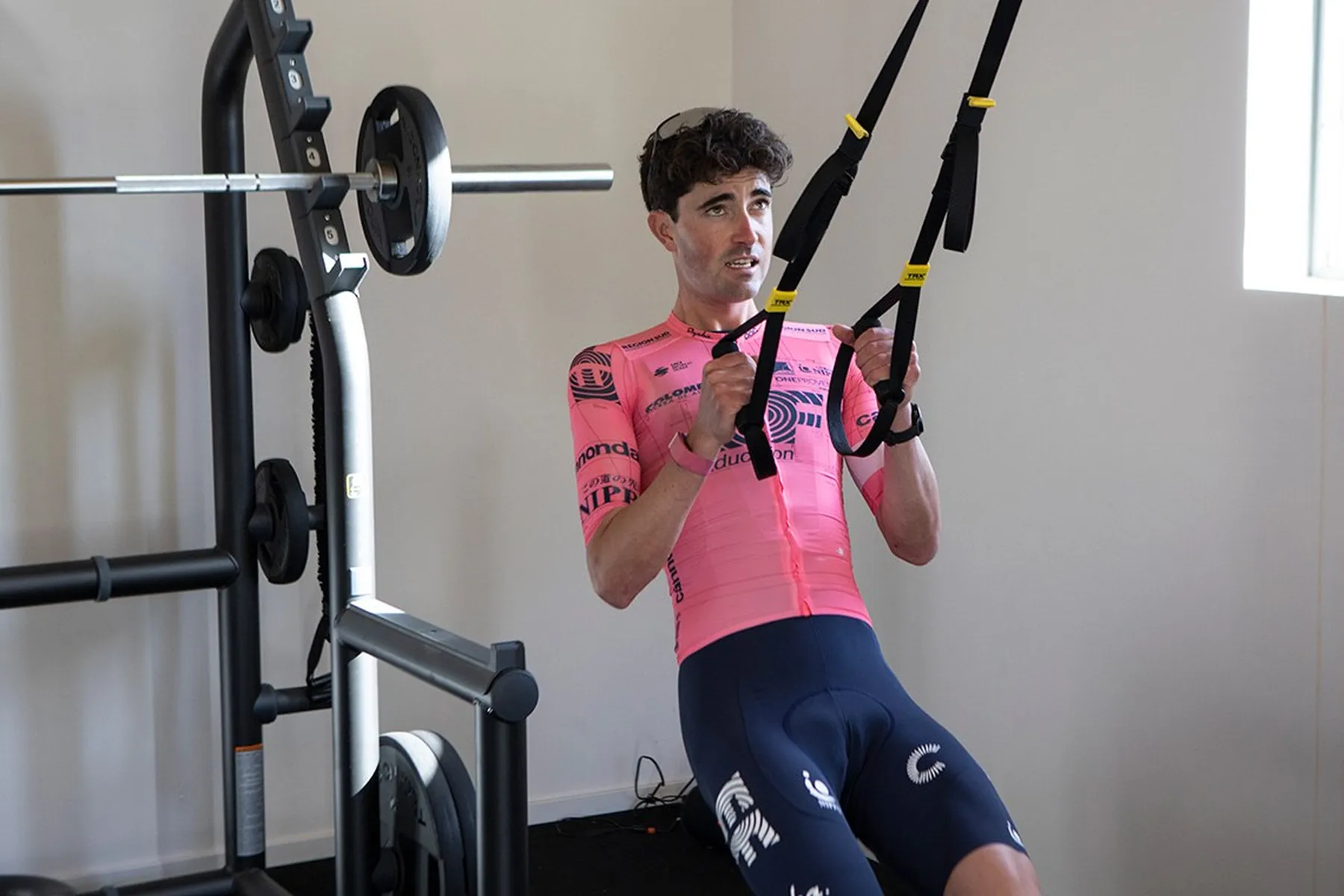
HOW TO FIT STRENGTH TRAINING AROUND CYCLING: ART O’CONNOR’S APPROACH
A free slot in the diary is not always the right slot for lifting. Start with your important rides, then consider the work on either side.
BACK TO THE BUNCH AFTER 40: GROUP-RIDE AND CHAINGANG CRAFT FOR RETURNING RIDERS
Coming back to the club run after a decade off, it isn't the fitness that worries you — it's not knowing the code. The half-wheeling, the through-and- off, the wheel you're meant to hold but not overlap. Nobody writes it down. So here it is.
BIKE FIT AFTER 40: WHY YOUR POSITION HAS TO CHANGE AS YOU AGE
Dr Andy Pruitt is blunt about it on the podcast: as you age your flexibility drops and your feet flatten, and the fit that felt perfect a decade ago slowly turns into the reason your back hurts on every long ride. The fix isn't a one-off. It's a yearly look.
CHRIS MEHLMAN'S BADLANDS PODIUM: HOW PACING AND KIT BEAT RAW POWER
Chris Mehlman averaged 180 watts for 800km of Spanish desert and finished third at Badlands 2025. His podium came from a strict power ceiling, redundant kit and a fuelling plan that broke the fat-adaptation rulebook.
RACE ACROSS AMERICA TRAINING SECRETS: HOW COLIN O'BRADY PREPARED FOR THE WORLD RECORD
Colin O'Brady reveals the exact training protocols, aerodynamic gains, and preparation strategies he used to attempt the Race Across America world record with his childhood friend.
DETRAINING AFTER 40: HOW FAST YOU LOSE FITNESS — AND HOW TO COME BACK
The high-search question nobody answers properly: how fast do I actually lose fitness? The real answer is a timeline, not a number — and after 40 the part that disappears first is exactly the part that's hardest to win back.
JOE FRIEL'S CYCLING TRAINING WEEK: WHAT HE ACTUALLY SAID
There is no universal perfect week. This transcript-checked guide separates Joe Friel's planning framework from the fixed ratios and schedules later attributed to him.
ULTRA DISTANCE CYCLING TRAINING: WHAT 37 RACES TAUGHT LAEL WILCOX ABOUT SLEEP, SETUP AND SURVIVAL
After 37 ultra races including the Trans Am record, Lael Wilcox reveals why sleep management matters more than training blocks, how gravel bikes beat mountain bikes for most terrain, and why ice cream became her primary fuel source during extreme conditions.
PROFESSIONAL GRAVEL TEAMS: INSIDE SPECIALIZED'S SUPER TEAM WITH MADS WÜRTZ SCHMIDT
European Gravel Champion Mads Würtz Schmidt joins Keegan Swenson and Matt Beers on Specialized's new super team, revealing how professional contracts and team tactics are transforming gravel cycling forever.
HOW TO CREATE A TRIATHLON TRAINING PLAN THAT ACTUALLY WORKS
Discover how Olympic triathlon coach Olav Bu designs training plans that actually work. Learn the psychology-first approach, gap analysis methods, and why chasing watts per kilogram might be sabotaging your performance.
WHAT A PRO CYCLIST'S DAILY ROUTINE ACTUALLY LOOKS LIKE
Professional cycling is not a rock-star lifestyle. EF Education's Darren Rafferty walks through the properly routine reality — daily weigh-ins, macro tracking, recovery trends read by team doctors, and the discipline that separates a World Tour day from a weekend rider's.
RACING AT 50+: HOW TO ACTUALLY BE COMPETITIVE IN MASTERS RACING
After 50 you can't burn ten matches and still have more. The young guns can. But the rider who wins the masters race usually isn't the strongest in the field — he's the one who never wasted a single effort. That's a skill, and it's trainable.
WHY CYCLISTS STRUGGLE TO LOSE WEIGHT: DR SHARON MADIGAN ON FUELLING THE BLOCK
Most cyclists fail at weight loss because they fuel by the calendar day, not the training block. Dr Sharon Madigan, who has worked with Olympic athletes for decades, explains the 24-hour approach that stops the underfuel-then-binge cycle.
SLEEP AND THE MASTERS CYCLIST: WHY RECOVERY GETS HARDER AFTER 40
The reason a hard session takes you 72 hours to absorb now instead of 48 isn't just your muscles. It's partly what's happening in the first ninety minutes after you fall asleep — and that's changing whether you notice it or not.
ZONE 1 TRAINING FOR CYCLISTS: WHY THE EASIEST RIDING BUILDS THE BIGGEST ENGINE
Zone 2 gets all the attention, but Astana's Vasilis Anastopoulos argues the foundation sits a level below it. Zone 1 riding at 55-60% of threshold builds the mitochondria and durability that make harder work possible — skip it and your gains collapse within months.
WHY YOUR HEART RATE ZONES DON'T MATCH INDOORS AND OUTDOORS
You hit Zone 2 on the road at 135 bpm. On the trainer, 135 feels like threshold. The problem isn't your fitness — it's that your body responds differently to the two environments. Here's the science and the fix.
BONE DENSITY AND CYCLING AFTER MENOPAUSE — THE STRENGTH WORK THAT MATTERS
Here is what nobody tells the lifelong female cyclist. All those miles built your engine and barely touched your bones — and at menopause, falling estrogen accelerates bone loss. It is fixable. Here is exactly how.