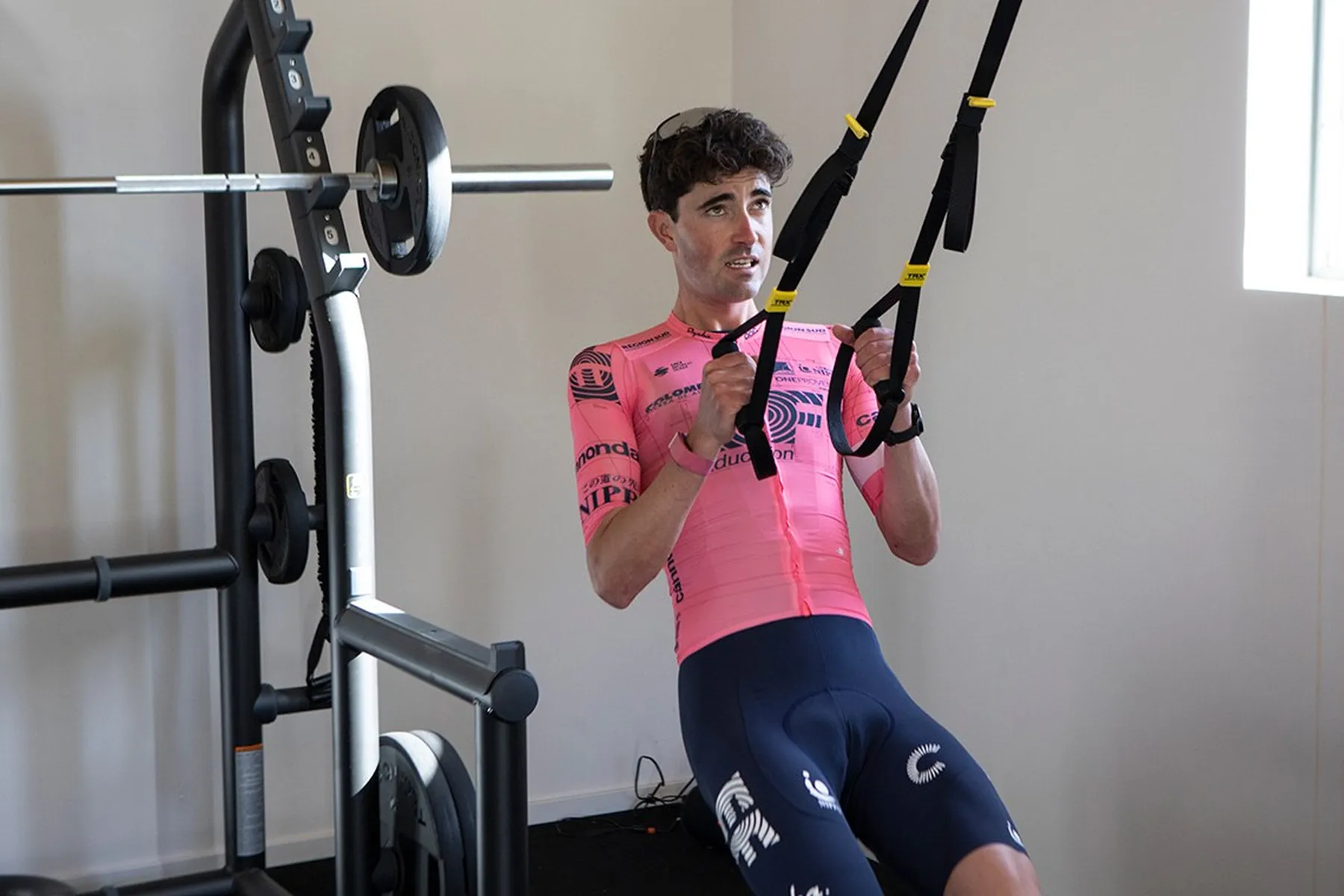
If you're a cyclist skipping strength training, you're leaving massive performance gains on the table. Art O'Connor, strength coach to pros like Keegan Swenson and Alex Wild, revealed the real difference-maker isn't monster deadlifts — it's targeted movements that access the power you already have. Most cyclists can't access their leg strength because they have weak cores and upper bodies. Three days per week, focusing on hip hinges, single-leg movements, and explosive power work will transform your cycling without adding bulk. He laid out the full system on I Tried Keegan Swenson's Strength Routine on the Roadman Cycling Podcast.
Key Takeaways
• Your legs aren't the weak link — most cyclists can't access existing leg strength due to weak cores and upper bodies • Three days per week is the sweet spot for non-professional cyclists (pros only need two due to 20+ hour bike weeks) • Focus on hip hinge movements (squats/deadlifts), single-leg work, pushing, pulling, and weighted carries • Start with 8-12 reps at light weight for 4 weeks, progress to 5-8 reps for strength, then 3-5 explosive reps for power • Stack strength sessions on hard bike days to preserve recovery — hard days hard, easy days easy • "Greasing the groove" with 3-5 sets of 3-5 bodyweight reps throughout the day maintains strength anywhere • Random periodisation (rolling dice for weekly focus) works as well as traditional linear progression • Tonnage (total weight moved) is the best metric for tracking strength training load
Why Your Core, Not Your Legs, Is Holding You Back
Here's Art's brilliant thought experiment that'll change how you think about cycling strength. Most people can leg press 300 pounds relatively easily, even untrained. But load that same weight on a barbell for squats? "If they could even get it off the rack, they're not going to be able to squat that. It's going to end really badly for them."
We've just proven their legs aren't the limiting factor. The difference between the leg press and squat? Core stability and upper body strength. When you're hammering up a climb or sprinting for a line, you need to transfer power through your entire kinetic chain. A weak core means power leaks. Weak shoulders and back mean you can't maintain position to generate maximum force.
This is why Art's programs aren't leg-centric like most cycling strength routines online. "I have yet in 30-plus years of coaching seen a person where their leg strength is the limiting factor. It's usually they can't access the leg strength they have because they have a weak core, weak upper body."
Your strength training should address what cycling doesn't give you. For most of us juggling jobs, families, and weekend racing, that means building a complete athlete. Art programs more upper body work for recreational riders than his pros because performance isn't everything — durability and general health matter more when you're not getting paid to pedal.
The pros can afford imbalances because their job is moving a pedal as fast as possible. For the rest of us, Art asks: "Does it matter if you can bench press 300 pounds if you can't run across the street without pulling a hamstring?"
The Exercises That Actually Move the Needle
Art's exercise selection is deliberately simple — no Instagram-worthy movements that look impressive but deliver minimal transfer to the bike. His foundation includes five categories you'll hit in every program.
Hip hinge movements form the cornerstone — squats or deadlifts every session. These teach you to generate power from your posterior chain, the engine room for cycling power. Start with bodyweight if needed. Art's seen plenty of lifelong cyclists who can't perform a basic squat properly due to mobility restrictions.
Single-leg movements are non-negotiable because cycling is fundamentally a single-leg sport. Bulgarian split squats and step-ups are his go-to choices. These address the imbalances that develop from always pushing both pedals and improve the stability you need when you're out of the saddle climbing or sprinting.
Upper body pushing and pulling rounds out the program. Push-ups are perfect for cyclists because they demand core strength while building the upper body stability you need to maintain position under load. "You'd be surprised how many people don't know how to do push-ups," Art notes. Most cyclists can't do a proper pull-up initially, so he scales with plank pulls and single-arm rows.
Weighted carries might seem random, but they're functional gold. Farmer's walks, suitcase carries, and overhead carries teach your core to stabilise while moving — exactly what you need when you're grinding up a 20-minute climb.
The progression is methodical. Four weeks at 8-12 reps with light weight, focusing on movement quality. Then 4-6 weeks of strength work at 5-8 reps. Advanced athletes progress to explosive power phases with 3-5 reps at 30% of max, moving fast with long recovery periods.
How to Periodise Strength Training Around Your Race Calendar
The biggest mistake recreational cyclists make is treating strength training like bodybuilding — constant progression toward failure. Art learned from Olympic lifters and powerlifters, athletes who share cyclists' need to be strong without gaining weight. Their secret? They rarely max out, spending most of their time in the 70-80% range with perfect technique.
During race season, Art drops his athletes to two sessions per week, stacked on hard bike days. Tuesday might be heavier strength work — three sets of three at 70-80% — while Thursday focuses on explosive power at 30% with maximum speed of movement. This preserves easy days for actual recovery.
The taper protocol mirrors cycling periodisation. Two to three weeks before A-events, drop the weight, increase movement speed, and extend recovery periods. "You're going to leave the gym feeling more energised than when you started," Art explains. Sessions become 30-40 minutes of explosive work that primes your nervous system rather than fatiguing it.
Here's where Art gets unconventional: he's adopted randomised periodisation based on Soviet research. Instead of traditional linear progression, he assigns strength, power, and volume focuses randomly throughout the year. "You literally roll a dice at the beginning of the week to figure out what that week's focus is going to be." Research shows this works as well as structured periodisation while preventing staleness.
For in-season maintenance when gym access is limited, Art recommends "greasing the groove" — a Pavel Tsatsouline concept using 3-5 sets of 3-5 bodyweight reps spread throughout the day. Five push-ups in the morning, three a couple hours later, repeat. By day's end, you've completed 25 reps without fatigue or soreness. This maintains strength with zero recovery cost.
What This Means for Your Training
Start with honest assessment. Can you squat to parallel with good form? Do five proper push-ups? Hold a plank for 60 seconds? If not, begin with bodyweight movements and mobility work before adding load. Art's golden rule: "Don't get hurt in the gym. Cycling is dangerous enough."
Your weekly structure should stack strength on hard bike days. If Tuesday is your threshold session, that's when you do heavier strength work. Thursday's VO2max intervals pair perfectly with explosive power movements in the gym. This protects your easy days for actual recovery and adaptation. Our complete strength training guide for cyclists lays out a full week if you want a template to start from.
Track your strength training by total tonnage moved, not perceived exertion or heart rate metrics that don't translate from cycling. If you squatted 3 sets of 5 at 100kg, you moved 1,500kg. Use this number to gauge session load and adjust accordingly.
Prioritise consistency over perfection. Art's top performers "don't miss" — they string together weeks of consistent training without gaps. Missing one session breaks your habit; missing two starts a new one. If something has to give due to life stress or training fatigue, it's always the gym session, not the bike work.
For travel or gym-less periods, pack resistance bands and focus on bodyweight movements. The "greasing the groove" approach works perfectly for hotel rooms — spread 3-5 sets of push-ups, air squats, or box jumps throughout your day. You'll maintain strength without dedicated gym time.
If you've added strength work and the gains still aren't showing up in your numbers, the limiter may be elsewhere — recovery, intensity distribution, or how the two are interacting. The Plateau Diagnostic looks at your training, recovery and progression together and shows you where the real constraint sits. Three minutes. Free.