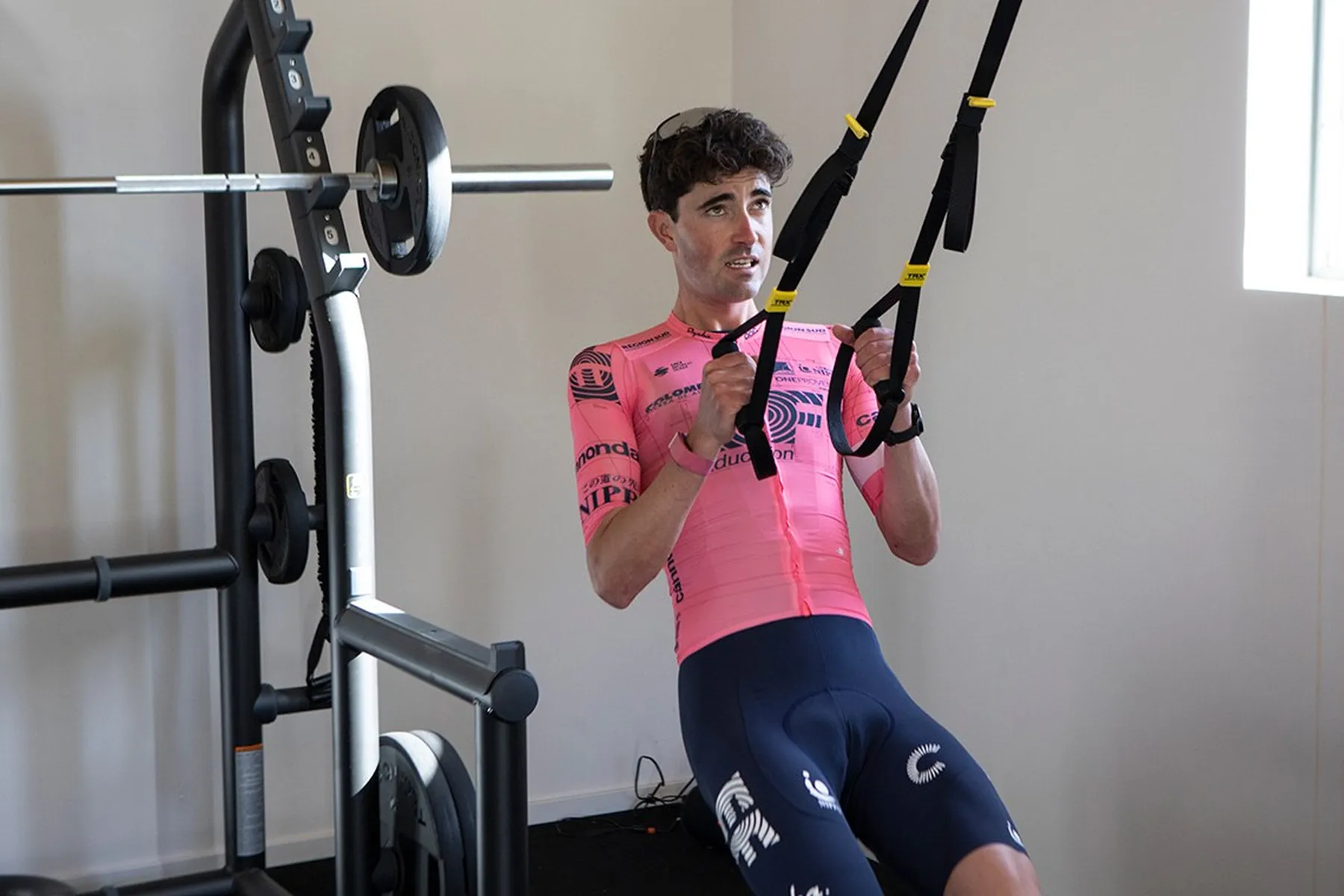
Yes, planks can be good for cyclists. They provide a simple way to train trunk endurance with no specialist equipment. But a plank is not a cycling-performance test, and no study shows that every rider needs a 60-, 90- or 120-second hold.
Use the version that challenges you without changing position. Progress when you can repeat it cleanly and it no longer provides a useful stimulus. That may mean a longer lever, a small load, controlled limb movement or a different trunk exercise—not simply a longer stopwatch battle.
What does a plank train?
A front plank is mainly an anti-extension task: gravity tries to move the pelvis and lumbar spine while the trunk muscles work isometrically to maintain the chosen position. The shoulders, hips and legs also contribute.
That can be useful. It does not prove three common claims:
- plank time predicts cycling power;
- a front plank recreates the trunk demand of pedalling; or
- a longer hold prevents back or knee injury.
The foundation cycling core routine uses planks as one option alongside dead bugs, bird dogs, Pallof presses and carries. Those exercises expose different demands; they do not form a scientific ranking.
How long should cyclists hold a plank?
There is no evidence-based universal target. Fifteen to 30 seconds can be challenging with a long lever, added load or strict stopping rule. A simpler version may allow a longer controlled set.
Use this test:
- choose one variation and starting position;
- breathe normally enough to avoid turning the set into a breath-hold test;
- stop when the position changes materially or discomfort appears;
- repeat for two or three sets; and
- record the controlled duration, not the heroic final seconds.
When the same variation is stable across several sessions, add a small amount of time or progress one other variable. A two-minute hold is not automatically better than three controlled 25-second sets of a harder version.
A practical plank progression
This is a coaching sequence, not a cyclist-tested protocol.
1. Elevated or knees-down front plank
Use a bench, wall or bent-knee position to shorten the lever. Build a repeatable position before moving the support farther from the hips.
2. Full front plank
Use elbows or hands. Keep the selected rib, pelvis and hip position while breathing. Stop before the shoulders or lower back become the only obvious limiting factor.
3. Longer-lever or lightly loaded plank
Move the elbows a little farther forward or add a small external load only when the basic variation is consistent. Change one variable, not both.
4. Slow plank shoulder tap
From a high plank, lift one hand and touch the opposite shoulder without rushing. Widen the feet or elevate the hands to regress it. This adds load shift and limb movement; it is not “more cycling-specific” by default.
5. Body saw or stir-the-pot
These variations add controlled movement around a stable trunk. Use sliders or a ball only when the equipment is secure and the movement stays small enough to control.
If wrist, elbow or shoulder comfort limits a plank, do not force the ladder. A dead bug or another suitable exercise can train trunk control without weight-bearing through the arms.
Side planks: a different job
A side plank challenges lateral trunk endurance. Start from the knees, progress to straight legs and then consider a longer lever or modest load.
It is not universally better than a front plank. It simply trains a different direction. Use it when that direction belongs in the programme and when the rider can tolerate the support position.
What comes after planks?
Moving “beyond” the plank does not require an unstable surface or a complex exercise. Three useful options are:
| Exercise | New demand | Progression boundary |
|---|---|---|
| Pallof press | External rotation force while standing or kneeling | Press without leaning or turning; add band tension gradually. |
| Suitcase carry | Lateral load while walking | Keep normal gait and trunk position; add load before excessive distance. |
| Dynamic dead bug | Limb movement around a floor-based trunk position | Add range, lever or resistance only while control remains stable. |
The exercise that looks most like cycling is not necessarily the one that transfers best. Transfer needs an outcome measured on the bike.
What the research says about transfer
The most-cited cyclist study is often overstated. In 2007, researchers deliberately fatigued the core of 15 competitive cyclists before repeating an exhaustive cycling test. Some knee and ankle motion increased, but pedal force and work did not change. The study did not test planks, a progression programme or future injury rates.
A 2023 meta-analysis of randomized athlete trials found larger effects for core endurance and balance but little effect on sport-specific performance. This makes a plank a plausible trunk-endurance tool, not a shortcut to power or speed.
In a small 2024 study of 36 trained road cyclists, conventional resistance training outperformed the tested core programme across five-second, 60-second, five-minute and 20-minute power outcomes. That does not make all isolated core work useless. It does argue against giving it priority over a complete strength programme when power is the goal.
Planks and cycling back pain
A review of eight cyclist biomechanical studies reported associations among low-back pain, lumbar position, muscle activation and extensor endurance. Association is not proof that planks prevent or treat pain.
Pain altered by cycling position may need a bike-fit and load review. Persistent or worsening pain, trauma, numbness, weakness, night pain, fever, unexplained weight loss or bowel/bladder changes need qualified assessment. The cycling back-pain guide sets out the wider decision.
Where planks fit in the riding week
Use one or two plank variations inside a short core circuit or full-body strength session. Two weekly exposures is a practical starting point, not a research-proven optimum.
Place demanding work after the priority ride, later that day or on a separate day. A light rehearsal in a warm-up should end well before fatigue. If harder plank variations repeatedly reduce the next key ride, reduce the sets, change the placement or remove the exercise.
The strength-session planner maps the work around actual rides. The 12-week beginner plan shows how a small trunk dose fits inside a complete programme.
How to measure progress honestly
Record:
- variation and support position;
- controlled hold time or repetitions;
- lever, load and rest;
- reason the set ended; and
- whether the wider training week stayed productive.
A better plank proves improvement at that plank. If the goal is better late-ride position, power or comfort, measure that outcome separately and avoid changing the bike fit, training load and exercise programme at the same time when possible.
From progression ladder to adaptive programming
Roadman's upcoming iPhone app is designed to choose an appropriate trunk progression inside a 30, 45 or 60-minute cyclist-specific strength session and adjust the dose with explainable readiness guardrails. See the strength and recovery app and join the single early-access list.
Sources and editorial limits
- Relationship between cycling mechanics and core stability (PMID 18076271)
- Core training and sport-specific performance meta-analysis (PMID 36829378)
- Conventional resistance training compared with core exercises in road cyclists (PMID 38817493)
- Body position, muscle activity and spinal kinematics in cyclists with low-back pain (PMID 27784817)
This page was last reviewed on 31 August 2026. It is educational, not diagnosis, treatment, rehabilitation or proof of one optimal cycling core progression. Corrections and source challenges can be submitted through the Roadman corrections page.