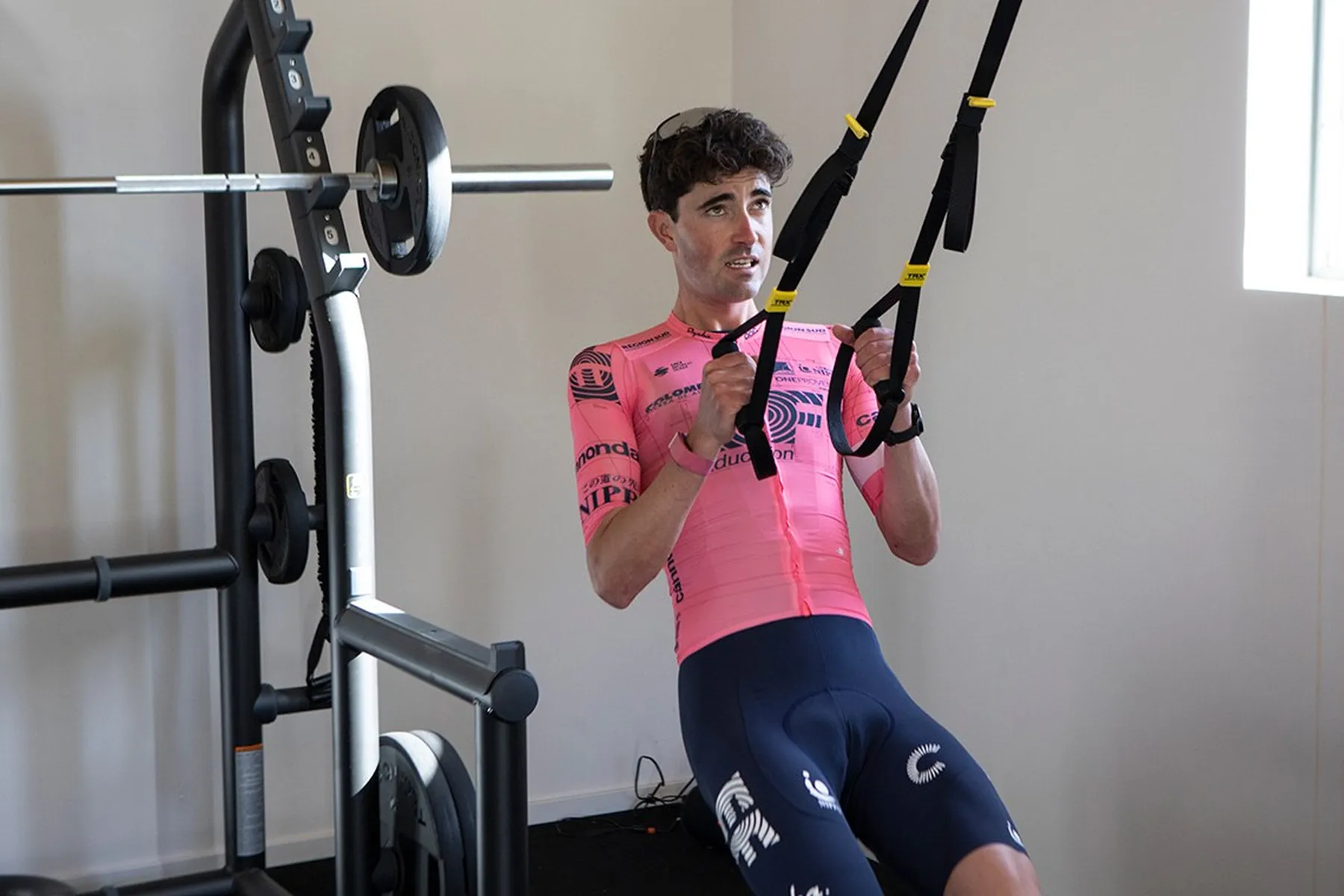
You have probably never thought about the direction your muscles work when you pedal. There is no reason you would. You push down, the crank turns, you go forward. The movement feels complete. But there is a gap in the loading pattern that most cyclists carry for years without realising it, and it only shows up when the terrain, the event, or the calendar puts a demand on the body that the pedal stroke never prepared it for.
That gap is the eccentric phase. The lowering part. The part where muscles lengthen under tension rather than shorten. And cycling, for all its virtues, almost completely ignores it.
Concentric in, eccentric out
Every muscle contraction has two phases. The concentric phase is the shortening — the part where the muscle generates force while getting shorter. When you push down on the pedal, your quads shorten concentrically. Your glutes shorten concentrically. The power you produce during the downstroke is concentric power.
The eccentric phase is the opposite. The muscle lengthens under load, acting as a brake. Walking downstairs. Lowering a weight. Absorbing impact. Running downhill. These are eccentric demands. The muscle is still working — it is under tension, producing force — but it is getting longer rather than shorter.
Cycling is one of the most concentric-dominant sports in existence. The downstroke is concentric. The upstroke, for most riders, is a passive recovery. There is no meaningful eccentric load at any point in the pedal revolution. You can ride 15 hours a week for 20 years and never once impose a significant eccentric demand on your quads, calves or hamstrings through cycling alone.
This matters more than most riders think.
Where the gap shows up
If you have ever finished a mountainous sportive and been unable to walk downstairs the following day, you have met the gap. If you have ever done a duathlon and felt fine on the bike but destroyed from the run, same gap. If you have hiked-a-bike up a gravel climb and felt the quads burning in a way that 200 watts never produces, that is the eccentric component of hiking — and your cycling legs were not ready for it.
Long descents load the quads eccentrically through sustained braking forces. Running loads the calves, quads and hamstrings eccentrically on every single stride — and the longer you run, the more the eccentric damage accumulates. Hiking uphill with a bike on your shoulder loads the calves and quads eccentrically through the deceleration of each step. Walking over rough terrain loads the ankle stabilisers eccentrically.
None of these demands exist in the pedal stroke. But all of them exist in the events that cyclists enter.
The result is predictable. A rider with an FTP of 280 watts and 12 hours of weekly saddle time turns up at a mountainous gran fondo with 4,000 metres of climbing. The climbing is fine. The rider is aerobically prepared. The descents, though — 40 minutes of sustained braking, quads absorbing load eccentrically through every switchback — produce muscle damage out of proportion to the effort. Two days later, the rider's legs are wrecked. Not cardiovascular fatigue. Structural damage. Microtears in muscle fibres that were never trained to lengthen under load.
The repeated bout effect
The most useful concept in the eccentric training literature is the repeated bout effect. Nosaka and colleagues demonstrated it clearly across multiple studies through the 1990s and 2000s: the first bout of eccentric exercise targeting a muscle group produces substantial damage, inflammation and delayed-onset muscle soreness (DOMS). But the second bout — even if it occurs two to six weeks later — produces markedly less damage. Sometimes 50-70 per cent less.
This is not just perceived soreness. The reduction shows up in blood markers of muscle damage (creatine kinase), in force production recovery timelines, and in imaging of the muscle tissue itself. The muscle adapts structurally after a single exposure to eccentric load. It adds sarcomeres in series, remodels the connective tissue, and adjusts its length-tension relationship so that subsequent eccentric demands cause less disruption.
The protection lasts. Studies by Nosaka and by Isner-Horobeti's research group have shown the repeated bout effect persisting for weeks to months after a single session. Douglas and colleagues extended this further, demonstrating that the protective effect is dose-dependent — more initial sessions produce stronger and longer-lasting protection.
For cyclists, the implication is direct. You do not need to become a gym athlete. You need to expose the relevant muscles to eccentric loading a handful of times before the event that will demand it. The first session will hurt. The second will hurt less. By the fourth or fifth, the muscles have adapted to the point where the same descent or the same run produces a fraction of the damage it would have without any preparation.
Tendons need eccentric load too
The conversation about eccentric training for cyclists does not stop at muscle protection. It extends to tendons, and for many riders — particularly those over 35 — the tendon piece is the more important one.
Tendons respond to eccentric load differently from how they respond to concentric load. Alfredson's landmark work on Achilles tendinopathy, published in 1998, demonstrated that a programme of eccentric calf raises — 3 sets of 15 repetitions, twice daily, for 12 weeks — produced an 89 per cent success rate in treating chronic mid-portion Achilles tendinopathy. This was a population that had failed other conservative treatments. The mechanism is collagen remodelling: eccentric loading stimulates the tendon to lay down new, organised collagen while breaking down the disorganised, painful tissue.
Silbernagel's subsequent research refined the protocol and extended it to broader populations, finding that eccentric-concentric combinations and heavy slow resistance protocols also work, with the common element being that the tendon receives controlled loading through its lengthening range.
Cyclists are not immune to tendon problems. Achilles tendinopathy from cleat position issues, patellar tendinopathy from saddle height or crank length mismatches, and proximal hamstring tendinopathy from aggressive time trial positions all show up in the cycling population. The standard rehabilitation for each includes eccentric loading. The logical step — which almost no cycling training plan includes — is to use the same protocols preventively.
Eccentric calf raises, performed 3 sets of 15 with a 3-5 second lowering phase, two to three times per week, will build Achilles tendon resilience that no amount of pedalling will provide. Eccentric step-downs target the patellar tendon. Slow eccentric hamstring work addresses the proximal hamstring. These are small investments in time — 10 minutes per session — with disproportionate protective returns.
The six exercises
The programme does not need to be complicated. Six movements, performed with deliberate eccentric tempo, cover the relevant muscle groups and tendons for cyclists. None of these are heavy compound barbell lifts. Most require a step, a wall, and bodyweight.
1. Eccentric calf raises
Stand on a step edge with the balls of the feet on the step and the heels hanging off. Rise onto both toes (the concentric phase), then shift your weight to one leg and lower slowly on that single leg over 3-5 seconds. Use the other leg to help you back up, then repeat on the same side. 3 sets of 12-15 each leg. This is the modified Alfredson protocol adapted for prevention rather than rehabilitation.
2. Eccentric heel drops (straight knee and bent knee)
Similar setup to the calf raise, but performed with the knee straight to target the gastrocnemius and then with a 20-30 degree knee bend to bias the soleus. The soleus is heavily active in the pedal stroke and in any off-bike walking or running. 3 sets of 15 each variation, 3-4 second lowering.
3. Eccentric step-downs
Stand on a step or box approximately 20cm high. With one foot on the step, slowly lower the opposite foot towards the ground over 3-4 seconds by bending the stance knee. Lightly touch the heel to the ground, then drive back up. The stance leg does the eccentric work. This is the primary exercise for patellar tendon loading and quad eccentric capacity. 3 sets of 10-12 each leg.
4. Slider hamstring curls
Lie on your back with knees bent and feet on furniture sliders (or a towel on a smooth floor). Lift the hips into a bridge position, then slowly slide the feet away from you, extending the legs over 4-5 seconds while maintaining the bridge. The hamstrings lengthen under load throughout the movement. Walk the feet back in and repeat. 3 sets of 8-10 repetitions. Swiss ball hamstring curls are the progression — the unstable surface increases the eccentric demand.
5. Tempo split squats (bodyweight)
Stand in a split stance, rear foot elevated on a low step or flat on the ground behind you. Lower slowly over 4 seconds, maintaining an upright torso. Drive back up in 1 second. The front-leg quads and glutes absorb the eccentric load throughout the lowering phase. 3 sets of 8-10 each leg. Bodyweight is sufficient for the eccentric adaptation. If you want to add load, hold a pair of dumbbells — never a barbell across the back for this population.
6. Eccentric single-leg press
If you have access to a leg press, this is the most controllable way to apply eccentric load to the entire lower limb. Press up with both legs, remove one foot, and lower with the working leg over 4-5 seconds. Replace the other foot and press up again. The machine constrains the movement, which makes it easier to maintain the tempo. 3 sets of 8 each leg. Start with a load approximately 60 per cent of your bilateral working weight.
For hamstring injury prevention specifically, Nordic curl progressions are worth adding. The full Nordic curl is an advanced movement, but slider curls and Swiss ball curls serve as accessible alternatives that deliver the same eccentric hamstring loading pattern without requiring a partner or specialist equipment.
Tempo: the variable that matters most
Most people who do resistance training lower the weight in about one second. They are not doing eccentric training. They are doing concentric training with an uncontrolled return.
The eccentric adaptation — the structural remodelling, the sarcomere addition, the tendon collagen response — requires time under tension during the lengthening phase. The tempo prescription is how you ensure it.
The standard notation is four numbers: eccentric-pause-concentric-pause, each in seconds.
A 4-0-1-0 tempo means: four seconds lowering, no pause at the bottom, one second lifting, no pause at the top.
A 5-0-1-0 tempo is harder: five seconds lowering, same lift.
A 3-1-1-0 tempo adds a one-second pause at the bottom — useful for eliminating the stretch-shortening cycle and making the concentric phase harder.
For the exercises in this programme, the prescription is:
| Exercise | Tempo | Sets x Reps |
|---|---|---|
| Eccentric calf raises | 4-0-1-0 | 3 x 12-15 each leg |
| Eccentric heel drops | 3-0-1-0 | 3 x 15 each variation |
| Eccentric step-downs | 4-0-1-0 | 3 x 10-12 each leg |
| Slider hamstring curls | 5-0-1-0 | 3 x 8-10 |
| Tempo split squats | 4-0-1-0 | 3 x 8-10 each leg |
| Eccentric single-leg press | 4-0-1-0 | 3 x 8 each leg |
A single session covering four to five of these exercises takes 25-35 minutes including rest periods. The time commitment is not what holds riders back. The soreness from the first two sessions is.
The DOMS warning
This needs its own section because it will affect your training week.
The first time you perform a dedicated eccentric session — particularly if you have never done slow eccentric work before — you will experience delayed-onset muscle soreness that peaks 24-72 hours after the session. For some riders, it persists for four to five days. It will feel disproportionate to the effort of the session itself. You will wonder if you did something wrong. You did not.
Eccentric contractions produce more microdamage to muscle fibres than concentric contractions at equivalent loads. This is the physiological basis of the repeated bout effect: the damage triggers the remodelling that provides future protection. But the first exposure is the worst.
Practical guidelines:
- Start with two sets per exercise, not three. The adaptation stimulus is the same; the damage is lower.
- Use bodyweight or light loads for the first two sessions. Progression comes later.
- Do not schedule an eccentric session within 48 hours before a key ride. The soreness will compromise your cycling. Schedule eccentric work early in the week if your key sessions are Thursday/Saturday, or on Monday if your weekend rides matter most.
- Expect the second session to be better. Not pain-free, but measurably better.
- By sessions four and five, the soreness should be manageable — present the next morning, largely gone by afternoon.
The worst mistake is to do a hard eccentric session on a Wednesday, feel terrible on Friday, abandon the protocol, and conclude that eccentric training does not work for you. What happened is that you experienced a normal physiological response and bailed before the adaptation completed.
Programming for your season
Eccentric work sits alongside your existing strength training, not instead of it. If you are already lifting twice per week using the Roadman strength protocols, the eccentric exercises integrate as accessory work at the end of each session.
If you are not currently lifting, eccentric training is the minimum viable gym intervention. Two sessions per week, 25-30 minutes, covering the six exercises above.
Off-season (base phase): Two eccentric sessions per week. Full exercise menu. This is when you build the eccentric capacity and accumulate the repeated bout exposure. Run the full programme for 6-8 weeks during the base phase and you enter the build phase with tendon and muscle resilience that will carry through the season.
Build phase: Maintain one to two sessions per week. Reduce volume slightly — two sets per exercise rather than three — to manage total training load. The eccentric capacity built during base persists for weeks even with reduced frequency.
Pre-event (8-10 weeks out): If you have not been doing eccentric work and you have a mountainous sportive, a gravel race with hike-a-bike, or a duathlon on the calendar, start now. Eight weeks gives you time to clear the initial DOMS phase (weeks 1-2), build the repeated bout protection (weeks 3-6), and taper the eccentric work (weeks 7-8) so you arrive at the start line protected but fresh.
Race week: No eccentric work in the final 5-7 days before an event. The protection is already in place. The residual fatigue from a session is not.
Masters riders: the case is stronger
After 35, and with increasing urgency after 50, eccentric training addresses a problem that cycling alone cannot touch.
Sarcopenia — age-related muscle loss — runs at roughly 3-8 per cent per decade from the mid-30s. The loss is not uniform. Type II (fast-twitch) fibres atrophy faster than type I (slow-twitch). This matters because type II fibres are the ones responsible for force absorption during eccentric loading. The older rider who has never trained eccentrically has lost both the muscle mass and the specific fibre type needed to handle descents, running, and uneven terrain.
LaStayo and colleagues published a series of studies through the 2000s and 2010s demonstrating that eccentric ergometer training in older adults — specifically, pedalling a motorised ergometer that forced the muscles to lengthen under load — improved muscle quality, reduced fall risk, improved balance, and preserved type II fibre size more effectively than traditional concentric resistance training at matched metabolic cost. The eccentric group got stronger with lower cardiovascular demand. For ageing cyclists who are already aerobically trained but losing muscle quality, this is a relevant finding.
The practical application does not require a motorised ergometer. The six exercises above deliver eccentric loading through the relevant muscle groups. For masters riders specifically, the investment pays compound interest: better tendon health, better muscle quality, better resilience to the demands that cycling ignores, and a measurably slower rate of the strength decline that cycling alone cannot prevent.
Research by Douglas and colleagues reinforced that the protective effects of eccentric training are particularly valuable in older populations, where the baseline susceptibility to eccentric muscle damage is higher and the recovery from unprotected damage is slower. A masters rider who arrives at an alpine sportive without eccentric preparation will take longer to recover from the descent-induced damage than a younger rider with the same lack of preparation. The cost of skipping eccentric work scales with age.
What this looks like in practice
A rider in the Not Done Yet community training for a mountainous sportive in October might programme it this way:
August (8 weeks out): Introduce eccentric work twice per week. Eccentric calf raises, step-downs, slider curls, and tempo split squats. Bodyweight or light load. Two sets per exercise. Expect significant DOMS in week one. Plan an easy ride day for 48 hours after the first session.
September (4 weeks out): Progress to three sets per exercise. Add the eccentric single-leg press if gym access allows. DOMS should be minimal by now. Maintain two sessions per week.
Early October (2 weeks out): Drop to one session per week. Two sets per exercise. The protection is built. The goal now is maintenance without fatigue accumulation.
Race week: No eccentric work. Ride easy. Arrive protected.
The rider who follows this block will descend the same 40-minute Alpine pass as the rider who did not. Both will use the same muscles. Both will absorb the same eccentric forces. The prepared rider will walk normally the next day. The unprepared rider will struggle with stairs for three.
The pedal stroke builds extraordinary concentric fitness. It builds cardiovascular capacity, metabolic efficiency, and the ability to sustain power for hours. It does not build the capacity to absorb force. That is a separate quality, trained through a separate mechanism, and it takes less time than most riders expect. Two sessions a week. Six movements. Controlled tempo. Thirty minutes.
The work that the pedal stroke misses is the work that keeps you moving when the road tilts the other way.
If you want structured programming around your riding, the Not Done Yet community on Skool is where we build training blocks, talk through protocols, and fit the gym work into real cycling weeks. Strength, riding, recovery — all integrated, nothing in isolation.