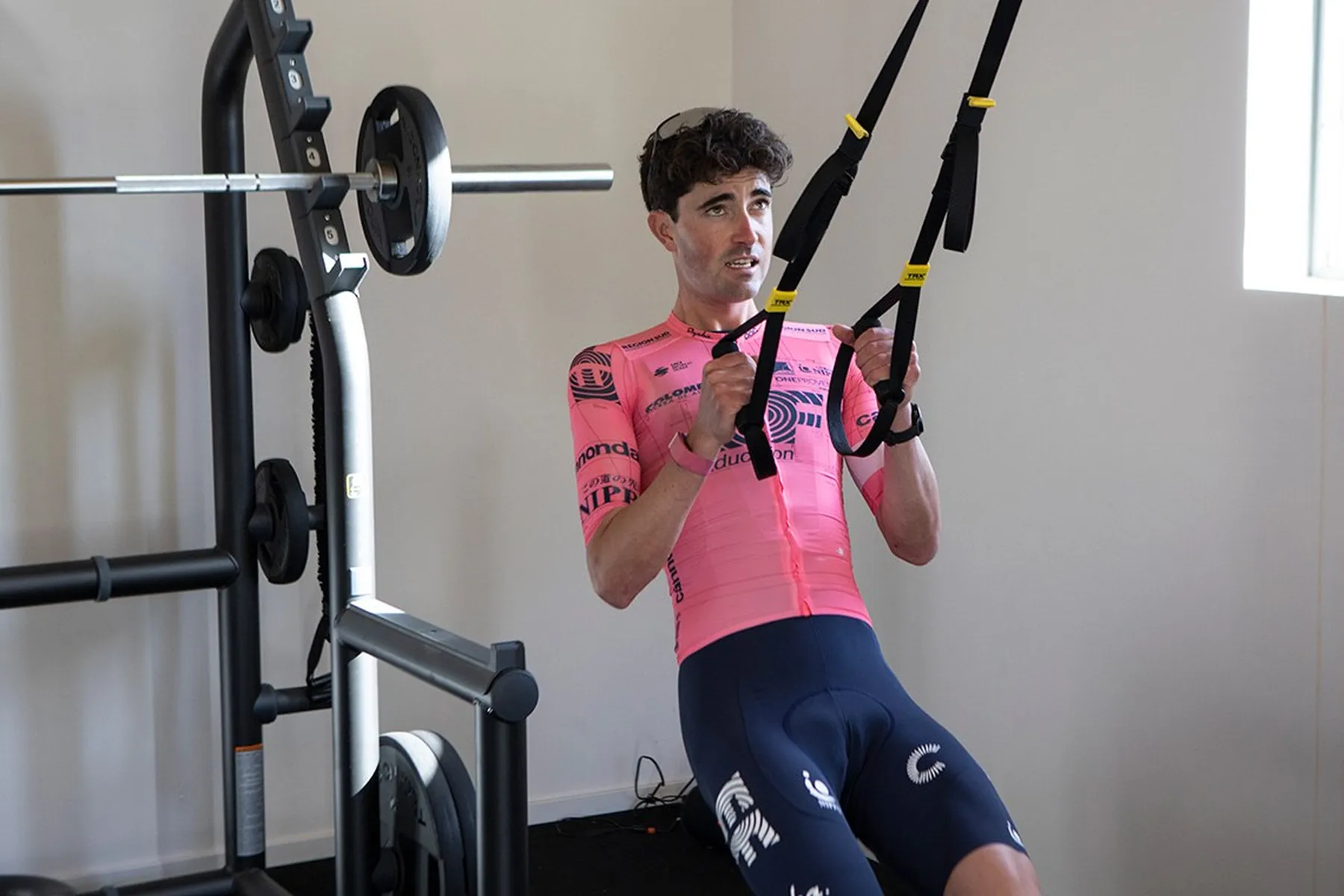
Here's the thing nobody tells you about getting stronger for cycling: you don't always need to move.
Most riders think strength training means loading a barbell, grinding through sets, hobbling around for two days afterwards, and then trying to hit intervals on legs that feel like they've been filled with concrete. That's one way to do it, and there's a time and place for dynamic resistance work. But there's an entire category of strength training that produces real, measurable adaptations — particularly for tendons and blood pressure — with almost zero recovery cost. And it takes 15 minutes.
Isometric training. Holding a position under tension without moving through a range of motion. Wall sits. Bridge holds. Calf raise holds. Plank variations. The kind of exercises that look boring, feel quietly brutal, and produce results that the research literature has been increasingly clear about for the last decade.
If you're over 35, riding consistently, and either skipping the gym entirely or looking for something that fits around your riding without wrecking recovery, this is worth your attention.
What isometric training actually is
An isometric contraction is muscle activation without joint movement. Your muscles generate force, but the joint angle stays fixed. Think of pressing your hands together in front of your chest as hard as you can — your pectorals and shoulders are working flat out, but nothing moves.
Contrast this with the two other contraction types: concentric (muscle shortens — the "up" phase of a push-up) and eccentric (muscle lengthens under load — the "down" phase). Dynamic exercises combine both. Isometrics isolate the third option — tension without motion.
This matters because the body adapts differently to isometric loading than it does to dynamic loading. The tendon response in particular is distinct, and for cyclists dealing with chronic tendon issues — patellar tendinopathy being the classic one — isometrics produce something that dynamic exercises struggle to replicate on the same timeline.
The tendon evidence
Let me break this down, because the tendon research is where isometrics shifted from "physio trick" to serious training tool.
Jill Cook and Craig Purdam's work at La Trobe University in Melbourne changed how sports medicine approaches tendinopathy. Their 2009 continuum model of tendon pathology showed that tendons don't simply "inflame and heal" — they progress through stages of reactive tendinopathy, tendon disrepair, and degenerative tendinopathy. And the loading strategy that works depends on where you are in that continuum.
Isometric loading fits at every stage. A 2015 study published in the British Journal of Sports Medicine by Rio and colleagues found that isometric loading protocols reduced patellar tendon pain by 70 per cent in athletes — in-season, without reducing their training load. That outperformed both rest and eccentric loading in the short term. The mechanism appears to be a combination of cortical inhibition of pain pathways and direct mechanical stimulus to tendon cells.
For cyclists, this is directly relevant. Patellar tendinopathy is one of the most common overuse injuries in the sport. The repetitive loading pattern of the pedal stroke — thousands of sub-maximal knee extensions per ride — stresses the patellar tendon in a way that often leads to that familiar dull ache below the kneecap. And the traditional advice of "rest until it settles" is now known to be exactly wrong for most tendinopathies. Tendons need load to heal. Isometric load is the entry point.
The protocol that the research supports for patellar tendon issues: five sets of 45-second holds at roughly 60 degrees of knee flexion (a shallow wall sit position), performed daily. Pain should be manageable during the hold — a 3-4 out of 10 at most. If it's higher, reduce the depth or the duration. If it's zero, you can increase the time under tension or add load.
The blood pressure evidence
This is where most people are quite surprised. A 2023 meta-analysis published in the British Journal of Sports Medicine by Edwards and colleagues analysed 270 randomised controlled trials involving over 15,000 participants. They compared the blood pressure effects of aerobic exercise, dynamic resistance training, combined aerobic and resistance training, high-intensity interval training, and isometric exercise training.
Isometric exercise came out on top. The average reduction in systolic blood pressure was 8.24 mmHg — more than any other exercise modality. To put that in context, a reduction of 5 mmHg in systolic blood pressure is associated with roughly a 10 per cent reduction in cardiovascular events. Eight millimetres of mercury is clinically meaningful.
The most studied protocol for blood pressure reduction: four sets of two-minute wall sits with two-minute rest between sets, three times per week. That is 16 minutes of actual work per week — total. The blood pressure reductions were observed after as little as four weeks and persisted as long as the training continued.
For the masters cyclist population — riders in their forties, fifties, and beyond — this is significant. Hypertension prevalence rises sharply with age, and most cyclists are already doing plenty of aerobic work. Adding 15 minutes of isometric holds three times a week addresses a cardiovascular risk factor that the riding alone may not be managing as well as you think.
The exercises
Four isometric holds cover the major muscle groups that matter for cycling. None require equipment. All can be done in your kitchen.
Wall sit
The single most studied isometric exercise in the literature — for both tendon health and blood pressure — and the foundation of any cycling isometric programme.
How to do it: Stand with your back flat against a wall. Walk your feet out and slide down until your thighs are parallel to the floor, knees bent at roughly 90 degrees. Your knees should be directly above your ankles, not pushed forward past your toes. Press your lower back into the wall. Hold.
The catch: Most cyclists will find that their weaker leg starts trembling first, or that they unconsciously shift weight onto the stronger side. Pay attention to that. It's information.
Progression: Start at 30-second holds if you've not done these before. Build to 45 seconds, then 60, then 90, then the full two-minute holds used in the blood pressure research. Once two minutes feels manageable, try a single-leg wall sit — one leg extended in front of you, all the load on the working leg. The difficulty increase is dramatic.
Programming: 3-4 sets, 30-90 second holds (or 2-minute holds if training for blood pressure reduction), 60-90 seconds rest between sets.
Split-stance variation for asymmetry: Place one foot slightly ahead of the other and shift roughly 60-70 per cent of your weight onto the rear leg. Hold. Switch sides. This bridges the gap between bilateral wall sits and full single-leg holds, and it directly addresses the left-right strength imbalance that cycling creates and reinforces.
Single-leg hip bridge hold
The glutes are the biggest power producers in the pedal stroke, and they're the muscles most amateur cyclists underuse. A single-leg hip bridge hold isolates glute activation on one side at a time.
How to do it: Lie on your back with knees bent, feet flat on the floor. Extend one leg straight so it's hovering above the ground. Drive through the heel of the planted foot and lift your hips until your body forms a straight line from shoulders to knee. Hold at the top. Keep your hips level — the tendency is to let the unsupported side drop.
What to feel: A deep burn in the glute of the working leg. If you feel it primarily in your hamstring or lower back, you're compensating — squeeze the glute harder before you lift, and check that your planted foot isn't too far from your body.
Programming: 3-4 sets of 20-45 second holds per side, 60 seconds rest between sets. Alternate legs within the set or complete all sets on one side before switching.
Calf raise hold
Achilles tendinopathy is the other overuse injury that nags cyclists, particularly those who ride in an aggressive position with significant heel drop. Isometric calf loading is now a standard first-line treatment in sports physiotherapy, and it's equally useful as prevention.
How to do it: Stand on the edge of a step with the balls of your feet on the step and your heels hanging off. Rise up onto your toes as high as you can. Hold at the top. For the single-leg version, lift one foot and hold all the load on the other.
The key detail: The hold position matters. For Achilles tendon health, the evidence supports holds at the top of the range (full plantarflexion). For soleus-dominant work — which is more relevant to the seated pedalling position — do the hold with a slight knee bend, which shifts load from the gastrocnemius to the soleus.
Programming: 3-4 sets of 30-45 second holds per leg, 60 seconds rest. Both straight-knee and bent-knee versions if you have time.
Plank variations
Core isometrics matter for cyclists because trunk stability determines how efficiently force transfers from your legs to the pedals. A weak core means energy leaks — your pelvis rocks, your upper body sways, and watts get absorbed by movement that doesn't drive the bike forward.
Standard plank: Forearms on the floor, body in a straight line from head to heels, hips level, glutes and abs engaged. If you can hold this for 60 seconds without form breakdown, it's time to progress.
Side plank: Forearm on the floor, feet stacked or staggered, hips lifted, body in a straight line. This targets the obliques and hip stabilisers — the muscles that prevent lateral pelvic drop when you're pushing hard on one pedal.
Copenhagen plank (advanced): Side plank position with the top leg supported on a bench and the bottom leg hanging free, or vice versa. This loads the adductors isometrically — a muscle group that contributes to pedalling efficiency more than most riders realise.
Programming: 2-3 plank variations, 3 sets of 30-60 seconds each, 45-60 seconds rest.
Programming isometrics into the cycling week
This is where isometrics really shine compared to dynamic strength work. The systemic fatigue cost is close to zero.
A full dynamic strength session — Bulgarian split squats, hip thrusts, step-ups — produces meaningful delayed-onset muscle soreness for 24-48 hours afterwards and creates enough neuromuscular fatigue that the next day's riding quality drops. That's manageable, but it requires careful scheduling.
An isometric session produces almost none of that. The eccentric component — which is the primary driver of muscle soreness — is absent. You can do a full isometric session on a Monday evening and ride quality intervals on Tuesday morning without noticing a thing.
The recommended structure: 15-20 minutes, three times per week, on easy ride days or rest days.
A sample session:
- Wall sits — 4 x 90 seconds, 90 seconds rest
- Single-leg hip bridge holds — 3 x 30 seconds per side, 60 seconds rest
- Single-leg calf raise holds — 3 x 30 seconds per side, 60 seconds rest
- Side plank — 3 x 30 seconds per side, 45 seconds rest
Total time: 18-20 minutes including transitions. No warm-up needed beyond a minute of walking around to loosen up. No equipment. No gym. No soreness the next day.
When to do them: After an easy ride is ideal. Before bed works. First thing in the morning works. The flexibility is the point — there is no wrong time as long as you're not doing them immediately before high-intensity efforts on the bike.
Integration with dynamic strength training: If you're already doing two gym sessions per week, add isometrics on two of your non-gym days. The adaptations are complementary, not redundant. The gym work drives maximum strength and power. The isometric work builds tendon resilience, maintains activation patterns, and contributes the blood pressure benefit that dynamic work doesn't match.
Isometrics for tendon rehabilitation
If you're already dealing with a tendon issue — patellar tendinopathy, Achilles tendinopathy, proximal hamstring tendinopathy — isometric loading is often the starting point before progressing to eccentric and then full dynamic loading. The protocol from Ebonie Rio's research that's become the clinical standard:
For patellar tendinopathy:
- Exercise: Wall sit at 60 degrees of knee flexion (a relatively shallow sit)
- Protocol: 5 sets of 45-second holds
- Intensity: Pain should be no more than 3-4 out of 10 during the hold
- Frequency: Daily, ideally before training or riding
- Expected timeline: Meaningful pain reduction within 1-2 weeks; structural tendon adaptation over 12+ weeks
For Achilles tendinopathy:
- Exercise: Single-leg calf raise hold at full plantarflexion
- Protocol: 5 sets of 45-second holds
- Intensity: Same pain threshold — 3-4 out of 10 maximum
- Frequency: Daily
- Progression: Once daily holds are comfortable, add load with a rucksack or hold a dumbbell
The critical point: these protocols are not instead of seeing a physiotherapist. They're what your physiotherapist is likely to prescribe. Having the protocol before the appointment means you can start sooner and arrive informed.
The honest limitations
Isometrics are not a complete strength programme. They fill a specific gap — tendon health, blood pressure, low-fatigue maintenance — and they fill it better than anything else. But they have real limitations you need to understand.
Angle specificity. Strength gains from isometric holds occur primarily at the joint angle you train, plus or minus roughly 15 degrees. A wall sit at 90 degrees of knee flexion makes you stronger at 75-105 degrees. It doesn't do much for the near-full-extension portion of the pedal stroke. This is why you need multiple positions — different wall sit depths, different bridge angles — to cover the range of motion the bike uses.
No eccentric component. Eccentric loading — where the muscle lengthens under tension — drives muscle growth and a specific type of tendon adaptation that isometrics don't replicate. For long-term strength development, you need both. Isometrics are the entry point and the maintenance tool, not the whole programme.
Limited power development. Power is force multiplied by velocity. Isometrics train force at zero velocity. They won't improve your sprint or your ability to produce force quickly. For that, you need dynamic and plyometric work.
Plateau potential. The adaptations from isometric training come relatively quickly — 4-8 weeks for meaningful gains — and then slow considerably. If you're doing isometrics as your only off-bike strength work, you'll reach the ceiling faster than with a progressive dynamic programme.
When dynamic training is better
Isometrics are not a replacement for structured dynamic strength work if you can make the time for it. They're a complement, or an alternative when circumstances don't allow gym access.
Dynamic training is better when:
- You're building peak strength. Progressive overload through full range of motion produces greater maximum strength gains than isometric holds alone.
- Sprint power matters. If your racing involves surges, attacks, and sprints, you need exercises that train force production at speed — step-ups, Bulgarian split squats with intent, plyometrics.
- You're in an off-season strength block. This is the time to load progressively through full range. Isometrics play a supporting role here, not the lead.
- You have gym access and the schedule to use it. Two 45-minute sessions per week with meaningful load will always outperform isometric holds alone for cycling performance.
Dynamic training is worse — and isometrics are better — when:
- You're mid-season and can't afford fatigue. Isometrics let you train strength without compromising riding quality.
- You're travelling or have no gym. A wall and a floor is all you need.
- You're rehabbing a tendon issue. Isometric loading is the evidence-based entry point.
- Recovery is already stretched. Heavy training load, poor sleep, life stress — isometrics give you something without taking much away.
- You want the blood pressure benefit. The evidence is unambiguous on this one.
Where to start
If you've never done isometric training, start with the wall sit. Two minutes might sound easy until you're 90 seconds in and your quads are on fire while the clock barely moves. That's normal. The adaptation is fast — within two weeks, the same hold will feel substantially less brutal.
Add the single-leg hip bridge holds in week two. The calf raise holds in week three. The plank variations whenever they fit. Within a month you'll have a complete 15-minute routine that you can do three times a week for the rest of the year without it ever conflicting with your riding.
The riders I see making the best long-term progress — the ones still getting quicker in their mid-forties and beyond — are the ones who do the small, boring things consistently. Isometric holds are exactly that. Small. Boring. Fifteen minutes. And the tendon resilience and cardiovascular benefit compound quietly in the background while you focus on the riding.
If you want to talk through how this fits into your specific training week, or you're dealing with a tendon issue and want to run through the protocol, that's exactly the kind of conversation we have daily inside the Roadman community on Skool. Riders helping riders figure this stuff out — no fluff, just what works.