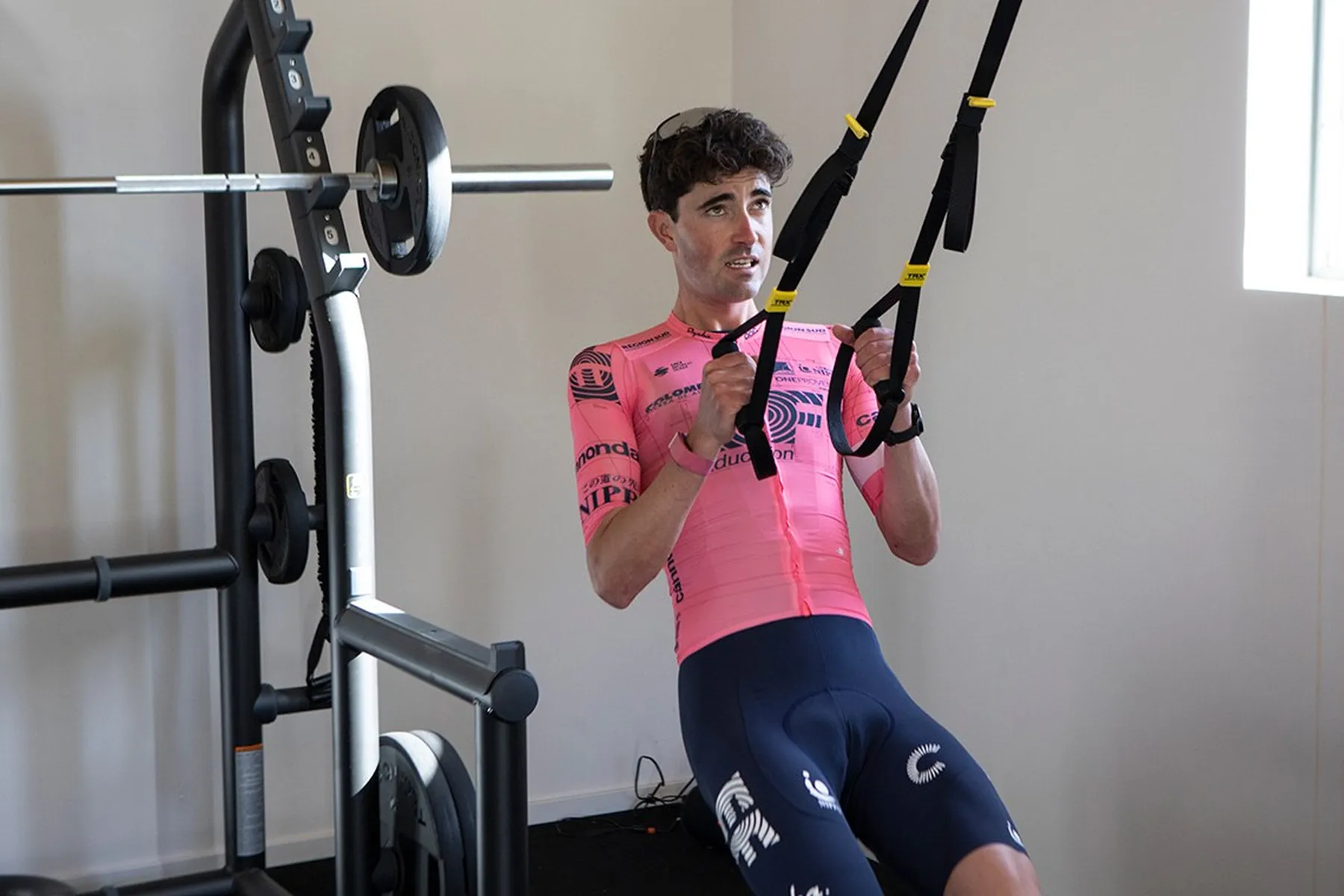
You know the feeling. You swing your leg over the bike, clip in, and the first ten pedal strokes feel like someone has tightened a vice around the back of your thighs. By kilometre five it loosens up. By kilometre fifty it is back. You get home, try to touch your toes, and your hamstrings feel like frayed rope.
So you stretch. Every night, dutifully, foot up on a chair, reaching for your toes. And nothing changes. The tightness comes back. The post-ride stiffness comes back. You start to wonder whether you are just built this way.
Here is the thing nobody tells you: your hamstrings are not tight because they are short. They are tight because they are weak. And until you address that distinction, all the stretching in the world will not fix the problem.
What Cycling Actually Does to Your Hamstrings
To understand why cyclists have such a specific hamstring problem, you need to look at what happens at the hip during a pedal stroke — and more importantly, what does not happen.
When you are seated on a bike, your hip never fully extends. Not once. The pedal stroke takes the hip from roughly 35 degrees of flexion at the top to about 145 degrees at the bottom. That is a partial range. Compare that to walking, where the hip moves through full extension on every stride, or running, where it moves through full extension under significant force. Cycling keeps you locked in a flexed window.
Over thousands of hours in that position, two things happen simultaneously. The hip flexors — primarily the psoas and rectus femoris — shorten and tighten. They adapt to the position you spend the most time in, and that position is seated flexion. Meanwhile, the hamstrings, which are the antagonists to the hip flexors, spend their time in a lengthened but largely passive state. They contribute to the pedal stroke (pulling through the bottom and into the upstroke), but they never work through a full range of motion and they rarely produce force at longer muscle lengths.
This creates what physiotherapists call reciprocal inhibition. When the hip flexors are chronically shortened and overactive, the nervous system down-regulates the hamstrings. The hamstrings become inhibited — not because there is anything structurally wrong with them, but because the neural drive to those muscles is reduced. The hip flexors dominate, the hamstrings comply.
The neural tone problem
Here is where it gets really interesting. Those hamstrings that feel so tight? In most cyclists, they are not structurally short. They have adequate length. The issue is neurological tone.
When a muscle lacks the eccentric strength to control itself at longer lengths — when it cannot safely decelerate — the nervous system does something protective. It increases the resting tone of that muscle. It pulls the handbrake on. The muscle feels tight because the nervous system is keeping it on a short leash, preventing it from reaching lengths where it cannot protect itself.
Greg Lehman, a physiotherapist and researcher whose work on pain science and movement has influenced how a lot of clinicians now think about tightness, puts it clearly: perceived tightness is often a capacity problem, not a length problem. The muscle feels restricted because it lacks the strength to operate safely at the range you are asking it to reach.
For cyclists, this means the classic post-ride sensation of hamstring tightness is not a stretching problem. It is a strength-at-length problem. And that distinction changes everything about how you address it.
The quad dominance cascade
There is another layer. Cycling is a quad-dominant activity. The quadriceps produce the majority of force during the downstroke — the phase where you generate the most power. The hamstrings contribute, but they are the junior partner. Over years of riding, the strength ratio between quads and hamstrings can drift significantly away from the healthy 60:40 benchmark (quads to hamstrings) that sports medicine uses as a reference point.
When the quads are substantially stronger than the hamstrings, the hamstrings become more vulnerable to strain. They cannot match the force the quads produce, particularly during sudden efforts — a sprint, a sharp out-of-saddle acceleration, or even a hard kick over a short climb. The quad fires aggressively, the hamstring cannot keep up eccentrically, and something gives.
This is not hypothetical. Croisier et al.'s research on hamstring strength imbalances demonstrated that athletes with a quad-to-hamstring strength ratio greater than 1.5:1 had significantly higher rates of hamstring injury. Cyclists, whose training is almost entirely quad-dominant, are sitting targets for exactly this pattern.
The Stretching Trap
Most cyclists respond to hamstring tightness by stretching. It seems logical. The muscle feels tight, so you try to lengthen it. And in the moment, it works — a good stretch temporarily reduces the sensation of tightness and gives you a few hours of relief.
But here is the problem. If the tightness is neurological — if the nervous system is increasing resting tone because the muscle lacks eccentric capacity — then stretching is addressing the symptom while ignoring the cause. You are temporarily overriding the nervous system's protective mechanism without giving it a reason to lower its guard permanently.
Worse, aggressive stretching of an eccentrically weak muscle can actually increase instability. You are pushing a muscle into ranges it cannot control. The nervous system registers that as a threat, and when you finish stretching, it cranks the tone right back up. This is why the tightness returns. You have not changed the underlying equation.
That does not mean stretching is useless. Short holds (15-20 seconds) as part of a warm-up or cool-down have value — they temporarily increase tissue compliance and reduce post-ride discomfort. But stretching as your primary intervention for hamstring health is like painting over rust. The surface looks better for a while, but the structural problem is still there.
What the research says
A 2021 systematic review in the Journal of Sports Science and Medicine examined the effects of stretching programmes on hamstring injury rates in athletes. The findings were clear: static stretching alone did not reduce hamstring injury incidence. What did reduce injury rates was eccentric strengthening — specifically, loading the hamstring at longer muscle lengths under controlled conditions.
The researchers noted that flexibility (passive range of motion) and functional capacity (the ability to produce and control force through that range) are separate qualities. You can have a hamstring that stretches beautifully on the physio table and still tears during a sprint because it has no strength at the range it can reach.
For cyclists, the takeaway is direct. Stop treating hamstring tightness as a flexibility problem. Start treating it as a strength deficit at end range. The stretching can stay as a small part of your routine, but it should not be the main event.
Three Exercises That Actually Fix the Problem
These three movements target the hamstring eccentrically at long muscle lengths — precisely where cycling leaves a deficit. None of them require a barbell. All of them can be done at home with minimal equipment.
1. Nordic hamstring curl (eccentric lowering progression)
The Nordic curl is the most extensively studied hamstring exercise in sports medicine. A 2019 meta-analysis published in the British Journal of Sports Medicine by van Dyk et al. found that Nordic curl programmes reduced hamstring injury risk by up to 51 per cent across multiple sports. No other single exercise has that level of evidence behind it.
The set-up: Kneel on a mat or folded towel. Anchor your ankles — under a heavy sofa, a loaded weight rack, or have a partner hold them. Your body should form a straight line from your knees to your shoulders.
The movement: Cross your arms over your chest. Keeping your hips extended (do not bend at the waist), slowly lower your torso toward the floor. The goal is to control the descent for as long as possible — five to eight seconds on the way down. When you can no longer control the fall, catch yourself with your hands in a push-up position.
Progression over 8 weeks:
- Weeks 1-2: Controlled negatives only. Lower as slowly as possible. Push yourself back up with your hands. Two sets of 4 reps.
- Weeks 3-4: Increase to two sets of 5-6 reps. Aim for a slower descent (6-8 seconds).
- Weeks 5-6: Begin adding a small concentric component — try to pull yourself back up using your hamstrings for the first 15-20 degrees before pushing up with your hands.
- Weeks 7-8: Increase to 3 sets of 5-6 reps. Continue pushing the controlled range of the concentric portion.
Form cues: Hips stay extended throughout. The moment you bend at the waist, you shift load from the hamstrings to the lower back. Think of your body as a plank from knees to shoulders. The only hinge point is the knee.
2. Single-leg Romanian hinge with light dumbbells
This is not a heavy lift. You are using light dumbbells — 5 to 10 kg each — and prioritising control, balance and hamstring length under load. The emphasis is on the eccentric lowering phase, not how much weight you can hold.
The set-up: Stand on one leg, holding a light dumbbell in each hand. Slight bend in the standing knee. Shoulders back, chest up.
The movement: Hinge at the hip, sending the free leg straight back behind you as your torso tips forward. The dumbbells track down alongside your standing shin. Lower until you feel a firm stretch through the hamstring of the standing leg — typically when your torso is roughly parallel to the floor. Pause for one second at the bottom, then drive back up through the glute and hamstring.
Reps and sets: Two to three sets of 8 reps per leg. The lowering phase should take 3-4 seconds. The standing phase takes 1-2 seconds.
Form cues: Keep the hips square — do not let the free hip open out to the side. The back leg, torso and head should move as one unit, like a see-saw. If you wobble badly, start by holding one dumbbell and keeping the other hand on a wall for balance.
3. Supine hamstring sliders
Sliders are a brilliant eccentric hamstring exercise that requires nothing more than a smooth floor and a pair of socks, furniture sliders, or a small towel. They load the hamstring through the full range from a bent-knee to a straight-leg position, which is exactly the range cycling neglects.
The set-up: Lie on your back, knees bent, feet on sliders (or socks on a hard floor). Arms by your sides. Lift your hips into a bridge position.
The movement: Keeping your hips elevated, slowly slide both feet away from you until your legs are nearly straight. Hold for one second. Then pull your feet back in using your hamstrings and glutes, returning to the bridge position.
Progression: Start with both legs (bilateral). After two to three weeks, progress to single-leg sliders — one foot on the slider, the other leg held off the floor. The single-leg version is significantly harder and provides a much greater eccentric challenge.
Reps and sets: Two sets of 8-10 reps (bilateral). Progress to two sets of 6-8 reps per leg (single-leg).
Form cues: Keep your hips up throughout. The moment your backside drops to the floor, the hamstrings unload. If your hamstrings cramp during the movement, that is actually a sign they are weak at those longer lengths — exactly what you are training. Reduce the range slightly and build up over a few weeks.
The 10-Minute Twice-Weekly Protocol
Here is the programme. Ten minutes, twice a week. Do this on non-ride days or after easy rides — never before a hard session, as eccentric hamstring loading creates temporary fatigue that you do not want before intervals or a long effort.
Weeks 1-4: Foundation
| Exercise | Sets x Reps | Tempo | Rest |
|---|---|---|---|
| Nordic curl (negatives only) | 2 x 4 | 5-sec lower | 90 sec |
| Single-leg Romanian hinge (light dumbbells) | 2 x 8 each leg | 3-sec lower | 60 sec |
| Supine sliders (bilateral) | 2 x 8 | 3-sec extend | 60 sec |
Weeks 5-8: Progression
| Exercise | Sets x Reps | Tempo | Rest |
|---|---|---|---|
| Nordic curl (negatives with partial concentric) | 3 x 5 | 6-8 sec lower | 90 sec |
| Single-leg Romanian hinge (light dumbbells) | 3 x 8 each leg | 4-sec lower | 60 sec |
| Supine sliders (single-leg) | 2 x 6 each leg | 3-sec extend | 60 sec |
Beyond week 8
Maintain the week 5-8 protocol. If you are consistent, the Nordic curls will progress naturally — you will control a larger portion of the range and begin to feel stronger in the bottom position. The single-leg hinges can increase in dumbbell weight by 1-2 kg every four to six weeks, but this is not a programme where load progression is the point. Control and consistency are the point.
The twice-weekly frequency is deliberate. Eccentric training creates more muscle damage per repetition than concentric training, and hamstring tissue needs 48-72 hours to recover and adapt. More is not better here. Two sessions a week gives the tissue the stimulus it needs and the recovery time to actually get stronger.
How Your Bike Fit Feeds the Problem
You can do every exercise in this article twice a week for a year, and if your bike fit is actively overloading your hamstrings, you will be fighting a battle you cannot win. Bike fit and off-bike work are two halves of the same equation.
Saddle height
This is the big one. A saddle that is too high forces the hamstring to work at excessive length at the bottom of every pedal stroke — bottom dead centre (BDC). At BDC, the hip is at its most extended point in the pedal cycle and the knee is at its most open. If the saddle is even 5-10mm too high, the hamstring is being pulled into a range it cannot control, thousands of times per ride.
The classic sign: posterior knee pain or a deep ache at the hamstring insertion point (high up where the hamstring meets the sitting bone). If this worsens on longer rides as fatigue accumulates, your saddle is almost certainly too high.
Phil Burt's recommendation is a knee angle of 25-30 degrees at BDC. If your fitter measures less than 25 degrees (leg too straight), your hamstrings are being overloaded on every stroke.
Saddle setback
A saddle that is too far back shifts load posteriorly — from the quads onto the hamstrings and glutes. That sounds like it might be a good thing, but too much setback creates excessive hamstring strain because the muscle is working harder than it should relative to the quads. The quad-hamstring partnership works best when the quads carry the larger share of the load during the downstroke and the hamstrings contribute without being overworked.
If you moved your saddle backward recently and your hamstrings started complaining, that correlation is not coincidental.
Hip angle at top dead centre
The other end of the stroke matters too. At the top of the pedal stroke (top dead centre, or TDC), the hip is at its most flexed point. If the bike fit creates an excessively closed hip angle at TDC — common in aggressive road positions with a long reach and low stack — the hip flexors are being compressed, the hamstrings are being stretched, and the neural tone issue described earlier gets worse. A more open hip angle at TDC (achieved by raising the bars, shortening the reach, or both) can reduce hamstring tension without changing anything about your off-bike routine.
The interaction between saddle height, setback and stack height is why a professional bike fit is worth the investment if you have persistent hamstring issues. Millimetre changes compound over thousands of pedal strokes, and the fit affects every ride you do.
When Tightness Becomes Injury
Most hamstring tightness in cyclists is a nuisance, not an injury. It responds to the protocol above, and within four to six weeks of consistent eccentric work, the sensation of chronic tightness starts to recede as the nervous system gains confidence in the muscle's capacity.
But there are clear signals that tightness has crossed a line. These are the red flags worth paying attention to.
Sharp pain during the upstroke. Dull tightness is the nervous system being cautious. Sharp pain — particularly during the pulling phase of the pedal stroke — suggests tissue irritation or strain. Stop riding and assess.
Pain that worsens in the first 10 minutes. Normal muscle tightness loosens as you warm up. If your hamstring pain gets worse during the first 10 minutes of a ride rather than easing, that is a sign the tissue is inflamed. Warming up should not make an injury feel worse.
Referred pain down the back of the knee or into the calf. Hamstring pain that radiates downward can indicate nerve involvement — specifically sciatic nerve irritation at the proximal hamstring, where the nerve runs close to the hamstring tendons as they attach to the sitting bone. This needs professional assessment.
A distinct pop or tearing sensation. This is obvious, but worth stating: if you felt something give — during a sprint, an out-of-the-saddle effort, or even off the bike — that is an acute hamstring tear until proven otherwise. Stop, ice it, and see a physiotherapist within 48 hours. Early assessment and graded loading protocols for hamstring tears produce dramatically better outcomes than waiting it out.
Persistence beyond 3-4 weeks. If you have been doing the protocol in this article consistently for a month and the tightness has not improved at all, something else may be driving the problem. Proximal hamstring tendinopathy (at the sitting bone), lumbar nerve root irritation, or sacroiliac joint dysfunction can all masquerade as hamstring tightness. A sports physiotherapist can differentiate these with a clinical examination.
The Bigger Picture
Hamstring health does not exist in isolation. It is one piece of a posterior chain that cycling systematically underloads — glutes, hamstrings, spinal erectors, and the deep stabilisers of the hip and pelvis.
The glute connection is critical. Weak glutes and weak hamstrings are almost always found together in cyclists, because both are victims of the same hip-flexor-dominant pattern. If the glutes are not firing properly, the hamstrings try to compensate during the pedal stroke — particularly during the pull-through phase at the bottom — and they overload. Addressing hamstring health without addressing glute activation is doing half the job.
This is why the injury prevention routine and the hip mobility protocol are not separate programmes. They are parts of the same strategy: building the posterior chain capacity that cycling strips away. The hamstring protocol in this article fills one specific gap. The glute and hip work fills another. Together, they create a foundation that supports the training you actually care about — the riding.
Long-term, the cyclists who ride well into their 50s and 60s without chronic pain are the ones who figured this out early. Not the ones who stretched the hardest. The ones who built strength where cycling left a deficit. The eccentric work. The single-leg stability. The boring, ten-minutes-twice-a-week stuff that does not appear on Strava and never gets a kudos.
Your hamstrings are fixable. The science has finally caught up with what experienced physios have been telling us for years — the answer is not more flexibility, it is more capacity. Strength at length. Controlled loading through the ranges cycling ignores. And a bike fit that does not ask your hamstrings to do work they are not equipped for.
Inside Not Done Yet, the posterior chain protocol is built around exactly this — age-appropriate eccentric work, glute integration, and the bike fit principles that keep everything working together. Come see what we are building.