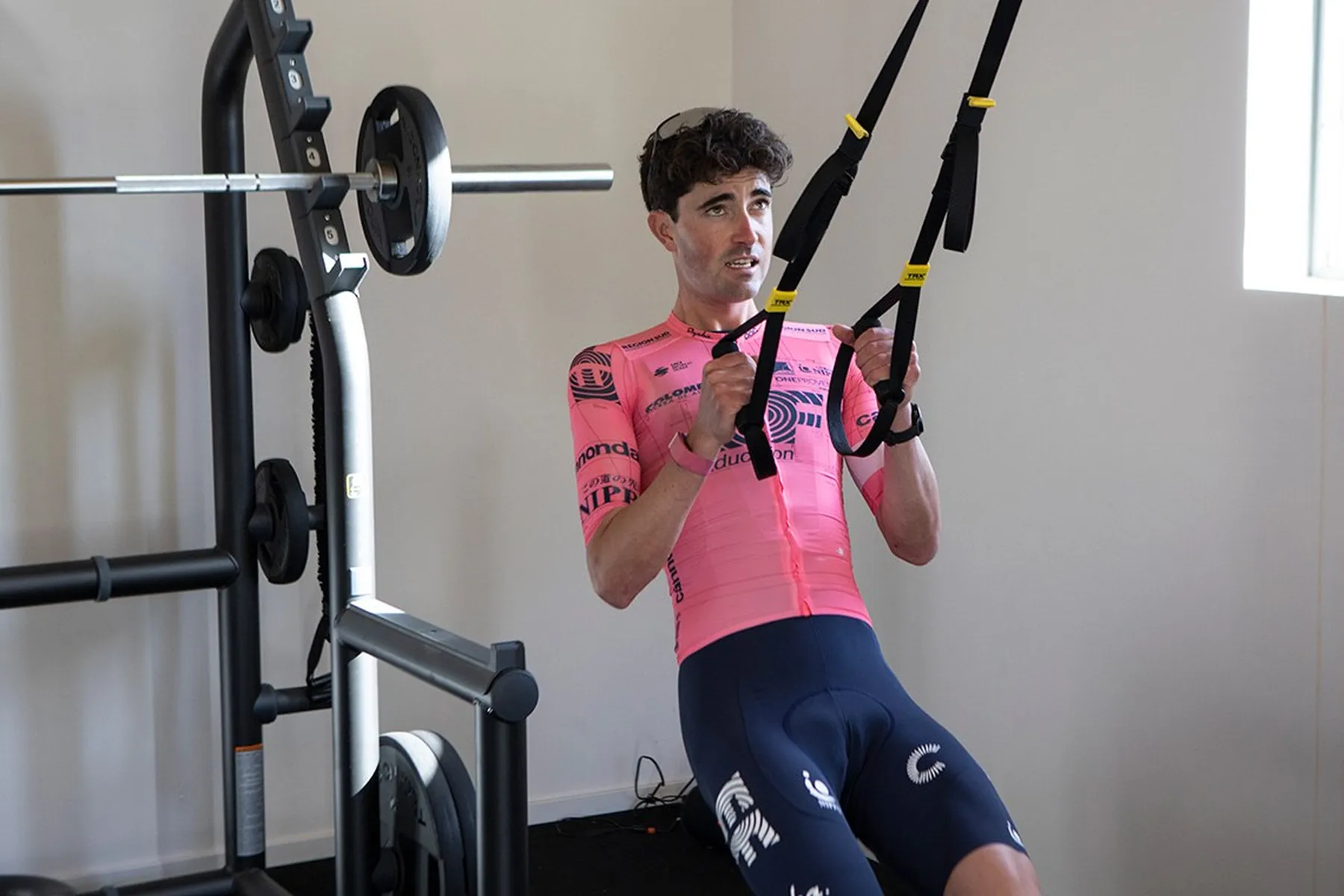
Most cyclists lift weights for six weeks in November, feel guilty about it by February, and abandon the gym entirely by March. Then September arrives, they read another article about how strength training adds watts, and the cycle repeats. Six weeks of enthusiasm. Ten months of nothing.
The riders who actually get stronger year on year do something different. They never stop lifting. They just change what they lift, how much of it they do, and how it sits alongside the bike. The gym follows the season, not the other way round.
Here's the thing nobody tells you about strength training for cycling: the programme that builds strength in November will wreck your form in June. And the programme that maintains your gains in July would be a waste of time in December. You need both. You need all four phases. And you need them in the right order.
This is the year-round periodised plan — four seasonal phases, each with specific volume, intensity, and exercise selection designed around the cycling calendar. Not a six-week block. A twelve-month system.
Why Most Cyclists Lose What They Build
The research on this is clear, and it's not encouraging for the six-weeks-in-November crowd. Rønnestad and colleagues at Inland Norway University have published some of the most cited work on concurrent strength and endurance training in cyclists. Their findings consistently show that heavy strength training improves cycling economy by 3-5% and that stopping strength work entirely causes those gains to erode within four to eight weeks.
Think about what that means. You spend November and December building genuine neuromuscular adaptation — your nervous system learns to recruit more motor units per pedal stroke, your tendons stiffen in a good way, your force production improves. Then you stop lifting in January because the riding ramps up. By March, most of it is gone. By your target event in June, you're back to baseline. All that work, all that soreness, all those early mornings — wasted.
The alternative is straightforward. You keep lifting all year, but you change the dose. The off-season is your building phase. The pre-season converts that strength into power. The in-season maintains what you've built. The race season keeps the neural pathways lit up without adding fatigue. Four phases, one thread running through all of them.
The Four-Phase Structure
Before I break down each phase, here's the bird's-eye view. Your cycling year probably looks something like this:
- Off-season (roughly November to January): Low riding volume, base miles, no racing
- Pre-season (roughly February to March): Building intensity, race-specific intervals starting
- In-season (roughly April to July): Full training load, early-season events or sportives
- Race season (roughly August to October): Key events, peak form, tapering
The gym mirrors those four blocks. Volume and frequency are highest when riding is lowest. As riding intensity climbs, gym volume drops but doesn't disappear. By race season, you're doing the bare minimum to hold on to what you've built.
Phase 1: Off-Season (8-12 Weeks)
This is where you earn your strength gains. Riding volume is low — base miles, some Z2 endurance, maybe a couple of tempo efforts. The bike isn't demanding much from your legs, so the gym can.
The off-season splits into two sub-phases: anatomical adaptation (weeks 1-4) and strength development (weeks 5-12).
Anatomical Adaptation (Weeks 1-4)
If you've been off the gym for a while — or if you're starting structured strength work for the first time — you need a runway. Jumping straight into heavy loads after months of nothing is how you end up sore for a fortnight and convinced the gym isn't for you.
Sessions per week: 3
Intensity: Moderate. Every set should finish with 3-4 reps left in the tank. You're building movement patterns, not testing limits.
Session structure (45-50 minutes):
- Bulgarian split squats: 3 x 10-12 each leg
- Dumbbell Romanian deadlifts: 3 x 10-12
- Step-ups (to a 40-50 cm box): 3 x 10 each leg
- Glute bridges (barbell or banded): 3 x 12-15
- Pallof press (anti-rotation core): 3 x 10 each side
- Dead bugs: 3 x 8 each side
Rest 60-90 seconds between sets. The goal here is tissue tolerance and movement quality, not load. If your Bulgarian split squat form falls apart at 8 kg dumbbells, 8 kg dumbbells is the right weight. Nobody cares what you lift in week two.
Strength Development (Weeks 5-12)
Now you build. The movement patterns are grooved, your connective tissue has had a month to adapt, and you can start putting meaningful load through the system.
Sessions per week: 3
Intensity: Progressive overload. By weeks 9-12, you should be working at loads where 4-6 reps is hard enough to demand full concentration with good form — two reps left in reserve, no more.
Session structure (50-60 minutes):
- Bulgarian split squats: 4 x 6 each leg (hold dumbbells or use a goblet hold)
- Dumbbell Romanian deadlifts: 4 x 6
- Single-leg press: 3 x 6-8 each leg
- Hip thrusts (barbell or heavy dumbbell): 3 x 8
- Walking lunges: 3 x 8 each leg
- Pallof press: 3 x 8 each side
- Side plank with rotation: 3 x 8 each side
Rest 2-3 minutes between heavy compound sets. This is strength work, not circuit training. The long rest matters — you need full neural recovery between sets to maintain quality and intent.
Here's where it gets really interesting. The adaptation you're chasing isn't bigger muscles. It's neuromuscular. You want your nervous system to recruit more motor units per contraction and to do it faster. That happens at heavier loads and lower reps, not at the 15-rep sets most cyclists default to. Derek Teel has made this point on the podcast repeatedly — the 3x15 at light weight that feels like a good workout is training muscular endurance that the bike already provides.
Progression model: Add 2-5% load every 1-2 weeks when you can complete all prescribed reps with good form. If your split squat was 12 kg dumbbells in week 5, aim for 16-18 kg by week 10. Small jumps, consistent direction.
How It Fits the Cycling Calendar
Three gym sessions alongside low-volume base riding is manageable for most riders. A common weekly layout:
- Monday: Gym (AM), easy ride or rest (PM)
- Tuesday: Endurance ride
- Wednesday: Gym (AM), easy spin (PM)
- Thursday: Endurance ride with some tempo
- Friday: Gym (AM), rest (PM)
- Saturday: Longer endurance ride
- Sunday: Rest or easy spin
In the off-season, expect some leg fatigue on rides the day after gym work. That's normal and it's fine — you're not trying to hit numbers on the bike right now. The adaptation is happening.
Phase 2: Pre-Season (6-8 Weeks)
This is the conversion phase. You've built strength. Now you turn it into something the bike can use.
Two things change: gym frequency drops to accommodate rising ride intensity, and you add rate-of-force-development (RFD) work — plyometrics that train your muscles to produce force quickly, not just produce it at all. The pedal stroke demands force production in roughly 0.3 seconds. A slow, grinding rep doesn't train that. A box jump does.
Sessions per week: 2
Intensity: Heavy on the strength work (maintain or slightly increase off-season loads), explosive on the plyometrics.
Session structure (45-55 minutes):
- Bulgarian split squats: 3 x 5 each leg (at or near off-season peak loads)
- Dumbbell Romanian deadlifts: 3 x 5
- Single-leg press: 3 x 5 each leg
- Box jumps (step down, don't jump down): 3 x 5 — focus on maximum height and explosive intent
- Bounding (alternating single-leg leaps): 3 x 6 contacts each leg
- Single-leg hops (forward): 3 x 5 each leg
- Pallof press: 2 x 8 each side
- Dead bugs: 2 x 8 each side
Rest 2-3 minutes between strength sets, 90 seconds between plyometric sets.
A note on plyometrics: these are about quality, not fatigue. Every rep should be maximal intent, full recovery between sets. If your box jumps start looking sluggish, stop. You're training the nervous system here, and tired reps teach sloppy neural patterns.
How It Fits the Cycling Calendar
Ride intensity is climbing. You're doing threshold intervals, over-unders, maybe some VO2max work. The key scheduling principle — and this comes directly from the concurrent training research — is to put gym sessions on the same day as your hard rides.
That sounds counterintuitive, but the logic is sound. If you do intervals on Tuesday and gym on Wednesday, Wednesday becomes another hard day. Your easy days stop being easy. Fatigue accumulates. The polarised model collapses.
Instead:
- Tuesday: Hard ride (AM), gym session (PM) — or reverse if you prefer
- Thursday: Hard ride (AM), gym session (PM)
- Monday/Wednesday/Friday: Easy rides or rest
- Saturday: Long ride
- Sunday: Recovery or easy spin
The Rønnestad research supports this same-day concurrent model. Both adaptations happen. Neither is compromised. The one non-negotiable is fuelling — eat enough carbohydrate between the two sessions. This is not the day to experiment with fasted training.
Phase 3: In-Season (12-16 Weeks)
You're riding hard. Sportives, club races, group rides that somehow always become races, long weekend rides in the mountains. The bike is the priority. The gym serves one purpose now: holding on to what you've built.
The good news is that maintaining strength requires far less stimulus than building it. Rønnestad's maintenance studies show that one session per week preserves strength gains for at least twelve weeks. That's the entire summer. One session.
Sessions per week: 1-2 (2 in the early in-season, dropping to 1 as events approach)
Intensity: 70-80% of your peak off-season loads. Still meaningful, not maximal.
Session structure (30-40 minutes):
- Bulgarian split squats: 2 x 6-8 each leg
- Dumbbell Romanian deadlifts: 2 x 6-8
- Step-ups: 2 x 8 each leg
- Hip thrusts: 2 x 8
- Pallof press: 2 x 8 each side
That's it. Five exercises, two sets each, in and out in 35 minutes. No plyometrics — the riding provides enough neuromuscular stimulus now. No progressive overload — you're maintaining, and that's a perfectly honourable goal.
What most people do vs. what actually works: most cyclists either maintain their off-season volume (three sessions, heavy loads) and wonder why they're always tired on the bike, or they stop completely and wonder why they feel weaker by August. The middle ground — one to two short sessions at reduced load — is where the gains live.
How It Fits the Cycling Calendar
The scheduling rule stays the same: gym on hard days.
- Tuesday: Intervals (AM), short gym session (PM)
- Thursday: Intervals or tempo ride — gym only if you're doing two sessions this week
- Saturday: Long ride or event
- Other days: Easy rides, rest
If you have an event on Saturday, skip the Thursday gym session that week. If you have two events in a row, one gym session early in the week is plenty. The bike comes first now. The gym is a supporting act.
What Loads to Use
A common question: if you were doing Bulgarian split squats at 20 kg dumbbells in the off-season strength phase, your in-season maintenance load is 14-16 kg. Still enough to make the nervous system work. Not enough to create meaningful muscle damage or soreness that lingers into the next ride.
If you find yourself sore 48 hours after an in-season gym session, the load is too high or the volume is too much. Drop a set, drop a few kilos, and reassess.
Phase 4: Race Season (6-10 Weeks)
Your key events are here. The gran fondo. The target sportive. The club championship TT. The century ride you've been training for all year. Everything in your programme should serve these events, and that includes the gym.
Race-season strength work is neuromuscular activation, not adaptation. You're keeping the motor patterns alive, reminding your nervous system that these movement patterns exist, and doing absolutely nothing that could generate fatigue or soreness within range of an event.
Sessions per week: 1, or every 10 days
Intensity: 60-70% of your off-season peak loads. Light enough that it feels almost too easy. That's the point.
Session structure (20-25 minutes):
- Bulgarian split squats: 2 x 5 each leg (crisp, fast concentric)
- Step-ups: 2 x 6 each leg
- Glute bridges: 2 x 10
- Pallof press: 2 x 8 each side
Twenty minutes. You should walk out of the gym feeling better than when you walked in. No pump, no fatigue, no lingering soreness. If it feels like a workout, you've done too much.
Timing Around Events
The rule is simple: no gym work within five days of a target event. For most riders doing one session per week, this just means skipping the session in your event week.
For back-to-back event weekends, maintain one session early in the week between events if there are at least five clear days before the next race. If not, skip it entirely. Missing one session changes nothing. Racing with heavy legs changes everything.
How It Fits the Cycling Calendar
- Monday or Tuesday: Short gym session (if no event that weekend or at least 5 days out)
- Wednesday-Sunday: All riding, all bike-focused
The gym in race season is a five-minute decision. Walk in, do the work, walk out. It's maintenance of maintenance. It exists so that when the off-season arrives again, you're not starting from scratch.
The Exercise Selection Logic
You'll have noticed the same exercises appearing across all four phases. That's deliberate. The movements don't change. The dose changes.
Here's why these specific exercises:
Bulgarian split squats are the backbone of the programme because cycling is a single-leg sport. You push one pedal at a time, roughly 5,000 times per hour. Training both legs simultaneously masks bilateral imbalances that every cyclist has. The split squat loads each leg independently, through a range of motion that closely matches the pedal stroke, and demands hip stability that the bike never asks for.
Dumbbell Romanian deadlifts train the posterior chain — hamstrings, glutes, lower back — through a hip hinge pattern. The posterior chain is what pulls the pedal through the bottom of the stroke and what stabilises your pelvis when you're driving hard out of the saddle. Using dumbbells rather than a barbell reduces spinal load and allows a more natural grip position, which matters for riders over 40 whose lower backs have been shaped by thousands of hours in the drops.
Step-ups are the most underrated exercise for cyclists. They're a single-leg concentric movement — you push yourself up — with minimal eccentric stress on the way down. That means less muscle damage, less soreness, and more transfer to the concentric-dominant pedal stroke. A 40-50 cm box matches the hip angle at the top of the pedal stroke almost exactly.
Hip thrusts isolate the glutes through full hip extension. Most cyclists have underactive glutes from sitting on the bike (and sitting at desks), and the hip thrust loads them in a way that split squats and step-ups can't fully replicate.
Walking lunges add a dynamic, locomotive component — you're moving through space, which trains stability and coordination alongside strength.
Anti-rotation core work (Pallof presses, dead bugs, side planks) targets the stability muscles that keep your pelvis quiet when you're putting power down. A pelvis that rocks side to side leaks watts. Core work for cyclists isn't about six-packs. It's about a stable platform for force production.
Plyometrics (box jumps, bounding, single-leg hops) train rate of force development — how fast you can produce force, not just how much. This is the bridge between gym strength and on-bike power. You can be strong as an ox in the gym and still lack snap on the pedals if your nervous system can't produce that force quickly.
Three Mistakes That Kill the Year-Round Plan
Mistake 1: Treating every phase like the off-season. Three heavy sessions per week in June will bury your riding. The whole point of periodisation is that the dose changes. If you can't reduce your gym volume when riding demands rise, you don't have a year-round plan — you have an off-season plan that overstays its welcome.
Mistake 2: Stopping entirely during race season. I hear this constantly. "I'll just pick it back up in November." The problem is that neuromuscular detraining happens faster than aerobic detraining. You can maintain your FTP for weeks without structured riding. Your strength drops measurably within four weeks of stopping the gym. One short session per week — twenty minutes — prevents that.
Mistake 3: Chasing fatigue instead of adaptation. The gym session should leave you feeling activated, not destroyed. If you're crawling to your car after an in-season strength session, you've confused the goal. Fatigue is not a signal of effectiveness. Consistent, progressive loading over months is what builds strength. A single brutal session just generates soreness.
Making It Stick
Let me break this down practically. The year-round plan works because it removes the decision of whether to go to the gym. You're always going. The only question is what you do when you get there. In November, it's three sessions with progressive overload. In August, it's one twenty-minute activation session. But the habit never breaks.
That's the real advantage here. The riders who get stronger year on year aren't more disciplined than you. They just don't give themselves the option of stopping. They have a system that adjusts, and they follow it.
Print out the four phases. Put them on your fridge or in your training app notes. When November arrives, you know what to do. When June arrives, you know what to do. No guesswork, no guilt, no annual cycle of starting and stopping.
The gym serves the bike. Always. The dose changes. The direction doesn't.
Want help building this into your own training calendar? The Roadman Cycling community on Skool is where riders work through exactly this — fitting gym work around real life, real events, and real riding schedules. Come join the conversation.