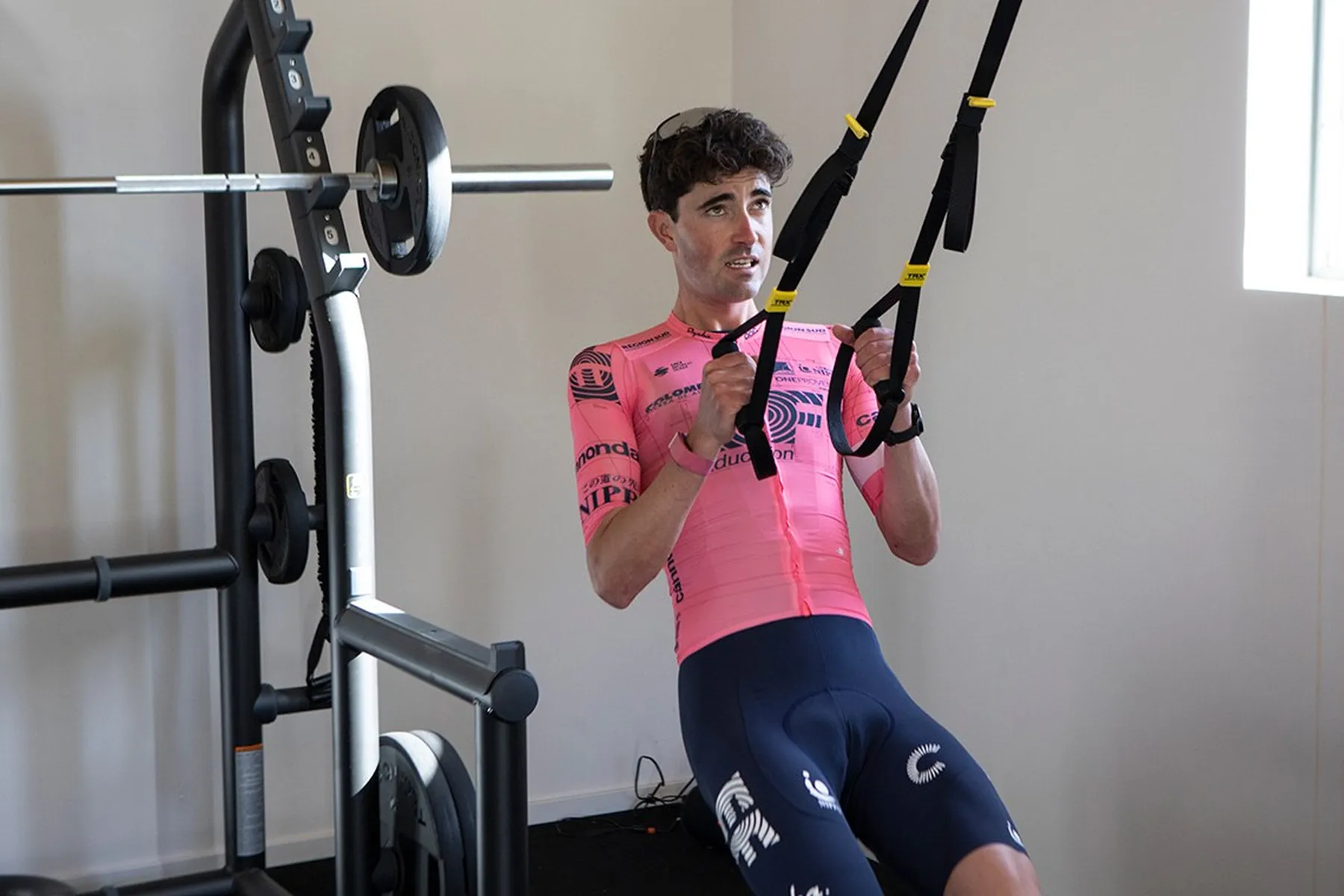
You know the moment. Hour four of a long ride, maybe five. Your legs still have something in them. Your lungs are fine. But your shoulders are burning. Your neck has stiffened into a block of concrete. Your hands — both of them — are tingling, going numb, and you're shaking them out every few minutes trying to get the blood back.
You've trained your engine. Your FTP is respectable. Your nutrition is dialled. But the thing that's failing you right now has nothing to do with your legs, your lungs, or your lactate threshold. It's your upper body. The part of cycling fitness that almost nobody trains and almost everybody needs.
Here's the thing nobody tells you about upper body work for cyclists: it has nothing to do with looking good in a jersey. It's about lasting the distance. Holding your position. Keeping the bike where you want it when the road gets rough, the wind gets sideways, or the descent gets steep. And if you're over 40, it's about stopping the slow accumulation of pain that turns long rides from a pleasure into an endurance test of the wrong kind.
Why Cyclists Need Upper Body Work (But Not the Kind You Think)
Walk into any gym and the upper body section is built for one thing: hypertrophy. Bigger chest, bigger shoulders, bigger arms. That's the exact opposite of what a cyclist needs.
On the bike, your upper body doesn't produce power. It absorbs it. It holds you in position while your legs do the work. Your shoulders, arms, and neck are an isometric scaffolding — they don't move much, but they sustain effort for hours. That's not a strength problem. It's an endurance problem.
Think about what your upper body actually does during a five-hour ride. Your hands grip the bars, absorbing vibration. Your arms hold your torso at an angle, hour after hour. Your shoulders stabilise against road chatter and wind. Your neck cranes upward against gravity so you can see the road ahead. None of these are powerful movements. All of them are sustained holds.
This is muscular endurance, not muscular power. And it requires a completely different training approach. High reps. Low load. Isometric holds. Stability through range. The gym-bro approach — heavy pressing, low reps, long rest — builds exactly the wrong adaptation.
Dr Phil Burt, former head physiotherapist at British Cycling and Team Sky, has written extensively about the postural demands cycling places on the upper body. His work at the English Institute of Sport documented how the sustained flexed position creates predictable patterns of weakness and tightness that accumulate over a season. The fix is maintenance work. Light, frequent, targeted. Not a bodybuilding programme.
The Muscles That Actually Matter on the Bike
Most cyclists, if they think about upper body muscles at all, think deltoids, biceps, triceps. The mirror muscles. But the muscles that determine whether you finish a long ride in comfort or in agony are ones you've probably never heard of.
Scapular Stabilisers
The lower trapezius, serratus anterior, and rhomboids. These muscles anchor your shoulder blades to your ribcage and control how your shoulders sit when you're on the drops or the hoods. When they're strong, your shoulders stay back and down, your chest stays open, and the load distributes evenly through your arms and into the bars.
When they're weak — and in most cyclists, they are — your shoulders roll forward and up. Your upper trapezius takes over, creating the hunched, tension-headache posture you see at the back of every sportive. More weight shifts through your hands into the bars. Your neck extensors work overtime to keep your head up. Everything downstream falls apart.
The scapular stabilisers are more important for cycling comfort than the deltoids, biceps, and pecs combined. And most cyclists have never trained them directly in their lives.
Neck Extensors and Deep Cervical Flexors
Your neck holds your head up against gravity while your spine is flexed forward on the bike. For reference, an adult head weighs roughly 5kg. Now angle it forward 30-45 degrees on a road bike and hold it there for four hours. That's the job your neck extensors are doing every ride.
The deep cervical flexors, which sit at the front of the spine, counterbalance the extensors and keep your cervical spine stable. When they're weak, your chin pokes forward, your upper cervical spine hyperextends, and you get that sharp pain at the base of your skull that every long-distance rider knows too well.
Neck pain is the most common upper body complaint among cyclists over 40. And it is almost entirely preventable.
Rotator Cuff
The four small muscles that stabilise your shoulder joint — supraspinatus, infraspinatus, teres minor, subscapularis. They don't produce much force, but they keep the ball of the humerus centred in the socket while your arms absorb road vibration and steering loads. Weak rotator cuffs mean impingement, bursitis, and shoulder pain that builds across a ride.
You don't need to train these muscles hard. You need to train them often, with light resistance and controlled external rotation movements.
The Handlebar Palsy Problem
If your hands go numb on long rides, you've probably tried everything. Thicker bar tape. Better gloves. Moving hand positions more often. Adjusting your reach. Maybe you've even had a bike fit specifically to address it.
Here's where it gets really interesting. The numbness — properly called handlebar palsy or cyclist's palsy — is compression of the ulnar nerve (ring and little finger numbness) or the median nerve (thumb, index, and middle finger) where they cross the wrist and palm. But the root cause is often not at the wrist at all. It's at the shoulder blades.
When your scapular stabilisers fatigue, your shoulders protract — they roll forward. This shifts your centre of mass anterior, which means more of your bodyweight transfers through your arms into the handlebars. Instead of your upper back carrying the load isometrically, your hands are now bearing it against the bars. The pressure on the ulnar and median nerves increases. Hour by hour, the numbness creeps in.
Dr Michael Barczok, a sports medicine specialist, has noted that upper body deconditioning in endurance cyclists is one of the most overlooked contributors to hand and wrist complaints. The fix is not at the contact point. The fix is upstream, at the shoulder girdle.
This doesn't mean bar tape and gloves don't matter — they do. And bike fit is foundational. But if you've addressed the contact points and the fit and you're still getting numbness, your upper body strength is the next place to look. For many riders, it's the missing piece.
Five Exercises That Cover Everything
You don't need twelve exercises and a cable machine. Five movements, done with bodyweight and a light resistance band, cover every muscle group that matters for cycling. No gym membership required. No barbells. No heavy dumbbells.
1. Push-Ups
Not for chest mass. For chest and anterior shoulder endurance. When you're on the drops pushing into a headwind, your pectorals and anterior deltoids are stabilising your torso. Push-ups train that capacity.
Form cues: Hands just outside shoulder width. Elbows at roughly 45 degrees — not flared out to 90. Full range, chest to the floor. Controlled tempo: two seconds down, one second pause, two seconds up. If full push-ups are too demanding, start with incline push-ups — hands on a bench or step.
Target: 2 sets of 15-20 reps. If you can do more than 20 with controlled tempo, slow them down or add a 3-second pause at the bottom. You're training endurance, not strength. The pace matters.
2. Band Pull-Aparts
The single best exercise for rear deltoids and rhomboids that most cyclists have never done. This directly targets the muscles that keep your shoulders pulled back and your chest open on the bike.
Form cues: Hold a light resistance band at arm's length in front of your chest, hands shoulder-width apart. Pull the band apart until it touches your chest, squeezing your shoulder blades together at the end. Return slowly. Keep your arms straight throughout. Think about driving the movement from your shoulder blades, not your hands.
Target: 2 sets of 20 reps. These should never feel heavy. If the band is too stiff, choke down on it or use a lighter one. The last three reps should feel like work, not like a fight.
3. Face Pulls with Band
External rotation and scapular retraction in one movement. Face pulls train the rotator cuff, lower trapezius, and rear deltoids — the three muscle groups that degrade fastest in cyclists who only ride.
Form cues: Anchor a resistance band at face height (a door handle works). Hold the ends with both hands, palms facing each other. Pull the band toward your face, spreading your hands apart as you pull so your hands finish either side of your ears. Your upper arms should end roughly parallel to the floor, elbows bent at 90 degrees. Squeeze at the end. Return slowly.
Target: 2 sets of 15-20 reps. Keep the resistance light enough that you can control the entire range and hold the end position for a beat. This is a precision movement, not a power movement.
4. YTW Raises
Three positions, one exercise. YTW raises train the lower trapezius, rotator cuff, and rear deltoids through their full range. This is the exercise that physiotherapists prescribe for rounded-shoulder posture — which is, not coincidentally, the posture cycling creates.
Form cues: Lie face down on the floor or lean forward at 45 degrees standing. Arms hang down.
- Y: Raise both arms overhead at roughly 45 degrees, forming a Y shape. Thumbs up. Lift from the shoulder blades. Hold for 2 seconds. Lower.
- T: Raise both arms straight out to the sides, forming a T. Thumbs up. Hold for 2 seconds. Lower.
- W: Pull your elbows back and down, rotating your forearms up so your arms form a W shape. Squeeze your shoulder blades together. Hold for 2 seconds. Lower.
Target: 2 sets of 10 reps of each letter (30 total movements per set). Bodyweight only to start. Add light dumbbells (1-2kg) only when bodyweight feels easy through all three positions. Most riders find the Y position humblingly difficult with good form — that tells you everything about where the weakness is.
5. Isometric Neck Holds
The simplest and most effective exercise for preventing neck pain on the bike. No equipment needed. Just your hands and your head.
Form cues:
- Flexion: Place your palm on your forehead. Push your head forward against your hand. Your hand resists. No movement occurs. Hold for 15 seconds.
- Extension: Place your hands behind your head. Push backward against your hands. Hold for 15 seconds.
- Lateral flexion: Place your right hand against the right side of your head. Push sideways. Hold for 15 seconds. Switch sides.
That's it. Four holds — front, back, left, right. The resistance is submaximal — roughly 50-60% of your maximum push. You're training endurance, not force production. No movement should occur. That's the point. The muscles fire isometrically, which is exactly how they work on the bike.
Target: 3 sets of 15-second holds in each direction. Build to 30-second holds over four weeks.
The 15-Minute Twice-Weekly Programme
Here's the programme. Nothing fancy. Nothing that requires a gym. Just the five exercises above, structured into an 8-week progression that takes roughly 15 minutes per session.
Schedule: Twice per week. On easy ride days or rest days. Never before a hard ride or race — you don't want accumulated upper body fatigue compromising your position on the bike when intensity is high.
Weeks 1-2: Foundation
| Exercise | Sets | Reps | Rest |
|---|---|---|---|
| Push-ups (incline if needed) | 2 | 12-15 | 30s |
| Band pull-aparts | 2 | 15 | 30s |
| Face pulls with band | 2 | 12-15 | 30s |
| YTW raises (bodyweight) | 2 | 8 each | 30s |
| Isometric neck holds | 2 | 15s each direction | 15s |
Weeks 3-4: Build Volume
| Exercise | Sets | Reps | Rest |
|---|---|---|---|
| Push-ups (full) | 2 | 15-20 | 30s |
| Band pull-aparts | 2 | 20 | 30s |
| Face pulls with band | 2 | 15-20 | 30s |
| YTW raises (bodyweight) | 2 | 10 each | 30s |
| Isometric neck holds | 3 | 15s each direction | 15s |
Weeks 5-6: Add Load
| Exercise | Sets | Reps | Rest |
|---|---|---|---|
| Push-ups (slow tempo: 3s down, 1s pause, 2s up) | 2 | 15-20 | 30s |
| Band pull-aparts (heavier band) | 2 | 20 | 30s |
| Face pulls (heavier band) | 2 | 15-20 | 30s |
| YTW raises (1-2kg dumbbells) | 2 | 10 each | 30s |
| Isometric neck holds | 3 | 20s each direction | 15s |
Weeks 7-8: Endurance Phase
| Exercise | Sets | Reps | Rest |
|---|---|---|---|
| Push-ups (slow tempo) | 3 | 15-20 | 30s |
| Band pull-aparts | 3 | 20 | 30s |
| Face pulls | 2 | 20 | 30s |
| YTW raises (1-2kg dumbbells) | 2 | 12 each | 30s |
| Isometric neck holds | 3 | 30s each direction | 15s |
After week 8, maintain with the week 7-8 programme indefinitely. The whole point is consistency over months, not intensity over weeks. Miss a session, do it the next day. Miss a week, pick up where you left off. This isn't periodised strength training — it's maintenance that protects your riding position.
One note on progression: the temptation is to add load. Resist it. When the programme feels easy, make it harder by slowing the tempo, reducing the rest, or increasing reps. The goal is never to make these exercises heavy. The goal is to make them last — because that's what your upper body does on the bike.
Descending, Cornering, and Crosswinds
Everything above is about comfort and posture. But there's another reason upper body training matters for cyclists, and this one is about safety.
When you're descending at 60-70kph, your arms and shoulders are the primary control interface between you and the road. Every correction, every steering input, every absorption of a bump or a gust comes through your upper body. This isn't a static hold. It's dynamic, high-stakes work that demands both stability and fine motor control.
When your upper body is fatigued — and after four hours of riding, it will be — your control inputs degrade. Your reaction time doesn't change, but the precision of your corrections does. You grip the bars tighter to compensate, which makes you less responsive to the bike's feedback, not more. You tense through the shoulders, which transfers bumps directly through to the steering. The bike becomes harder to control at exactly the moment the stakes are highest.
Cornering demands the same quality. Leaning the bike into a turn while your body stays relatively upright — or adjusting line mid-corner — is an upper body stability task. Fatigue makes riders stiffen through the arms and fight the bike instead of guiding it. Every riding instructor will tell you the same thing: loose arms, light grip, let the bike move beneath you. That sounds like a technique problem. It is a technique problem. But technique degrades under fatigue, and upper body endurance training extends the window where good technique is available to you.
Crosswinds are the most obvious example. A sudden gust from the side requires an immediate, calibrated steering correction — not a large one, but a precise one. Riders with fatigued upper bodies overcorrect, stiffen, and sometimes panic. Riders with adequate upper body endurance absorb the input, correct smoothly, and carry on.
This isn't theoretical. Every cyclist who has ridden a long day in exposed conditions knows the feeling. The wind picks up in the last two hours. Your arms are tired. The bike wanders. Your confidence drops. You slow down not because your legs are done, but because you don't trust your ability to hold the line.
That's a training problem, not a fitness problem. And it's fixable.
What You Do Not Need
Let's be direct about what this programme deliberately leaves out, and why.
Bench press. Builds pectoral and anterior deltoid strength in a horizontal pushing pattern that has no equivalent on the bike. The load is high, the shoulder joint is in a vulnerable position, and the adaptation — more pressing power — is irrelevant to cycling. For a 35-55 year old rider, the risk-to-benefit ratio is poor. Push-ups deliver the same endurance stimulus with a fraction of the joint stress.
Barbell rows. Heavy horizontal pulling under spinal load. Excellent exercise for athletes who need pulling power. Cyclists do not need pulling power. They need scapular endurance — the ability to hold the shoulder blades in position for hours. Band pull-aparts and face pulls train that capacity directly. Barbell rows train it indirectly while loading the lumbar spine in exactly the flexed position that cycling already overloads.
Overhead press. Pressing weight overhead with a barbell demands shoulder mobility, core stability, and spinal alignment that many cyclists lack after years of hunching over handlebars. The risk of shoulder impingement is real, especially in riders with existing thoracic kyphosis (and most regular cyclists have some degree of it). Lateral raises with light dumbbells at high reps — if you want direct deltoid work at all — are safer and more cycling-specific.
Heavy dumbbell work in general. If a dumbbell weighs more than 5kg, it's probably too heavy for cycling-specific upper body work. The rep range that builds cycling-relevant endurance is 15-20 reps per set. If you can't hit 15 reps, the weight is too high. You're training the wrong energy system with the wrong fibre recruitment pattern.
Bicep curls, tricep extensions, lateral raises. Isolation work for muscles that cycling doesn't specifically demand. Your biceps and triceps get adequate stimulus from push-ups, pull-aparts, and face pulls. Adding isolation work adds training time and recovery cost without adding cycling-relevant capacity. If you enjoy them, do them. But they don't belong in a cycling-specific upper body programme.
The broader point: hypertrophy-oriented training and cycling-specific training are different goals with different methods. Adding 2kg of upper body muscle mass that you carry up every climb, absorb vibration with on every descent, and produce no pedalling power with — that's a trade-off that goes the wrong way. The 15-minute programme above builds the endurance your upper body needs without adding appreciable mass. That's the goal. Enough muscle to hold position. Not enough to weigh you down.
Upper body training for cyclists isn't glamorous. Nobody posts their isometric neck holds on Instagram. Band pull-aparts don't make the highlight reel. But the riders who finish a long day comfortable — shoulders relaxed, neck loose, hands with full feeling, bike under control — are the riders who spent 30 minutes a week doing the work that nobody sees.
Fifteen minutes, twice a week. A resistance band and a floor. That's what separates a rider who fades in the last hour from a rider who doesn't.
If you want structured training guidance and a community of riders working through this stuff together, the Roadman Cycling community on Skool is where we do it. Real riders, real questions, real answers. No fluff.