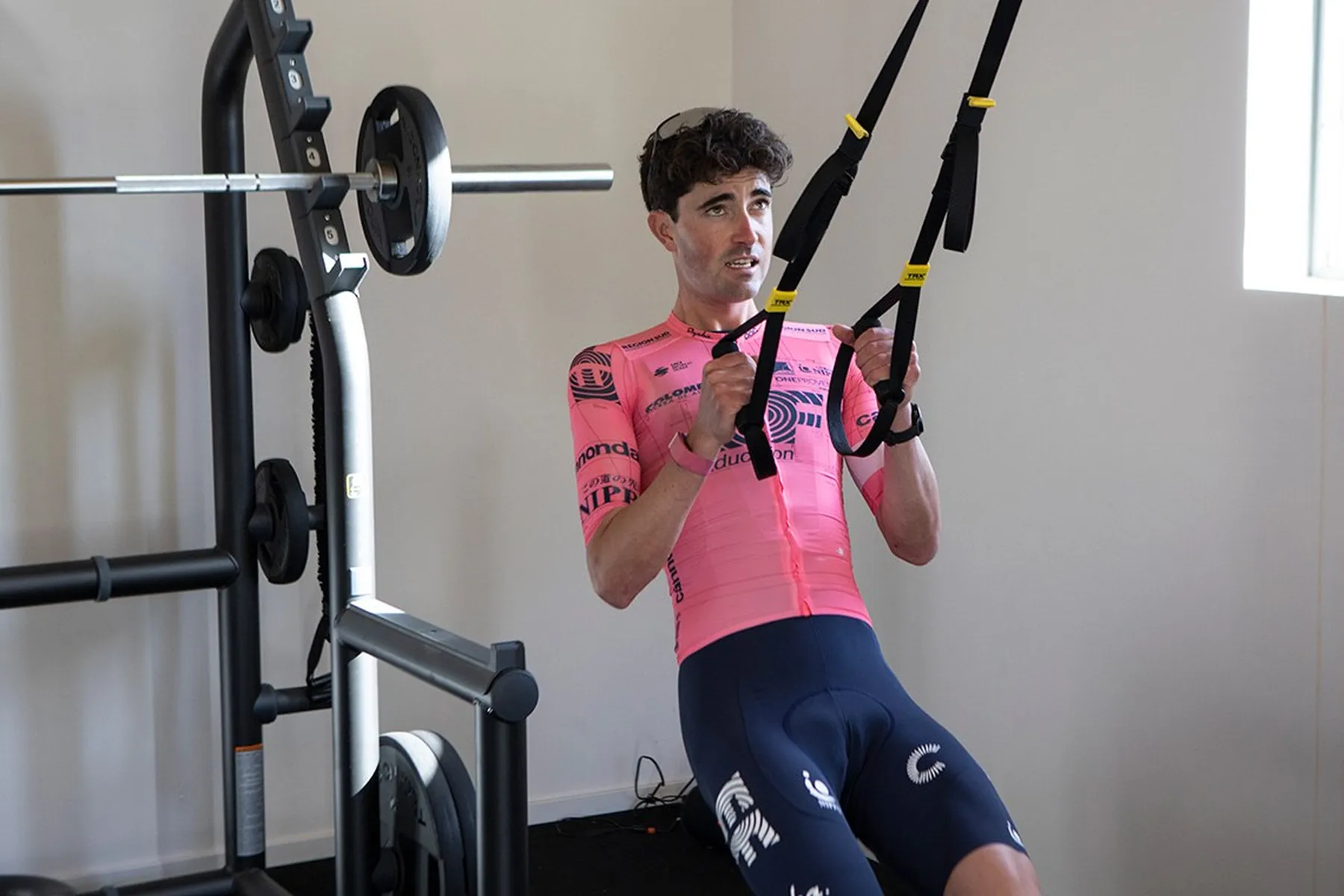
You know the feeling. You spent November through March in the gym. Two, maybe three sessions a week. You got stronger. The goblet squats went up. The Bulgarian split squats stopped making you walk like a newborn deer. Your core felt bulletproof on the bike and your late-ride power numbers held together in a way they never had before.
Then April arrived. The roads dried out, the evenings stretched, and the racing calendar started filling in. Suddenly the gym felt like a threat. Every set of step-ups was a set that might take something away from Tuesday's intervals. Every session that left your legs heavy was a session that could ruin the group ride on Saturday.
So you did what most cyclists do. You stopped.
Here's the thing nobody tells you about that decision: the strength you built over winter has an expiry date. And it is shorter than you think.
The detraining problem
Aerobic fitness is relatively sticky. Miss a week of riding and your VO2 max barely flinches. Miss two weeks and you might lose 4-6%. Frustrating, but recoverable.
Strength is a different animal.
Research from the Norwegian School of Sport Sciences — and this has been replicated consistently — shows that trained individuals start losing measurable force production within three to four weeks of stopping resistance training. By six weeks, the neural adaptations that made you feel sharper and more powerful on the bike are significantly degraded. By eight weeks, you are back close to where you started.
That is not a theoretical problem. That is your winter's work evaporating by late May.
And the losses are not abstract. They show up on the bike in ways you can feel. The late-ride power fade that was gone in March comes creeping back. The snap out of corners that made crits feel manageable starts to dull. The lower back that felt rock-solid for four hours starts complaining at three. These are not fitness losses. They are strength losses. And they are entirely preventable.
For masters riders — and if you are reading this site, there is a reasonable chance you are north of 35 — the picture is worse. Dr. Andy Galpin has talked about this extensively: age-related muscle loss (sarcopenia) accelerates from your late thirties onwards. You lose approximately 3-8% of muscle mass per decade after 30, and the rate increases after 50. You are not just losing the strength you built over winter. You are losing the baseline muscle mass that keeps you powerful, resilient, and injury-resistant as a cyclist. Bone density declines too, and cycling alone does nothing to address it because the bike is non-weight-bearing. The Danish cycling cohort studies have repeatedly shown that competitive cyclists have lower bone mineral density than age-matched non-athletes — the bike protects your heart but not your skeleton.
The riders who stay strong through August are not the ones who trained hardest in January. They are the ones who kept a maintenance stimulus present all season.
Why maintenance requires far less than you think
Here is where it gets interesting. Building strength requires progressive overload — more weight, more sets, more challenge session to session. It is demanding. It requires recovery. It competes with hard riding.
Maintaining strength does not.
The dose-response relationship for strength maintenance is remarkably forgiving. A 2011 study in Medicine and Science in Sports and Exercise examined what happened when trained subjects reduced their resistance training volume by up to two-thirds. The result: strength was fully maintained for 32 weeks. Over eight months. On a fraction of the original volume.
The critical variable was not how many sets they did. It was how heavy the load stayed.
When subjects kept intensity high (80-85% of their working loads) but dropped volume dramatically, they held onto their strength. When they dropped intensity — going lighter, more reps, more of a "maintenance feel" — they lost it.
This is precisely the mistake most cyclists make in-season. They think maintenance means lighter weights and higher reps. It means the opposite. Keep the weight meaningful. Cut the volume.
Professor Seiler's polarised training model applies here, oddly enough. Just as your riding should be either properly easy or properly hard — never in the grey zone — your in-season gym work should be properly loaded or not done at all. A half-effort gym session is the worst of both worlds: enough to create fatigue, not enough to preserve adaptation.
Programming principles for in-season strength
Four rules. Everything else is detail.
Rule 1: Reduce volume by 40-60%, keep intensity at 80-85%.
If your off-season lower-body session was four exercises, four sets each, sixteen total sets — your in-season session is three exercises, two to three sets each, six to nine total sets. The weight on the bar (or the dumbbell in your hands) stays within 15-20% of your off-season numbers. You are doing less, but what you do still means something.
Rule 2: Two sessions per week maximum.
One lower-body focused. One upper-body and core focused. Each session under 40 minutes including warm-up. If life forces you to one session, make it the lower-body day — that is where the cycling-specific transfer lives.
Rule 3: Reps in the 4-8 range.
This is strength territory, not endurance territory. Three sets of five at a meaningful load does more for strength maintenance than three sets of fifteen at a weight that makes you feel busy but does not challenge the neuromuscular system. Low reps, adequate rest between sets (90 seconds to two minutes), full range of motion.
Rule 4: In and out.
No supersets, no circuits, no finishers, no "just one more." The in-season gym session is clinical. Warm up, do your working sets, leave. The goal is to deliver a maintenance stimulus with the least possible fatigue cost. Your ambition lives on the bike right now, not in the gym.
Exercise selection: what actually transfers and what just tires you out
This is where the in-season programme diverges most from what the internet tells you. The conventional strength-training advice — heavy bilateral barbell work, big compound movements with maximal loading — is designed for athletes whose primary sport is in the gym. Yours is not. Your primary sport happens on two wheels and anything that compromises that is working against you.
For cyclists over 35, and especially in-season, the exercise selection should prioritise three things: low spinal load, unilateral correction, and minimal central nervous system fatigue.
Why these three? Spinal loading matters because you already spend 8-12 hours a week in a flexed position on the bike. Adding heavy axial compression from a loaded barbell across your back is asking a spine that is already under directional stress to absorb more. Unilateral correction matters because power meter data consistently shows left-right imbalances of 3-8% in amateur cyclists — and those asymmetries get worse under fatigue, which is precisely when you need your pedal stroke to hold together. And CNS fatigue matters because heavy bilateral lifts tax the central nervous system far more than their unilateral equivalents, creating a systemic recovery cost that bleeds into your riding for 48-72 hours.
The exercises below are chosen because they score well on all three criteria. They load the muscles that matter for cycling, in patterns that match the pedal stroke, without creating the kind of whole-body fatigue that ruins your Tuesday intervals.
Lower-body session (Monday)
Bulgarian split squats — 3 sets of 5-6 per leg, dumbbells in hands.
This is the single best in-season lower-body exercise for cyclists. It trains the single-leg pattern that actually matches the pedal stroke. It exposes and corrects left-right asymmetries that bilateral movements mask. It loads the quads and glutes heavily without compressing the spine the way a barbell on your back does. And because each leg works independently, the total systemic load is lower — which means less central fatigue and faster recovery.
When I had Derek Teel on the podcast, he made a point that stuck with me: the bike is a single-leg sport. You never push with both legs at the same time. Your gym work should reflect that.
Step-ups — 3 sets of 6-8 per leg, holding a dumbbell or kettlebell at chest height.
Use a box height that puts your thigh parallel to the ground or just above. Drive through the working leg without pushing off the trailing foot. This is a knee-dominant exercise that builds the specific quad strength you need for sustained climbing efforts. The balance demand also activates the stabiliser muscles through the hip and ankle that bilateral work misses entirely.
Hip thrusts — 3 sets of 8-10, barbell or heavy dumbbell across the hips.
Glute strength is the engine for high-torque efforts — out of the saddle climbing, sprinting, closing gaps. The hip thrust isolates the glutes without loading the spine and allows you to push seriously heavy loads safely. This is one exercise where you can afford to keep the weight ambitious in-season because the recovery cost is low and the glute activation is specific to the posterior chain power you need on the bike.
Single-leg calf raises — 2 sets of 12-15 per leg.
Often neglected, always valuable. Calf endurance matters for pedalling efficiency and Achilles tendon health, particularly for riders who also run or who spend time on gravel where standing efforts are more frequent.
That is four exercises. Six to nine total working sets depending on whether you run two or three sets per movement. Twenty-five to thirty-five minutes including warm-up. Done.
Upper-body and core session (Thursday)
The upper-body session is less about cycling performance and more about structural balance, posture, and injury prevention. Cyclists are chronically weak through the upper back, shoulders, and deep core — the positions we hold on the bike create predictable imbalances that compound over a season.
Cable or band face pulls — 3 sets of 12-15.
The single best corrective exercise for the rounded-shoulder, forward-head posture that cycling reinforces. Targets the rear deltoids, external rotators, and mid-traps. Light weight, high quality, full squeeze at the back.
Single-arm dumbbell row — 3 sets of 8-10 per arm.
Upper back strength for the sustained effort of holding your position on the drops during a crit or a long tempo block. The single-arm version allows each side to work independently and keeps the loading moderate.
Press-ups or dumbbell bench press — 3 sets of 8-12.
Basic pushing strength to balance the pulling work. Press-ups are fine for most cyclists. If you want load, a dumbbell bench press at moderate weight keeps the shoulders healthier than a barbell version.
Core circuit — 10 minutes:
- Pallof press: 3 sets of 8-10 per side (anti-rotation — this is the most cycling-specific core exercise because it trains your torso to resist the rotational forces of pedalling)
- Dead bugs: 3 sets of 8 per side (anti-extension, deep core)
- Side plank with hip dip: 2 sets of 10 per side (lateral stability for out-of-the-saddle efforts)
That is the full upper-body and core session. Four movements plus a short core circuit. Under 40 minutes.
Timing: where the gym fits in the training week
Timing is not a nice-to-have. It is the difference between a gym programme that supports your riding and one that quietly sabotages it.
The non-negotiable rule: never lift before a key bike session. If Tuesday is your VO2 max interval day, you do not go to the gym on Monday evening. If Saturday is a race or a hard group ride, Friday is not a gym day. The principle is simple — your legs must be fresh for the sessions that drive cycling-specific adaptation. Everything else is secondary.
The rhythm that works for most time-crunched amateurs:
Monday: Lower-body gym session (AM or PM)
Tuesday: Key interval session on the bike (VO2 max, threshold, or race-specific efforts)
Wednesday: Zone 2 endurance ride
Thursday: Upper-body and core gym session (AM or PM)
Friday: Easy spin or rest day
Saturday: Long ride, group ride, or race
Sunday: Zone 2 or recovery ride
This gives you 48 hours between the Monday gym session and the Saturday hard ride. It places the upper-body session on Thursday, which does not fatigue your legs at all and allows Friday to be properly easy. The Monday lower-body session is far enough from Tuesday's intervals that your legs will have recovered — particularly if the session stays within the volume and intensity parameters above.
If your key interval day is Wednesday rather than Tuesday, shift the lower-body gym session to Monday morning and you still have a full day of recovery before the hard bike work.
The critical pattern is this: consolidate stress, protect recovery. Put the gym work on days when you are already accumulating training load, or on days that are far enough from your key bike sessions that the fatigue has cleared.
The same-day stacking option
Joe Friel has talked about this, and it works well for riders who prefer distinct hard days and distinct easy days. Do your interval session in the morning. Do your gym session in the evening. One hard day, one full recovery day following.
The advantage is obvious — you protect more genuine rest days across the week. The disadvantage is that the evening gym session will not be your best work. You will be fatigued from the morning ride. That is fine. Remember, the in-season gym session is maintenance, not building. You do not need to set personal bests. You need to deliver a stimulus that says "keep this strength."
A sample in-season training week
Here is what a typical week looks like for a rider doing 8-10 hours on the bike with two gym sessions folded in:
| Day | Morning | Evening |
|---|---|---|
| Monday | Lower-body gym (35 min) | Easy spin or rest |
| Tuesday | VO2 max intervals (75 min) | Rest |
| Wednesday | Zone 2 endurance (90-120 min) | Rest |
| Thursday | Zone 2 or tempo (60-75 min) | Upper-body/core gym (35 min) |
| Friday | Rest day | Rest |
| Saturday | Long ride or race (3-4 hrs) | Rest |
| Sunday | Recovery ride (60 min) | Rest |
Total gym time: approximately 70 minutes across the week. That is less than 10% of total training time. If this is compromising your riding, the problem is not the gym — it is the programming.
When to drop the gym entirely
There are three situations where the right call is to skip the gym completely.
Race week. If you have a target event — a sportive, a crit, a time trial — drop to one short maintenance session early in the week (Monday or Tuesday at the latest) at 60% of your normal in-season load. Three to five days before the event, you want zero residual gym fatigue. If the race is on Saturday, your last gym session should be Tuesday at the absolute latest, and even that should be brief: two sets of Bulgarian split squats, two sets of hip thrusts, and out. Some riders prefer to skip the gym entirely in race week. That is fine. The strength you have built through consistent in-season work will still be present on race day — you are not going to detrain in five days.
Taper blocks. If you are running a structured taper into a peak event — two to three weeks of reduced volume — drop the gym after the first week of the taper. Keep one session in week one of the taper at reduced load. Eliminate it in weeks two and three. The goal of the taper is to shed accumulated fatigue while preserving fitness. The gym adds fatigue. Remove it.
Overreaching blocks. If you are deliberately running a two- to three-week overreaching block on the bike — high-volume, high-intensity, deliberately digging a fatigue hole — drop the gym for the duration. You cannot simultaneously overreach on the bike and maintain a gym stimulus without something breaking. The gym comes back when the recovery block begins.
Outside of these three scenarios, the gym stays in the programme. Every week. The consistency of the stimulus is what makes it work.
Signs you are doing too much
The line between "enough to maintain" and "too much for the bike" is narrower than most riders realise. Watch for these three warning signals:
Persistent DOMS beyond 48 hours. If your legs are still sore from Monday's gym session on Wednesday morning, the volume is too high or the exercises are too novel. In-season gym work should not create significant delayed-onset muscle soreness. If it does, cut the total sets by 30% and reassess. DOMS in-season means your muscles are being damaged beyond what they can repair alongside the riding — and that repair process is stealing resources from your cycling adaptation.
Declining bike power numbers. Track your normalised power on comparable efforts week to week. If your Tuesday interval numbers start drifting down — 5W here, 8W there — and nothing else has changed (sleep, fuelling, life stress), your gym load is the most likely culprit. This is not the time to push through. Reduce the gym volume for two weeks and see if the bike numbers recover. They almost always do.
A resting-heart-rate trend change. If you measure under consistent conditions, a meaningful departure from your personal baseline can support a back-off decision. It is not the cheapest “most reliable” marker and there is no universal five-beat rule. Cross-reference it with sleep, perceived fatigue, health and cycling performance; if the pattern began when gym load increased, reduce that load and reassess.
The mistake most riders make when they notice these signals is to push through. "It's just the gym catching up with me. I'll be fine by the weekend." Maybe. But more often, what happens is the weekend ride is flat, the next week's intervals are flat, and by the time you actually reduce the gym work you have dug a fatigue hole that takes two to three weeks to climb out of. Two to three weeks of compromised riding because you did not cut two sets of Bulgarian split squats on Monday.
Any one of these signals is a prompt to reassess. A worsening cluster strengthens the case for reducing gym load, but there is no validated symptom-count rule or mandatory one-week prescription.
The goblet squat option
I want to address one exercise that sits between bilateral and unilateral work: the goblet squat. Holding a dumbbell or kettlebell at chest height and squatting through a full range of motion is an excellent in-season option for riders who find Bulgarian split squats too demanding on their balance or who want a squat pattern without the spinal loading of a barbell.
The goblet squat loads the quads and glutes effectively, keeps the torso upright (which most cyclists need because their hip flexors are chronically tight), and allows you to work at a meaningful load — 24-32kg for most riders — without any of the recovery cost of heavy bilateral loading. Two to three sets of six to eight reps is a solid in-season prescription. If you are choosing between the goblet squat and the Bulgarian split squat, the split squat is the stronger choice for asymmetry correction. But if your programme only has room for one lower-body exercise — a genuine one-session-per-week scenario — the goblet squat combined with hip thrusts covers the bases.
The long game
Here is what I want you to understand about in-season strength training. It is not about the gym. It is about the bike.
Every set of Bulgarian split squats you do on Monday is there to protect your power on Saturday's race. Every hip thrust is there so your glutes do not fade on the third hour of a sportive. Every Pallof press is there so your core holds your position on the drops when you are two hours into a time trial and everything wants to collapse.
The riders who perform best in July and August are not the ones who trained hardest in January and then stopped. They are the ones who kept a small, consistent strength stimulus present across the entire season. Two sessions. Under 40 minutes each. Meaningful load, minimal volume.
The good news is this: you do not need more time. You need better programming. And you now have it.
If you want to see how other serious amateurs are programming their in-season strength work — the sets, the reps, the timing, the adjustments — the Roadman Cycling community on Skool is where that conversation happens every week. Real riders, real programmes, real results. You are not done yet.