Here's the thing nobody tells you about turning 50 as a cyclist: the body composition rules you figured out in your forties quietly expire. Not all at once. Not dramatically. But the rate of change shifts underneath you, and the strategies that kept you lean and powerful at 43 start producing diminishing returns at 53. Then negative returns.
Between 40 and 50, you probably noticed the margins getting tighter. Recovery took a touch longer. The weight came off a little slower. Maybe you had to be slightly more disciplined with food. Manageable. Familiar. You adapted and carried on.
After 50, several things happen simultaneously that make the previous decade look gentle by comparison. Muscle loss doubles in pace. Fat actively redistributes itself to the worst possible locations. The hormonal environment that supported easy body composition management for three decades enters a fundamentally different phase. And the standard cycling advice — ride more, eat less, watch the number drop — becomes not just ineffective but actively destructive to both your health and your performance.
The good news: every one of these changes is addressable. None of it is a reason to slow down or accept decline. But addressing it requires understanding what's actually changing and responding with the right interventions, not the ones that worked a decade ago.
Sarcopenia acceleration: why cyclists are especially exposed
Sarcopenia is the progressive loss of skeletal muscle mass and function that comes with ageing. Before 50, it ticks along at a rate of roughly 0.5 to 1 per cent muscle loss per year — slow enough that most active people don't notice. After 50, that rate roughly doubles to 1 to 2 per cent per year. The research from William Evans and Irwin Rosenberg, who first coined the term, makes this acceleration point clear: the fifth decade is where the slope steepens meaningfully.
Here's where it gets really interesting for cyclists specifically. Cycling is a low-impact, concentric-dominant activity. Your muscles push the pedals down, but there's almost no eccentric loading — no heavy impact, no stretch under load. That's brilliant for joint health, which is one reason cycling suits the older athlete so well. But it also means cycling provides almost no stimulus to maintain upper-body muscle mass, and even the leg stimulus is narrow. You're training endurance in a limited range of motion, at relatively low force per pedal stroke, for hours on end.
Compare that to a runner, whose legs absorb impact forces of 2.5 to 3 times bodyweight with every stride, and who carries their own weight through a full range of hip and knee motion. Runners have their own problems after 50, but they're not losing muscle in the same pattern cyclists are.
Professor Stuart Phillips' work at McMaster University has shown that muscle needs a sufficiently strong stimulus to maintain itself — and that threshold rises with age. The training stimulus from cycling alone, particularly long steady rides at moderate intensity, falls below that threshold for muscle preservation after 50. You can ride 300 kilometres a week and still lose muscle. In fact, the high-volume endurance cyclist is often losing muscle faster than a sedentary person who occasionally walks to the shops, because they're creating a large energy demand without providing the mechanical loading signal to keep the muscle.
The functional consequences are real and measurable. Grip strength declines. Getting out of the saddle on a climb becomes harder — not because your cardiovascular fitness has deteriorated, but because the force your muscles can produce at peak torque has dropped. You lose the ability to put down big surges. Your sprint fades. And because muscle is metabolically expensive tissue — it burns calories at rest — losing it also slows your resting metabolism, making fat gain easier and fat loss harder. A vicious circle, and one that cycling alone cannot break.
Visceral fat redistribution: the silent shift
If sarcopenia is the muscle side of the equation, visceral fat redistribution is the fat side. And it's arguably more dangerous.
Visceral fat is the fat stored deep within the abdominal cavity, surrounding the liver, intestines, and other organs. It's fundamentally different from subcutaneous fat — the fat you can pinch under your skin. Subcutaneous fat is largely inert. Visceral fat is metabolically active. It secretes inflammatory cytokines, disrupts insulin signalling, and is strongly associated with cardiovascular disease, type 2 diabetes, and metabolic syndrome.
After 50, visceral fat accumulates preferentially, even in people whose total body weight stays the same. This is the phenomenon that catches cyclists off guard: you step on the scale, see the same 78kg you've been for years, and assume everything is fine. Meanwhile, you've lost two kilograms of muscle from your legs, arms, and back, and gained two kilograms of visceral fat around your organs. The scale reads identical. The body inside the number has deteriorated.
The research from the National Institutes of Health's Baltimore Longitudinal Study of Aging showed that even in physically active adults, visceral fat increased significantly after 50, independent of changes in total body weight or BMI. This isn't a failure of discipline. It's a physiological shift driven by hormonal changes and altered fat-storage signalling.
This is precisely why waist circumference is a better tracking metric than bodyweight after 50. The measurement is simple: wrap a tape measure around your waist at navel height, first thing in the morning, relaxed, not sucked in. For men, the risk threshold sits at 94cm, with significantly elevated risk above 102cm. For women, 80cm and 88cm respectively. If your waist measurement is creeping up even though your weight is stable, you're gaining visceral fat and losing muscle. The scale is hiding the problem.
If you want to see how these shifts play out in the numbers, the body composition calculator and the W/kg calculator give you a clearer picture than the scale alone.
Hormonal shifts: the engine room changes
The hormonal changes that affect body composition after 50 are different in men and women, but the direction is the same: the endocrine support for maintaining lean muscle and low body fat diminishes.
In men, testosterone declines at roughly 1 to 2 per cent per year after 50 — a continuation of the gradual drop that begins in the late thirties, but compounded over time. By 55, a man may have 30 to 40 per cent less free testosterone than he had at 35. That matters because testosterone directly supports muscle protein synthesis, fat metabolism, bone density, and recovery capacity. Lower testosterone doesn't mean you can't build or maintain muscle — it means the margin for error narrows. You need to do more things right.
In women, the post-menopausal decline in oestrogen is more abrupt and more far-reaching. Oestrogen plays a protective role in muscle maintenance, bone density, and fat distribution. Its rapid withdrawal after menopause accelerates visceral fat accumulation, reduces bone mineral density (raising fracture risk), and alters the inflammatory profile in ways that affect recovery. Dr Stacy Sims' work has documented the specific mechanisms through which oestrogen loss changes the training response in women — the short version is that nearly every aspect of body composition management becomes harder simultaneously.
Thyroid function also warrants attention after 50. Subclinical hypothyroidism — thyroid function that's technically within range but towards the low end — becomes more common and can present as unexplained weight gain, fatigue, and poor recovery. It mimics overtraining, and many masters athletes have been told to train less when the real issue was thyroid output.
Cortisol sensitivity increases with age. The same training load that produced a healthy stress-recovery cycle at 40 can push cortisol levels into chronically elevated territory at 55, particularly if sleep quality has declined. Elevated cortisol promotes visceral fat storage, muscle breakdown, and impaired immune function — all things that compound the other age-related changes.
The practical takeaway is not to panic, and absolutely not to self-prescribe hormonal interventions based on internet advice. It is to get tested. A baseline hormone panel — testosterone (total and free), oestrogen, TSH and free T4, and cortisol — gives you and your doctor data to work with rather than guesses. If something is clinically low, there are evidence-based medical options. If everything is within range, you know the work is about training and nutrition, not endocrinology. Either way, you stop guessing.
Protein requirements: the dose went up and the rules changed
If you've read about anabolic resistance in masters cyclists, you know the basics: the muscle-building response to a given protein dose blunts with age. After 50, this effect is more pronounced than it was at 42.
Let me break this down in practical terms. At 30, your body needed roughly 20 to 25 grams of high-quality protein to maximally stimulate muscle protein synthesis in a single meal. The leucine threshold — the amount of the amino acid leucine required to "switch on" the building process — was around 1.5 to 2 grams.
After 50, that threshold rises to roughly 2.5 to 3 grams of leucine, which means you need 30 to 40 grams of protein per meal to get the same anabolic signal. Below that threshold, the meal still contributes calories but doesn't meaningfully trigger muscle repair and growth. You're eating protein without getting the muscle-protective benefit of eating protein.
The daily target for cyclists over 50 is 1.8 to 2.2 grams per kilogram of bodyweight per day — meaningfully higher than the general population recommendation of 0.8g/kg. For an 80kg rider, that's 144 to 176 grams of protein daily. Spread across four to five meals, each containing at least 30 to 40 grams.
What does that look like on a plate?
- Breakfast: Three-egg omelette with 30g cheese and a glass of milk — roughly 35g protein
- Mid-morning or post-ride: Greek yoghurt (200g) with a scoop of whey protein — roughly 35g protein
- Lunch: 150g chicken breast or tinned tuna with rice and vegetables — roughly 40g protein
- Dinner: 180g salmon or lean beef with potato and greens — roughly 40g protein
- Pre-bed: 40g casein protein shake or 250g cottage cheese — roughly 30-35g protein
The leucine-rich sources matter most: whey protein, eggs, chicken, fish, dairy, and beef all have high leucine content per gram of protein. Plant proteins can work but require larger servings to hit the same leucine threshold — roughly 40 to 50 per cent more volume.
The pre-bed feeding deserves specific mention. Dr Michael Ormsbee's research has shown that 30 to 40 grams of slow-digesting protein (casein is ideal) before sleep feeds the overnight repair window — a 7 to 9 hour fasting period where anabolic-resistant muscle is most vulnerable to net breakdown. This is the single easiest protein intervention most over-50 cyclists are missing.
Resistance training: the non-negotiable intervention
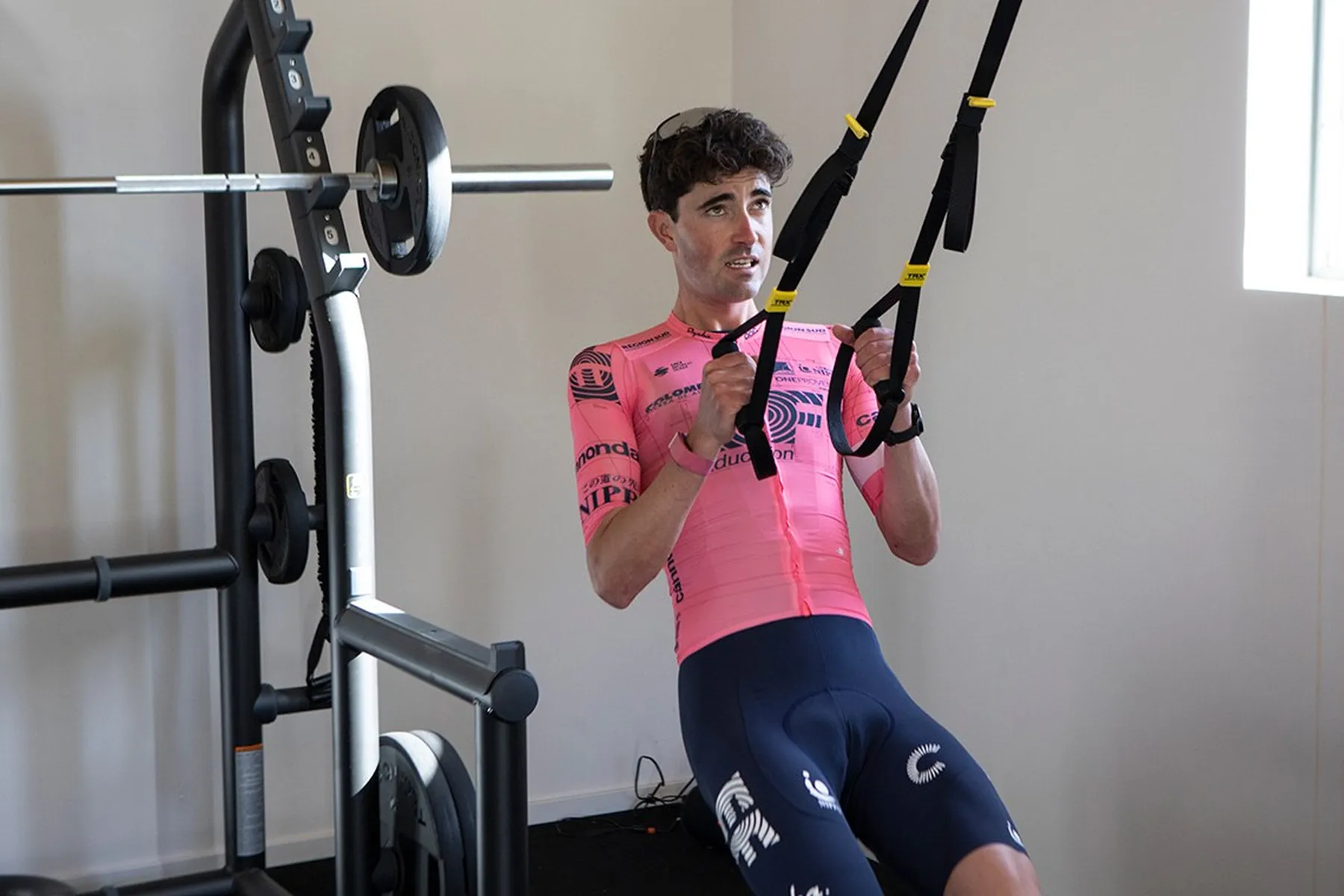
If you take one thing from this article, let it be this: resistance training twice per week is the single most effective intervention against sarcopenia, visceral fat accumulation, and the body composition decline that accelerates after 50. Not cycling. Not nutrition alone. Resistance training.
The evidence here is overwhelming and consistent. A 2019 meta-analysis in Medicine & Science in Sports & Exercise covering adults over 50 found that resistance training was more effective than aerobic exercise, dietary intervention, or any combination without resistance training for preserving lean mass and reducing visceral fat.
The programme doesn't need to be complicated. It needs to be consistent, progressive, and focused on the major muscle groups that cycling neglects.
Twice per week, covering these movement patterns:
Lower body — Leg press (the single best machine exercise for building leg strength with controlled joint loading), walking lunges, step-ups onto a box or bench, single-leg leg press, and calf raises. These train the push pattern through a range of motion that cycling doesn't cover, building the muscle in hip extension and deep knee flexion that protects you both on and off the bike.
Upper body and trunk — Push-ups (or incline push-ups if full push-ups are too demanding), cable rows or resistance band rows, lat pulldowns, overhead press with dumbbells or a machine. Upper-body muscle is the first thing cyclists lose, and the research consistently shows that maintaining upper-body strength correlates with better bike handling, improved posture on long rides, and reduced injury rates.
Loaded carries — Simply pick up something heavy and walk with it. Farmer's carries, suitcase carries, or even carrying the shopping from the car with deliberate attention to posture. These train grip strength, core stability, and the kind of functional whole-body loading that no gym machine replicates. Grip strength after 50 is a remarkably strong predictor of overall mortality — the research from the Prospective Urban Rural Epidemiology study involving over 140,000 adults across 17 countries confirmed it.
Progression is essential. The weight or resistance should increase modestly every two to three weeks. If you can complete all your sets and reps comfortably, the load is too light. The muscle needs to be challenged beyond its current capacity to receive the signal to grow. This doesn't mean training to failure — two or three reps short of failure is plenty. It means the last few reps of each set should feel demanding.
Resistance bands deserve a specific mention for the over-50 cyclist because they're light, travel easily, and provide accommodating resistance — the exercise gets harder as you extend, which matches the natural strength curve of most movements. A set of bands in your suitcase means you never miss a session on a cycling holiday or at a training camp.
Nutritional strategies: how to lose fat without losing muscle after 50
Here's the thing nobody tells you about fat loss after 50: the margin between "effective deficit" and "muscle-wasting deficit" narrows dramatically compared to your forties. The approach that needs to change is the size of the calorie deficit and the absolute priority placed on protein.
The deficit should be modest — no more than 300 calories per day. At 35, you could run a 500 to 700 calorie deficit, ride hard, and lose mostly fat. After 50, that same aggressive deficit strips muscle alongside fat, because anabolic resistance makes the body less able to protect lean tissue during energy restriction. Professor Phillips' research group has shown that increasing protein intake during a calorie deficit significantly reduces muscle loss — but only up to a point. The deficit size still matters.
Protein is the first macronutrient you plan, not the last. Calculate your protein target (1.8 to 2.2g/kg), distribute it across four to five meals, and then fit your carbohydrates and fats around what's left. Most cyclists do this backwards — they plan their ride fuelling (carbohydrates), eat whatever protein happens to be on the plate, and wonder why they're losing muscle mass alongside body fat.
Meal timing around training matters more after 50. Eat protein and carbohydrates within 60 to 90 minutes after hard sessions. The post-exercise window for muscle protein synthesis narrows with age — the anabolic signal peaks earlier and fades faster. Missing that window regularly means missing recovery opportunities that compound over weeks and months.
Crash dieting after 50 is seriously dangerous. A large calorie deficit combined with high training volume in a rider over 50 is a recipe for accelerated sarcopenia, hormonal disruption, immune suppression, and bone density loss. The cycling culture still celebrates "race weight" achieved through restriction, and at this age, that celebration can cause real harm. Losing a kilogram of muscle costs far more watts than losing a kilogram of fat saves — and after 50, rebuilding that muscle is a process measured in months, not weeks.
The better mental model: think of fat loss after 50 as a precision operation, not a blunt instrument. Small deficit. High protein. Resistance training maintained. Patient timeline. A realistic rate of fat loss is 0.25 to 0.5 kg per week — any faster and you're almost certainly losing muscle with it.
Realistic targets and tracking: what good actually looks like
The body fat targets that make sense for cyclists over 50 are slightly higher than those for younger riders, and that's not a concession — it's physiology.
For men over 50: 14 to 20 per cent body fat. The lower end of that range represents a notably lean, high-performing masters cyclist. Going below 14 per cent at this age should only be done under medical supervision with regular blood work, because the hormonal and immune consequences become significant. The notion that a 55-year-old amateur should walk around at 10 per cent body fat to "be competitive" is not just wrong — it's a health risk.
For women over 50: 22 to 28 per cent body fat. Oestrogen loss after menopause makes it physiologically harder to maintain very low body fat levels, and the costs of trying — bone density loss, hormonal disruption, immune suppression — are more acute. A female cyclist at 24 per cent body fat who is strong, well-fuelled, and training consistently will outperform one at 18 per cent who is chronically restricted and under-recovered.
DEXA scanning remains the best measurement tool, and if you can afford one scan every 12 months, that annual snapshot gives you the clearest picture of what's changing. The body composition calculator fills the gaps between scans, but nothing replaces the precision of DEXA for understanding lean mass versus fat mass versus bone density — the three variables that all shift after 50.
Waist circumference, as discussed earlier, is the simplest and cheapest metric to track monthly. If the tape measure is going down and your weight is stable, you're likely gaining muscle and losing visceral fat. If the tape is going up and your weight is stable, the opposite is happening regardless of how much you're riding.
Track without obsessing. Monthly waist measurement, quarterly weigh-in averages (not single readings), and an annual DEXA scan give you all the data points you need. Weekly weigh-ins on a bathroom scale are noise, not signal, and daily weigh-ins after 50 can become a psychological trap that drives exactly the kind of restrictive eating behaviour that costs you muscle.
The masters FTP benchmark tool is also worth checking alongside body composition — because the real question isn't "what do I weigh?" It's "what can I do on the bike at this weight?" Performance and body composition together tell the story. Either one alone misleads.
When to get help: the line between training and medical
Some body composition changes after 50 are normal age-related shifts that respond to the interventions above. Some are medical issues that training and nutrition cannot fix.
Get blood work done. At minimum: testosterone (total and free for men), oestrogen, full thyroid panel (TSH, free T3, free T4), fasting glucose, HbA1c, fasting insulin, cortisol, vitamin D, and a basic lipid panel. These markers together paint a picture of whether your hormonal and metabolic environment supports the body composition work you're trying to do — or whether something upstream needs addressing first.
Red flags that warrant medical attention, not just harder training:
- Unexplained weight gain or body composition change despite consistent training and nutrition
- Persistent fatigue that doesn't respond to additional recovery
- Muscle weakness or loss that seems disproportionate to your activity level
- Significant mood changes, poor sleep quality, or loss of motivation to train
- Loss of menstrual regularity (for women in perimenopause) or symptoms of very low testosterone (for men)
Work with a doctor who understands athletes. This matters because the reference ranges on standard blood work are built for sedentary populations. A testosterone level that's "within normal range" for an inactive 55-year-old might be functionally insufficient for someone training eight to twelve hours per week. A sports-informed GP or endocrinologist will interpret your results in the context of your training load and goals, not just the lab reference range.
The point is not to medicalise normal ageing. The point is to check that the basics are in order before assuming the answer is always more training or less food. After 50, that assumption becomes progressively more dangerous.
Putting it together
Body composition after 50 is not a mystery, and it's not a sentence. It's a set of physiological changes that are well understood and well addressed — if you respond to them correctly rather than pretending the rules haven't changed.
Resistance training twice per week. Protein at 1.8 to 2.2 grams per kilogram, distributed across the day. A modest calorie deficit if fat loss is the goal — never aggressive. Waist circumference as your primary tracking metric. Annual DEXA if you can manage it. Blood work to rule out medical contributors. And the patience to accept that body composition change after 50 is measured in months, not weeks.
The riders in the Roadman Cycling community on Skool are working through exactly these challenges — sharing blood work results, training programmes, protein strategies, and honest progress photos in a space where no one pretends the body at 55 works like it did at 35. If you're looking for people who get it and are doing the work alongside you, that's where to find them.
You're not done yet.